Silver buyers in India are back: Will they stay?


While China kept more of its silver at home in October, India's imports nearly tripled, a sign that demand held back by import rules since May is coming back.
That matters because India relies on imports for most of the silver it uses, and those imports have been restricted since mid-May. October suggests that much of the buying was delayed rather than lost. China, meanwhile, sent less silver abroad, but for ordinary business reasons rather than policy. Whether the two moves together tighten the market for silver is a separate question. November's trade data, due around December 15, will help answer it.
Silver traded at $42.27 an ounce on the morning of November 26, according to USAGOLD's daily report. A day earlier it had slipped below $40. The trigger was the Fed's preferred measure of underlying inflation, which rose to 3.3% in October. At Golden Meadow®, we track how interest rates and physical demand pull on the price at the same time. Right now rates appear to be pulling harder, with the Fed's next decision due on December 9.
India came back to buy
India started buying silver from abroad again in October. Its imports that month were worth ₹18,634 crore, a crore being ten million rupees. That is nearly three times September's value, on commerce ministry figures reported by JM Financial. It is still 22.5% below October last year.
The government published no tonnage, so I converted the value at October's average price. On my estimate, India brought in roughly 32 to 36 million ounces (Moz). That is close to the monthly pace of the import permits the government issued in late October. Reuters reported those permits at about 6,500 tonnes over six months. That works out to about 35 Moz a month.
In Issue #26, I discussed how India eased its import rules ahead of the festival season. October's trade figures are the first to include those changes.
Indian investors bought through funds as well. Silver exchange-traded funds, which hold metal for investors who buy their shares, took in ₹3,092 crore in India in October. The figure comes from AMFI, the industry body. That is up 57% on September. At domestic prices it is worth roughly 4.3 to 5.0 Moz, though the funds' own metal purchases might differ.
China kept more Silver at home
China moved the other way. It exported 285.43 tonnes of refined silver in October, about 9.2 Moz, according to Shanghai Metals Market, a Chinese price and data service. Exports for January to October were 15.5% below last year.
Comparing two of its year-to-date totals gives a sharper view of the last three months. On my arithmetic, China's exports from August to October were about 37% lower than a year earlier. That is roughly 18.9 Moz less silver leaving the country.
The reasons are commercial. Buyers inside China wanted the metal, so smelters, the plants that refine it, sold at home for a small premium. Exporting through Hong Kong paid slightly less than the London price, so there was no gain in shipping it out. India's own restrictions had also cut demand from a major customer. I found no evidence that Beijing tightened its export rules.
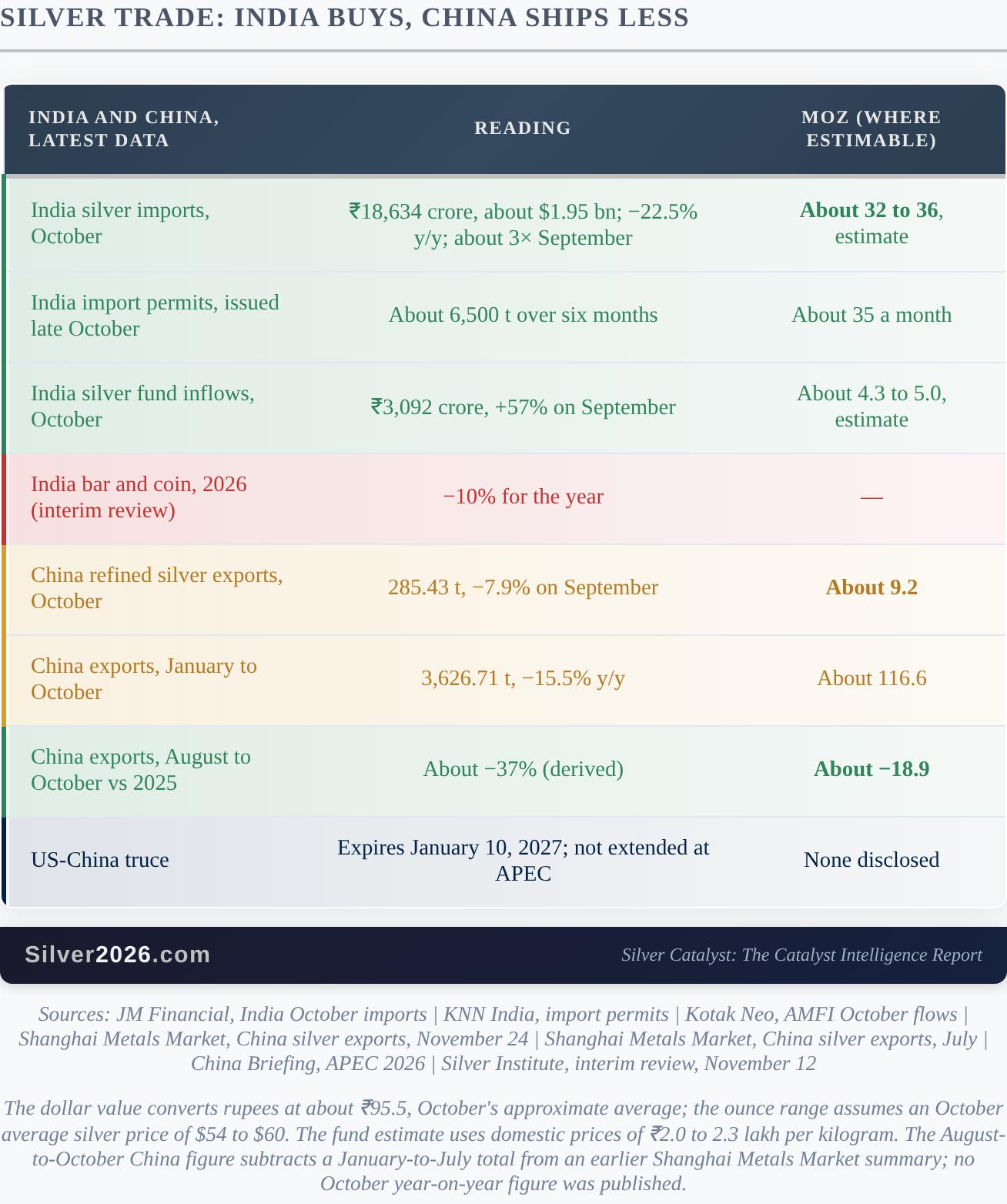
Sources: JM Financial, India October imports | KNN India, import permits | Kotak Neo, AMFI October flows | Shanghai Metals Market, China silver exports, November 24 | Shanghai Metals Market, China silver exports, July | China Briefing, APEC 2026 | Silver Institute, interim review, November 12
The dollar value converts rupees at about ₹95.5, October's approximate average; the ounce range assumes an October average silver price of $54 to $60. The fund estimate uses domestic prices of ₹2.0 to 2.3 lakh per kilogram, a lakh being 100,000 rupees. The August-to-October China figure subtracts a January-to-July total from an earlier Shanghai Metals Market summary; no October year-on-year figure was published.
Why the two moves don't simply add up
It is tempting to add India's buying to China's lower exports and call it a squeeze, a sudden shortage of metal available to buy. The numbers don't support that yet.
Some of the silver India bought might have come from China, so the two moves overlap. China's imports also fell by more than half in October. On my arithmetic, its net exports, exports minus imports, rose from September. A full comparison with last year needs import data I don't have.
The full-year forecast also tempers the picture. The interim review from Metals Focus and the Silver Institute still expects Indian bar and coin demand to fall 10% this year. One strong month does not reverse that.
The politics did not change either. Trump and Xi met in Shenzhen on November 19. They announced no tariff changes and no extension of the trade truce, which runs to January 10. Silver was not mentioned in the outcome.
What this means to Silver investors
India's buyers did not walk away from silver. Once the paperwork eased, imports rose to roughly the monthly pace of the new permits. That supports the longer-term case for silver, because India relies on imports for most of the silver it uses.
China's lower exports help less than they first appear. They reflect strong demand at home, which is good for silver, but not a policy decision to hold metal back.
So the verdict is close to neutral for silver right now, with a modest positive from India. The interim review still expects a shortfall of 35 Moz this year. Silver exchange-traded funds worldwide are forecast to release 45 Moz, more than covering it. The price is also answering to interest rates more than to trade flows, as how silver has traded this autumn shows. November's Indian trade data will show whether October was a catch-up month or the start of a steadier pace.
Want free follow-ups to the above article and details not available to 99%+ investors? Sign up to our free newsletter today!
Author
Przemyslaw Radomski, CFA
Gold Price Forecast
Przemyslaw Radomski, CFA (PR) is a precious metals investor and analyst who takes advantage of the emotionality on the markets, and invites you to do the same. His company, Sunshine Profits, publishes analytical software that any
















