AUD/USD Forecast and News
AUD/USD resumes its advance on Friday after a brief bout of weakness following a stronger-than-expected United States (US) employment report. The pair initially fell to 0.7173 before reversing as the US Dollar (USD) struggled to capitalize on the upbeat figures, even as they strengthened expectations of a Federal Reserve (Fed) rate hike at the September 15-16 meeting. At the time of writing, AUD/USD trades around 0.7206, near levels last seen on May 15.
Technical Analysis
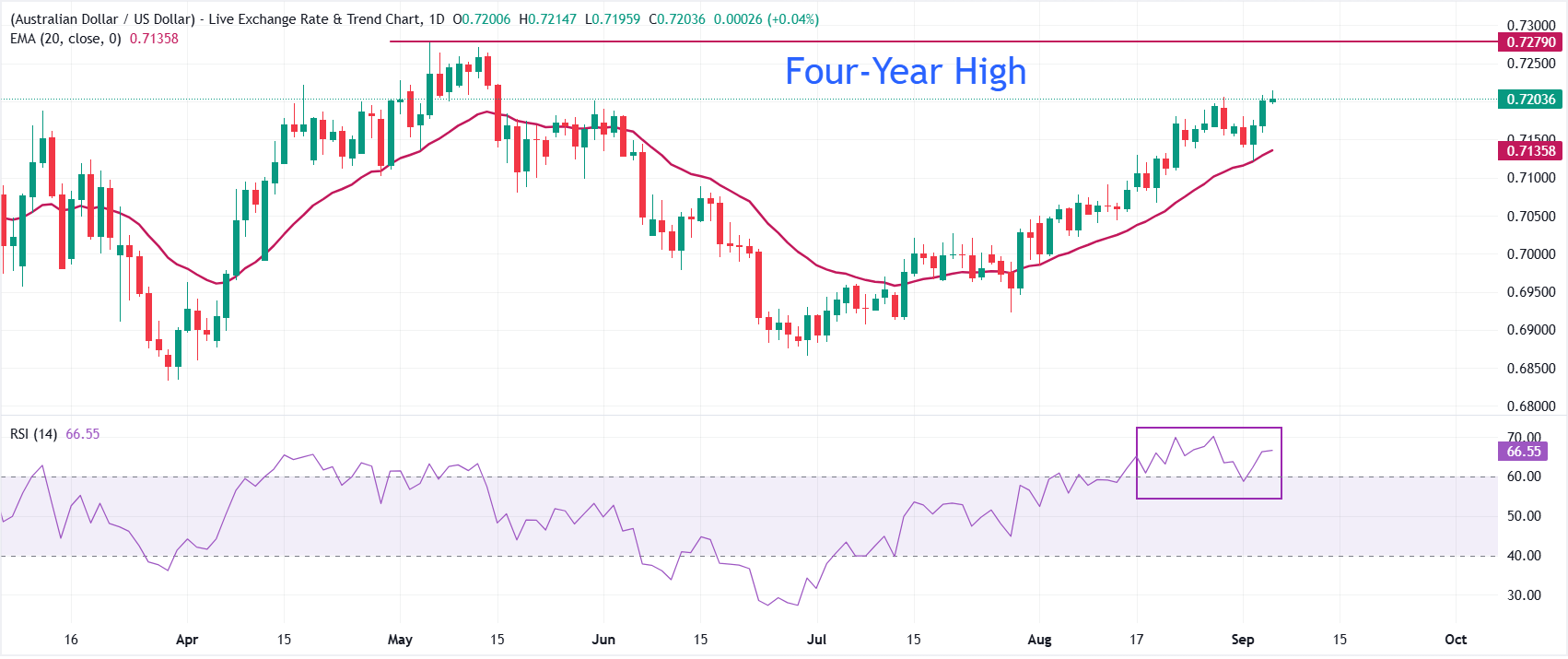
In the daily chart, AUD/USD trades at 0.7203, maintaining a bullish near-term bias as spot holds above the 20-day exponential moving average (EMA) at 0.7136. The pair extends its advance after reclaiming this dynamic support, while the Relative Strength Index (RSI) at about 66 stays in bullish territory, suggesting buyers retain control even as conditions approach overbought.
On the downside, immediate support is seen at the 0.7200 area, with the 20-day EMA at 0.7136 acting as a secondary floor that would need to give way to signal a deeper correction. Looking up, the pair aims to revisit the four-year high near 0.7280.
(The technical analysis of this story was written with the help of an AI tool. Know more.)
Williams flags strong economy behind higher yields as inflation trend cools
Fed's Williams delivered a mildly hawkish-leaning message, with a 6/10 FXS Speechtracker score just above the 5.9/10 historical average, emphasizing that rising yields reflect a strong economy and robust outlook rather than worsening inflation expectations. The focus on tariffs and Middle East conflict as key drivers of above-target inflation, alongside contained expectations and a trend toward lower inflation with a stable labor market, signals confidence that the Fed can stay data-dependent while keeping 2% as the clear priority.
The FXS Fed Sentiment Index slipped by 1.42 points to 127.44, indicating a modest pullback in perceived hawkishness despite the still-elevated stance. With the index firmly above the 100 neutral line, markets continue to see policy as hawkish overall, but the slight decline suggests some easing in the perceived urgency for additional tightening relative to recent readings captured by the FXS Speechtracker.
Fundamental Analysis
| Time | Event | Impact | Actual | Consensus | Previous |
|---|
The Australian Dollar (AUD) remains underpinned by the Reserve Bank of Australia’s (RBA) hawkish stance.
US Nonfarm Payrolls (NFP) increased by 162K in August, well above market expectations for a 56K gain. July’s reading was revised higher to 21K from the previously reported 23K decline, while the Unemployment Rate held steady at 4.1%, as expected. US Bureau of Labor Statistics
The US Dollar jumped after the employment report but quickly lost momentum. The US Dollar Index (DXY), which tracks the Greenback’s value against a basket of six major currencies, trades around 99.10 after climbing to 99.36.
According to the CME FedWatch Tool, markets now price in around a 60% chance of an increase, up from 50% before the NFP release. Uncertainty over the Fed’s policy path persists, with the outcome of the September meeting likely to hinge on next week’s US Consumer Price Index (CPI) and Producer Price Index (PPI) reports. Recent inflation data points to some moderation, although elevated Oil prices due to the war in the Middle East could complicate the inflation outlook.
Cleveland Fed President Beth Hammack said in a LinkedIn post that policy is not restrictive, adding that “inflation is too high — and the longer it stays above our objective, the harder it will be to bring it back down.”
The Australian Dollar remains supported by the RBA’s hawkish stance, with traders anticipating another rate increase later this month as inflation sits above the central bank’s 2%-3% target band, while resilient second-quarter growth gives policymakers room to tighten further.
Looking ahead, Australia’s economic calendar is relatively light next week, with September Consumer Inflation Expectations the only major domestic release. Chinese inflation and trade data will also draw attention given Australia’s close trade ties with China.
AUD/USD Forecast Poll

In a context where AUD/USD rate differentials, institutional credibility, and geopolitical dynamics are once again central, 2026 could mark a new phase in the balance of power between the Australian Dollar and the US Dollar.
1 Week
- 25%
- Bullish
- 50%
- Bearish
- 25%
- Sideways
1 Month
- 18%
- Bullish
- 46%
- Bearish
- 36%
- Sideways
1 Quarter
- 31%
- Bullish
- 54%
- Bearish
- 15%
- Sideways
About AUD/USD
AUD/USD
The AUD/USD currency pair, commonly known as the "Aussie", represents how many US dollars (the quote currency) are needed to purchase one Australian dollar (the base currency). Alongside the New Zealand Dollar (NZD) and the Canadian Dollar (CAD), the AUD is considered a commodity currency due to Australia's significant exports of raw materials such as precious metals, Oil, and agricultural products.
The Reserve Bank of Australia (RBA) has historically maintained higher interest rates compared to other industrialized nations. Combined with the relatively high liquidity of the AUD, this has made the AUD attractive for carry traders looking for higher yields.
Australia's economy and currency are closely tied to China, its largest trading partner. Any changes in the Chinese economy can significantly impact the AUD. Additionally, the Australian Dollar is often seen as a diversification tool due to its exposure to Asian economies.
The pair AUD/USD also correlates with Gold prices. Gold is widely viewed as a safe haven asset against inflation and it is one of the most traded commodities.
INFLUENTIAL ORGANIZATIONS AND PEOPLE FOR THE AUD/USD
Reserve Bank of Australia (RBA)
The Reserve Bank of Australia (RBA) is Australia's central bank, deriving its functions and powers from the Reserve Bank Act 1959. Its primary duty is to contribute to currency stability, full employment and the economic prosperity and welfare of the Australian people. The RBA achieves this by setting the cash rate to meet a medium-term inflation target of between 2% and 3%, maintaining a strong financial system and efficient payment infrastructure and issuing the nation's banknotes.
Decisions are made by a board of governors at eight meetings a year and ad hoc emergency meetings as required.
The RBA provides banking services to the Australian Government, its agencies and several overseas central banks and official institutions. Additionally, it manages Australia's gold and foreign exchange reserves.
The official website, on X and Youtube
The Federal Reserve (Fed)
The Federal Reserve (Fed) is the central bank of the United States (US) and it has two main targets: to maintain the unemployment rate at its lowest possible levels and to keep inflation around 2%. The Federal Reserve System's structure is composed of the presidentially appointed Board of Governors and the partially appointed Federal Open Market Committee (FOMC). The FOMC organizes eight scheduled meetings in a year to review economic and financial conditions. It also determines the appropriate stance of monetary policy and assesses the risks to its long-run goals of price stability and sustainable economic growth. The FOMC Minutes, which are released by the Board of Governors of the Federal Reserve weeks after the latest meeting, are a guide to the future US interest-rate policy.
Fed official website, on X and Facebook
Michele Bullock
Michele Bullock is an Australian economist and the current Governor of the Reserve Bank of Australia. She assumed the role in September 2023 and is the first woman to hold the position. She is the Chair of the Reserve Bank Board, Payments System Board and Council of Financial Regulators. Prior to her current role, Bullock was the Deputy Governor of the RBA.
Kevin Warsh
Kevin Warsh took office as chairman of the Board of Governors of the Federal Reserve in May 2026, for a four-year term ending in 2030. His term as a member of the Board of Governors will expire in May 2040. Warsh, born in Albany (New York) on April 13, 1970, is an American financier and attorney who already served as a member of the Fed Board of Governors from 2006 to 2011 and was significantly involved in the central bank's response to the financial crisis. Before that, he served as a special assistant to the president for economic policy and the executive secretary of the National Economic Council under President George W. Bush.
ASSETS THAT INFLUENCE AUD/USD THE MOST
- Currencies: The Japanese Yen (JPY) and the Chinese Yuan (CNY), as Japan and China are the most significant trading partners of Australia. Other relevant currency pairs include EUR/USD, GBP/USD, USD/JPY, USD/CHF, NZD/USD and USD/CAD.
- Commodities: The most important is Gold, alongside Iron Ore and Natural Gas.
- Bonds: GACGB10 (Australia 10-year Government Bond Yield), and T-Note 10Y ( 10-year US Treasury note).