Gold Weekly Forecast: Holiday-shortened week leaves a lot to be desired for bulls
- Gold staged a modest rebound following the previous week’s sharp decline.
- Macroeconomic data releases from the US could trigger the next directional action in XAU/USD.
- The near-term technical outlook is yet to confirm a bullish reversal.


Gold’s (XAU/USD) unusual positive correlation with global stock markets remained intact this week, paving the way for the precious metal to close in positive territory, following two consecutive weeks of losses. Upcoming macroeconomic data releases from the United States (US) could influence the market pricing of the Federal Reserve’s (Fed) policy outlook and trigger the next directional action in XAU/USD.
Gold rebounds alongside Wall Street
Gold started the week on a bullish note and gained more than 2.5% on Monday, as fears over deleveraging causing further liquidity pressures eased,with major equity indexes posting impressive gains. Following the news of Nvidia (NVDA) reinstating Jensen Huang as chief executive less than two weeks after he resigned, the tech-heavy Nasdaq Composite rose nearly 7% on the day, while the S&P 500 added about 4.7%.
On Tuesday, market mood soured on reports claiming that the US was preparing to raise tariffs on some trading partners, including China and the European Union. In turn, Wall Street failed to build on Monday’s risk rally and Gold lost more than 2% on the day to erase the majority of the previous day’s gains.
The US Bureau of Economic Analysis (BEA) reported on Wednesday that the Personal Consumption Expenditures (PCE) Price Index rose by 3.8% on a yearly basis in October. This print followed the 3.7% increase recorded in September and came in line with market expectations. In this period, the core PCE Price Index, the Fed’s preferred gauge of inflation, climbed to 3.3% from 3.1%. Additionally, the BEA revised the annualized Gross Domestic Product (GDP) growth for the third quarter to 4.3% from 3.4% in its initial estimate. As the US Dollar (USD) preserved its strength, XAU/USD extended its slide and touched its weakest level in nearly 15 months below $3,430.
However, a steady rebound in US stock indices ahead of the Thanksgiving Day holiday helped Gold reverse its direction in the American session to close marginally higher on Wednesday.
Following Thursday’s subdued action, risk flows returned to markets on Friday and lifted US stock index futures, allowing Gold to push higher toward $3,700.
Gold investors await US PMI and NFP data
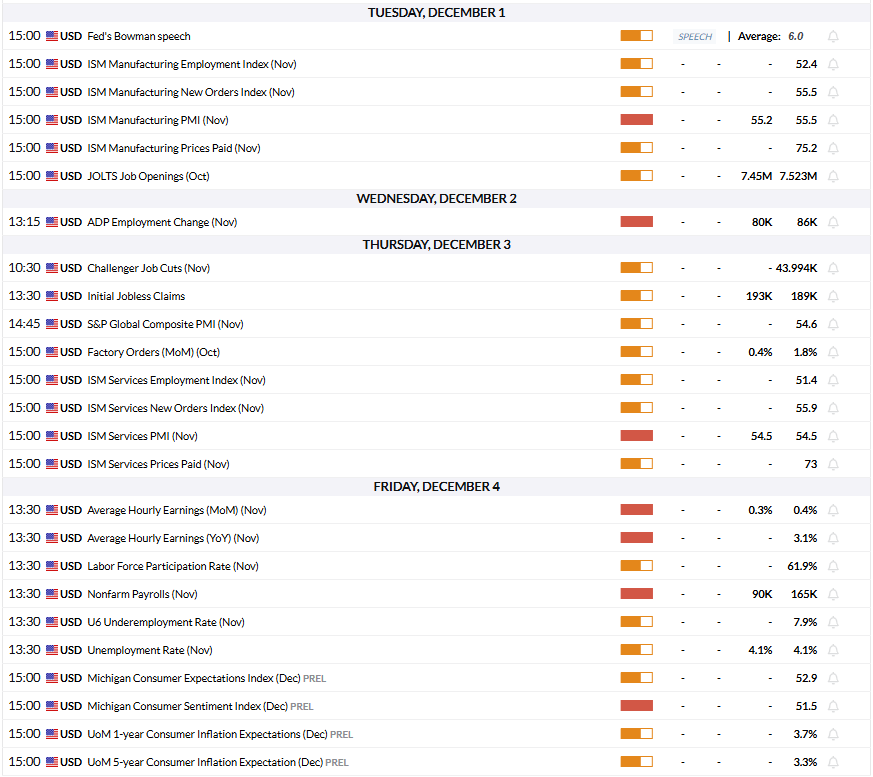
On Tuesday, the Institute for Supply Management (ISM) will publish the Manufacturing Purchasing Managers’ Index (PMI) data for November. In case the headline PMI stays in the expansion territory above 50 and there is an increase in the inflation component of the survey, the Prices Paid Index, the USD could gather strength with the immediate reaction,making it difficult for XAU/USD to gather bullish momentum.
The ISM will publish the Services PMI data on Thursday but investors could dismiss it and opt to wait for Friday’s critical November employment report.
Nonfarm payrolls are expected to have increased by 90K in November, with the unemployment rate remaining unchanged at 4.1%.
Payrolls (NFP) rose by 165K in October and surpassed the market expectation of 65K by a wide margin, confirming healthy labor market conditions. Moreover, the Unemployment Rate declined to 4.1% from 4.2%.
Following October’s upbeat data, market participants are likely to see a decent print of 60K or more in NFP, even if it falls short of the market expectation, as ‘good enough’ for the Fed to continue to focus on taming inflation without cooling down the labor market.
According to the CME FedWatch Tool, a 25 basis points (bps) Fed interest rate increase in December is fully priced-in, and there is about a 65% probability of a consecutive hike in January. Hence, a ‘good enough’ employment report could feed into expectations for further policy tightening in January and weigh on Gold. Conversely, a significant negative surprise, a reading below 40K, could have the opposite effect and help the precious metal edge higher heading into the weekend.
Having said that, it will also be critical for investors to continue to monitor the action in stock markets. Another bout of selloff in technology shares could revive deleveraging fears and cause Gold to come under bearish pressure. On the other hand, the yellow metal could benefit from another risk rally in the near term.
According to TD Securities, “risks of entrenched inflation and a sharp deterioration in risk appetite are weighing on Gold,” even as the bank argues that “an additional rout is not in the cards as algorithmic traders cease shortening, and energy prices are set to stabilize.” The firm cautions that for Gold to extend losses towards “the next long-term support level between 3,200-3,300/oz, the market would need a reason to materially increase its interest rate hike expectations.” With those risks still present, TD Securities concludes that “it is likely too early to call a bottom in Gold, and indeed in the precious metals complex.”
Gold technical analysis: Long way before a bullish reversal is confirmed
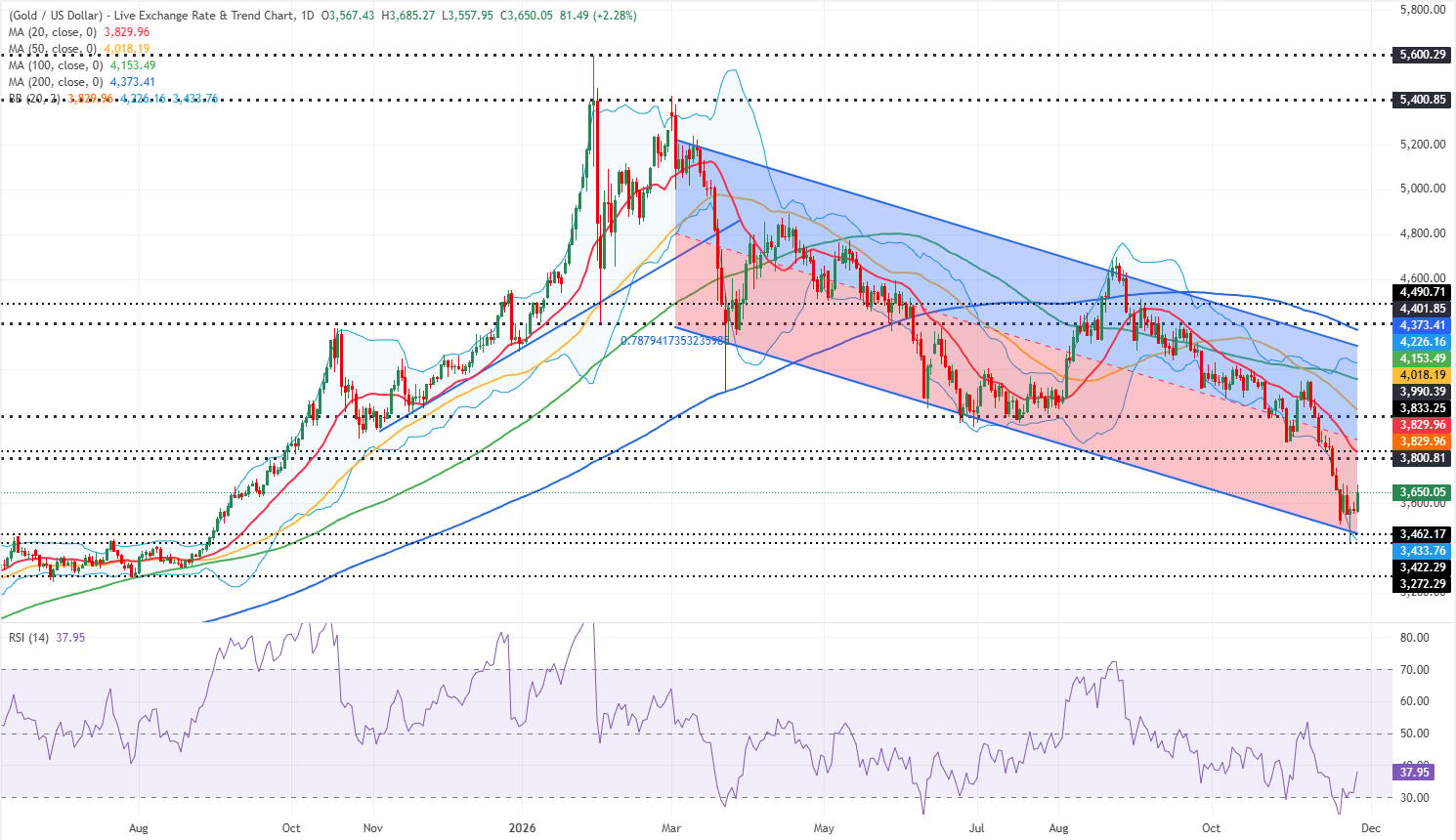
The Relative Strength Index (RSI) indicator on the daily chart remains well below 50, while Gold continues to trade in the lower half of the descending regression channel drawn from March and the Bollinger Bands, suggesting that the latest recovery is a technical correction, rather than a bullish reversal.
On the upside, $3,800 - $3,830 (20-day Simple Moving Average (SMA), static level, former support) aligns as the next resistance area ahead of $4,000-$4,020 (psychological level, 50-day SMA) and $4,150 (100-day SMA).
Looking south, the first important support region could be seen at $3,500-$3,460 (psychological level, lower limit of the descending regression channel). In case Gold drops below this level and fails to reclaim it, $3,270 (static support that held between June and August of 2025) could be set as the next potential bearish target.
Gold FAQs
Gold has played a key role in human’s history as it has been widely used as a store of value and medium of exchange. Currently, apart from its shine and usage for jewelry, the precious metal is widely seen as a safe-haven asset, meaning that it is considered a good investment during turbulent times. Gold is also widely seen as a hedge against inflation and against depreciating currencies as it doesn’t rely on any specific issuer or government.
Central banks are the biggest Gold holders. In their aim to support their currencies in turbulent times, central banks tend to diversify their reserves and buy Gold to improve the perceived strength of the economy and the currency. High Gold reserves can be a source of trust for a country’s solvency. Central banks added 1,136 tonnes of Gold worth around $70 billion to their reserves in 2022, according to data from the World Gold Council. This is the highest yearly purchase since records began. Central banks from emerging economies such as China, India and Turkey are quickly increasing their Gold reserves.
Gold has an inverse correlation with the US Dollar and US Treasuries, which are both major reserve and safe-haven assets. When the Dollar depreciates, Gold tends to rise, enabling investors and central banks to diversify their assets in turbulent times. Gold is also inversely correlated with risk assets. A rally in the stock market tends to weaken Gold price, while sell-offs in riskier markets tend to favor the precious metal.
The price can move due to a wide range of factors. Geopolitical instability or fears of a deep recession can quickly make Gold price escalate due to its safe-haven status. As a yield-less asset, Gold tends to rise with lower interest rates, while higher cost of money usually weighs down on the yellow metal. Still, most moves depend on how the US Dollar (USD) behaves as the asset is priced in dollars (XAU/USD). A strong Dollar tends to keep the price of Gold controlled, whereas a weaker Dollar is likely to push Gold prices up.
Author
Eren Sengezer
FXStreet
As an economist at heart, Eren Sengezer specializes in the assessment of the short-term and long-term impacts of macroeconomic data, central bank policies and political developments on financial assets.
















