Gold sinks despite falling US yields as core PCE hits 3.3%
- XAU/USD loses 0.70% after touching multi-month lows near $3,426.
- US Core PCE accelerates to 3.3%, while quarterly GDP growth reaches 4.3%.
- Fed hike odds ease to 92% as Treasury yields retreat.


Gold (XAU/USD) registers a 0.70% loss on Wednesday after the latest US inflation report was hotter than expected, while the economy remains resilient, with Gross Domestic Product (GDP) figures crushing forecasts. At the time of writing, XAU/USD trades at $3,511 after reaching a low of $3,426, its lowest level since September 2025.
Bullion recovers from multi-month lows but remains pressured by persistent inflation
The US Bureau of Economic Analysis (BEA) reported that the Federal Reserve’s (Fed) preferred inflation gauge, the Core Personal Consumption Expenditures (PCE) Price Index, expanded by 3.3% YoY in October, up from 3.1%. The headline PCE rose from 3.7% to 3.8%, in line with forecasts, while the economy grew above estimates, with Q3 GDP exceeding forecasts of 3.4% to 4.3% in its second estimate.
The data barely moved expectations for further Fed tightening, as the CME FedWatch Tool still prices in a 92% chance for a 25-basis-point rate hike in December, down from 97% a day ago.
Other data showed that Durable Goods Orders slowed from 2% in September to 0.2% in October, while Initial Jobless Claims for the week ending November 21 fell from 202K to 189K, well below the 200K forecast.
After the US data release, the Greenback has weakened, as indicated by the US Dollar Index (DXY). The DXY, which tracks the buck’s performance against six currencies, is down 0.22% at 103.61.
US Treasury yields, mainly the 10-year T-note, have fallen nearly nine basis points, to 4.84%, even though money markets had priced in additional rate hikes.
In breaking news, US President Donald Trump reignited trade tensions by proposing tariffs on major trading powers, including China, despite his party’s midterm losses.
Ahead, the US economic docket is empty on Thursday as US markets will remain closed in observance of the Thanksgiving Holiday.
XAU/USD technical analysis: Gold hovers near $3,500 as downtrend remains intact
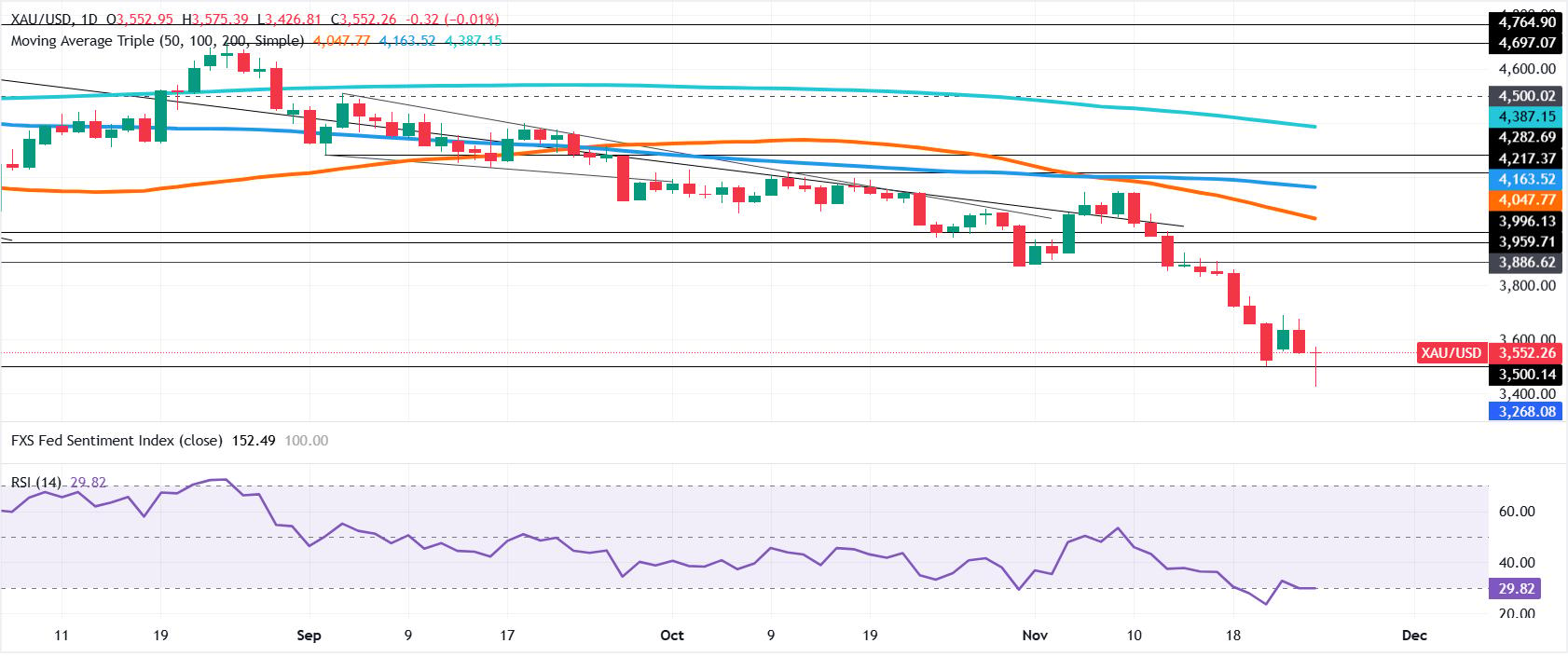
Price action shows Gold forming a ‘dragonfly doji,’ meaning that after reaching a new yearly low, buyers are gaining momentum as XAU/USD closes near the day's highs above $3,500.
Despite this, the Relative Strength Index (RSI) turned flat near oversold territory. This suggests the yellow metal appears overextended on the downside, with traders booking profits ahead of the next catalyst.
For a bearish continuation, XAU/USD must fall below $3,500, the April 22, 2025, swing high that has now become support. Traders would then watch for further losses, with the next support at $3,268—the July 30, 2025, swing low—followed by the $3,000 mark.
For a bullish reversal, Gold must clear the last week’s high of $3,901 ahead of the $4,000 mark. A breach of the latter will expose the 50-day Simple Moving Average (SMA) at $4,062.
Gold FAQs
Gold has played a key role in human’s history as it has been widely used as a store of value and medium of exchange. Currently, apart from its shine and usage for jewelry, the precious metal is widely seen as a safe-haven asset, meaning that it is considered a good investment during turbulent times. Gold is also widely seen as a hedge against inflation and against depreciating currencies as it doesn’t rely on any specific issuer or government.
Central banks are the biggest Gold holders. In their aim to support their currencies in turbulent times, central banks tend to diversify their reserves and buy Gold to improve the perceived strength of the economy and the currency. High Gold reserves can be a source of trust for a country’s solvency. Central banks added 1,136 tonnes of Gold worth around $70 billion to their reserves in 2022, according to data from the World Gold Council. This is the highest yearly purchase since records began. Central banks from emerging economies such as China, India and Turkey are quickly increasing their Gold reserves.
Gold has an inverse correlation with the US Dollar and US Treasuries, which are both major reserve and safe-haven assets. When the Dollar depreciates, Gold tends to rise, enabling investors and central banks to diversify their assets in turbulent times. Gold is also inversely correlated with risk assets. A rally in the stock market tends to weaken Gold price, while sell-offs in riskier markets tend to favor the precious metal.
The price can move due to a wide range of factors. Geopolitical instability or fears of a deep recession can quickly make Gold price escalate due to its safe-haven status. As a yield-less asset, Gold tends to rise with lower interest rates, while higher cost of money usually weighs down on the yellow metal. Still, most moves depend on how the US Dollar (USD) behaves as the asset is priced in dollars (XAU/USD). A strong Dollar tends to keep the price of Gold controlled, whereas a weaker Dollar is likely to push Gold prices up.
Author
Christian Borjon Valencia
FXStreet
Markets analyst, news editor, and trading instructor with over 14 years of experience across FX, commodities, US equity indices, and global macro markets.