Crude Oil extends its rally as the Pentagon adds another carrier group
- WTI extends its rally to just above $92.50 as the Pentagon adds a carrier group.
- Chinese refiners suspend fuel exports through a holiday that ends October 7.
- US distillate inventories 14% below the five-year average, Crude Oil 2% above.

A report that the Pentagon is sending a third aircraft carrier strike group to the Middle East has added a second leg to Thursday's rally in Crude Oil. Crude Oil trades near $92.00, its highest since Tuesday, after the first leg came on reports that China's refiners have stopped selling fuel abroad. Neither leg takes a barrel of Crude Oil off the market in October.
A third carrier means one of the first two doesn't go home
The Pentagon is sending a third carrier strike group and more Marine Corps ships to the Middle East, US officials said in a report on Thursday. The deployment adds up to 10K troops, all due in the region by the end of November. President Trump has told a magazine it's possible he will order strikes on Iran after the November 3 midterms, days after rejecting Iran's seven-day ceasefire plan on September 26.
The strike group led by the carrier Theodore Roosevelt, which makes three, left San Diego on September 27, so Crude Oil rallied on a ship that had been at sea for four days. It sailed as the reported relief for the George Washington, and a US official said on Thursday that the Washington will now stay alongside the George H.W. Bush.
The US last had three carriers in the region in April, the most since the 2003 invasion of Iraq. Iran said on Wednesday it had received a US response to its latest ceasefire proposal, and Qatar is still passing messages between the two sides. The extra forces arrive after the vote and a deal could come before it, so the premium the report added is the easiest part of Thursday's rally to give back.
Beijing steadies fuel supplies, starting with China's
Chinese refiners have suspended fuel exports to everywhere except Hong Kong and Macau until Beijing says otherwise, people familiar with the matter said on Thursday. A state-owned refiner cancelled a handful of October gasoline and jet fuel cargoes on Wednesday, most of them deals it had agreed within the previous two weeks.
The halt came less than a week after President Trump asked President Xi in Washington to help steady global fuel supplies. Beijing first restricted fuel exports in March, after the war began, and eased the curbs in July. China's week-long holiday runs to October 7 with no export approvals in place, and whether they resume could depend on domestic fuel stocks and refinery output.
China has the largest refining capacity in the world but usually exports less fuel than India or South Korea. The reason trade sources give for the halt matters more than the cargoes, and that reason is a drop in China's own fuel stocks. Rebuilding them takes Crude Oil, and in Asia diesel now sells for about $75 a barrel more than the Crude Oil it's made from.
The US has more Crude Oil than usual and 14% less diesel
Middle East Crude Oil exports rose in September to their highest since the war began on February 28. US Crude Oil stocks sit 2% above their five-year average, according to the Energy Information Administration (EIA). Distillate stocks, which cover diesel and heating fuel, are 14% below theirs after falling 2.3 million barrels in the week to September 25. US refiners are short of fuel to sell rather than barrels to run.
One consultancy estimates a ban on US diesel exports could cut US refinery runs by as much as 12% as storage fills within a month. A barrel a US refiner doesn't run has to find another buyer abroad, where high freight costs and scarce tankers have already held US exports back. On September 24, talk of a ban pushed US Crude Oil to its widest discount to the international benchmark since early May.
The US average diesel price passed $6.50 a gallon for the first time in September, and the administration wants it lower before the November 3 midterms. President Trump said on Wednesday he is still discussing a US diesel export ban, and the White House has asked the European Union to release its emergency diesel stocks to lower world prices.
Levels and bias
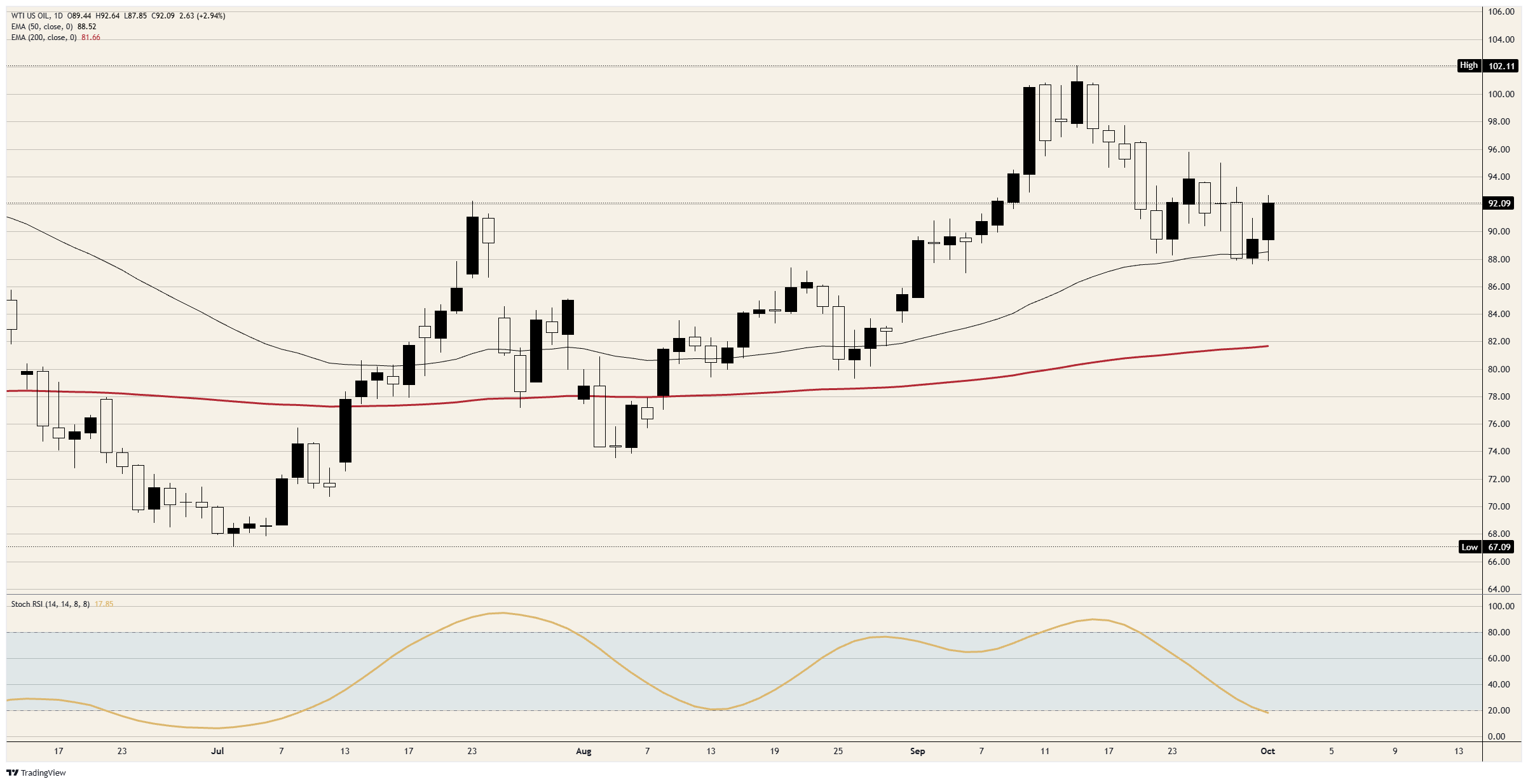
Resistance: The session high just above $92.50 is where the jump on the report stopped. Friday and Tuesday both sold off from the $93.00-$93.50 area, and Monday's spike to $95.00 fell short of the September 24 high near $96.00.
Support: The jump on the report started just above $90.50, the top of a $90.00-$90.50 area that held on September 25 and September 28 before Tuesday's break. Beneath it, Thursday was the third straight session to bottom just under $88.00.
Bias: Lean long while $90.50 holds, with $93.50 the first objective and Monday's $95.00 spike high the second. The daily Stochastic Relative Strength Index (Stoch RSI) is near 18, at the bottom of its range and yet to turn up. The long is wrong on a daily close below $90.00.
WTI daily chart
WTI Oil FAQs
WTI Oil is a type of Crude Oil sold on international markets. The WTI stands for West Texas Intermediate, one of three major types including Brent and Dubai Crude. WTI is also referred to as “light” and “sweet” because of its relatively low gravity and sulfur content respectively. It is considered a high quality Oil that is easily refined. It is sourced in the United States and distributed via the Cushing hub, which is considered “The Pipeline Crossroads of the World”. It is a benchmark for the Oil market and WTI price is frequently quoted in the media.
Like all assets, supply and demand are the key drivers of WTI Oil price. As such, global growth can be a driver of increased demand and vice versa for weak global growth. Political instability, wars, and sanctions can disrupt supply and impact prices. The decisions of OPEC, a group of major Oil-producing countries, is another key driver of price. The value of the US Dollar influences the price of WTI Crude Oil, since Oil is predominantly traded in US Dollars, thus a weaker US Dollar can make Oil more affordable and vice versa.
The weekly Oil inventory reports published by the American Petroleum Institute (API) and the Energy Information Agency (EIA) impact the price of WTI Oil. Changes in inventories reflect fluctuating supply and demand. If the data shows a drop in inventories it can indicate increased demand, pushing up Oil price. Higher inventories can reflect increased supply, pushing down prices. API’s report is published every Tuesday and EIA’s the day after. Their results are usually similar, falling within 1% of each other 75% of the time. The EIA data is considered more reliable, since it is a government agency.
OPEC (Organization of the Petroleum Exporting Countries) is a group of 12 Oil-producing nations who collectively decide production quotas for member countries at twice-yearly meetings. Their decisions often impact WTI Oil prices. When OPEC decides to lower quotas, it can tighten supply, pushing up Oil prices. When OPEC increases production, it has the opposite effect. OPEC+ refers to an expanded group that includes ten extra non-OPEC members, the most notable of which is Russia.
Author

Joshua Gibson
FXStreet
Joshua joins the FXStreet team as an Economics and Finance double major from Vancouver Island University with twelve years' experience as an independent trader focusing on technical analysis.