Fed Minutes: Officials saw inflation risks worsening before September hike

All participants at the Federal Reserve's (Fed) September 15–16 meeting supported the 25-basis-point rate increase, while most judged that another hike would probably be appropriate by the end of the year. The Minutes show policymakers increasingly focused on upside inflation risks, a resilient economy and the possibility that strong AI investment could add to demand pressures.
Participants generally agreed that inflation remained elevated, while the labour market was close to full employment. Almost all saw inflation risks tilted to the upside, with some saying those risks had become more pronounced recently. Job-market risks were viewed as broadly balanced, giving the Fed greater scope to concentrate on restoring price stability.
Several officials warned that the AI buildout could eventually push aggregate demand ahead of supply, creating additional upward pressure on prices. The staff’s economic outlook was also stronger than in July, reinforcing the view that the economy could withstand further policy tightening. Against that backdrop, most participants considered another rate increase by year-end likely to be appropriate.
Financial conditions were also judged to remain supportive of growth despite the recent rise in long-term Treasury yields. A few participants said the Treasury market was functioning smoothly, while they stressed the importance of preparing for episodes of market stress.
Overall, the minutes reinforce a hawkish policy bias: the September hike was supported unanimously, and further tightening remained the most likely path if inflation fails to moderate.
Market reaction
The Greenback remains well bid on Wednesday, motivating the US Dollar Index (DXY) to keep its trade above the 102.00 yardstick as investors continue to assess the latest release of the FOMC Minutes.
US Dollar Price Today
The table below shows the percentage change of US Dollar (USD) against listed major currencies today. US Dollar was the strongest against the Euro.
| USD | EUR | GBP | JPY | CAD | AUD | NZD | CHF | |
|---|---|---|---|---|---|---|---|---|
| USD | 0.56% | 0.47% | -0.09% | 0.36% | 0.27% | 0.37% | 0.16% | |
| EUR | -0.56% | -0.09% | -0.62% | -0.21% | -0.29% | -0.17% | -0.41% | |
| GBP | -0.47% | 0.09% | -0.54% | -0.11% | -0.20% | -0.09% | -0.30% | |
| JPY | 0.09% | 0.62% | 0.54% | 0.43% | 0.36% | 0.48% | 0.24% | |
| CAD | -0.36% | 0.21% | 0.11% | -0.43% | -0.08% | 0.04% | -0.18% | |
| AUD | -0.27% | 0.29% | 0.20% | -0.36% | 0.08% | 0.09% | -0.11% | |
| NZD | -0.37% | 0.17% | 0.09% | -0.48% | -0.04% | -0.09% | -0.25% | |
| CHF | -0.16% | 0.41% | 0.30% | -0.24% | 0.18% | 0.11% | 0.25% |
The heat map shows percentage changes of major currencies against each other. The base currency is picked from the left column, while the quote currency is picked from the top row. For example, if you pick the US Dollar from the left column and move along the horizontal line to the Japanese Yen, the percentage change displayed in the box will represent USD (base)/JPY (quote).
This section below was published as a preview of the FOMC Minutes of the September 16-17 meeting at 16:30 GMT.
- The Fed Minutes are expected to shed some light on the extent and the timing of the monetary tightening cycle.
- Lower-than-expected price pressure and disappointing employment data have curbed hopes of back-to-back rate hikes.
- Futures market prices in a 20% chance of a rate hike in October and an 80% chance of at least one hike before year-end.
The United States (US) Federal Reserve (Fed) will release the Minutes of September’s Federal Open Market Committee (FOMC) meeting on Wednesday. Investors are eager for some details that shed light on the extent and the timing of the central bank´s tightening cycle after approving the first interest rate hike in three years in September.
The FOMC met expectations and raised the fed funds rate by 25 basis points to the 3.75%-4.00% range in September in a unanimous decision. Chair Kevin Warsh surprised with unequivocally hawkish rhetoric, considering his natural reluctance to give excessive forward guidance. This reaffirmed investors’ confidence in the bank’s independence and sent the US Dollar rallying across the board.
Warsh stated that inflation has been “too high for too long” in the press conference following the decision. The monetary policy statement endorsed that view and reaffirmed the committee’s commitment to deliver price stability and pursue a monetary policy to “support a timelier return to the Committee’s 2% target.”
The statement also highlighted the strength of the US labour market, which boosted expectations of back-to-back rate hikes. Data released last week, however, has tempered those hopes, and investors will be analysing the Minutes to confirm a rate hike in December after practically discarding a tightening move later this month.
Inflation and labour data have dampened hopes of an October rate hike
US Personal Consumption Expenditures (PCE) Prices Index revealed that inflation remained steady in August, providing some leeway for the bank to take some time to better assess the impact of September’s rate hike before tightening monetary policy further. Beyond that, September’s Nonfarm Payrolls data has raised some doubts about the strength of the labour market altogether, strengthening the case for a pause at the next meeting.
Economic activity, however, remains solid. The US ISM Services Purchasing Managers' Index (PMI) Index slowed down but remains at levels consistent with a strong expansion of business activity, reflecting strong demand and an improvement in employment. Data by GDPNow estimates that the US economy accelerated to 3.7% annual growth in the third quarter from the 2.2% increase seen in the previous quarter, providing an ideal scenario for a tightening cycle.
The question, thus, is on the timing, especially after mixed messages by Fed officials. Chicago Fed President Austan Goolsbee affirmed last week that inflation outweighs labour market concerns at this moment, and Dallas Fed President Lorie Logan stated that more rate hikes will be needed to bring inflation to target. The central bank’s Vice Chair for Supervision, Michelle Bowman, on the other hand, said that there is not an urgent need for further rate hikes this year, and New York Fed President John Williams supported that idea.
Analysts at ING describe the latest data as slightly hawkish “but not enough to materially alter the Fed narrative.” In their view, “markets are likely to remain comfortable with an October hold provided September core CPI (released on 14 October) prints at 0.2% MoM, which is where consensus is converging.” ING reiterates that “a hike in December remains the base case,” keeping risks for the Dollar (USD) skewed to the upside.
When will FOMC Minutes be released, and how could they affect the US Dollar?
The FOMC will release the Minutes of its September 15-16 monetary policy meeting on Wednesday at 18:00 GMT.
The bank hiked interest rates by a quarter point and hinted at further rate hikes ahead, but recent data has dampened hopes of back-to-back rate hikes. Data from the CME’s FedWatch Tool shows a 78% chance that the bank will leave rates unchanged later this month, up from 50% last week. Hopes of some hike before the year-end, however, remain practically unchanged around an 85% chance.
Fed tightening hopes, combined with the US economic exceptionalism, concerns about high Oil prices that are weighing on most of the US Dollar’s rival currencies and, above all, a bond rout that has put the focus on the Euro Area, have propelled the US Dollar since early September. The US Dollar Index (DXY), which measures the value of the US Dollar against six majors, has rallied about 3.4% over the last four weeks to hit 18-month highs at 102.50.
Within this framework, the market expects the September Minutes to confirm that inflation remains front and center in the bank’s monetary policy plans, which would add to the case for a December hike.
The impact on the US Dollar, however, is likely to be limited as the report predates last week’s Personal Consumption Expenditures (Prices Index) and Nonfarm Payrolls reports. In that sense, next week’s US Consumer Price Index (CPI) and Producer Price Index (PPI) releases might have a higher impact, as they may set the outcome of the next meeting.
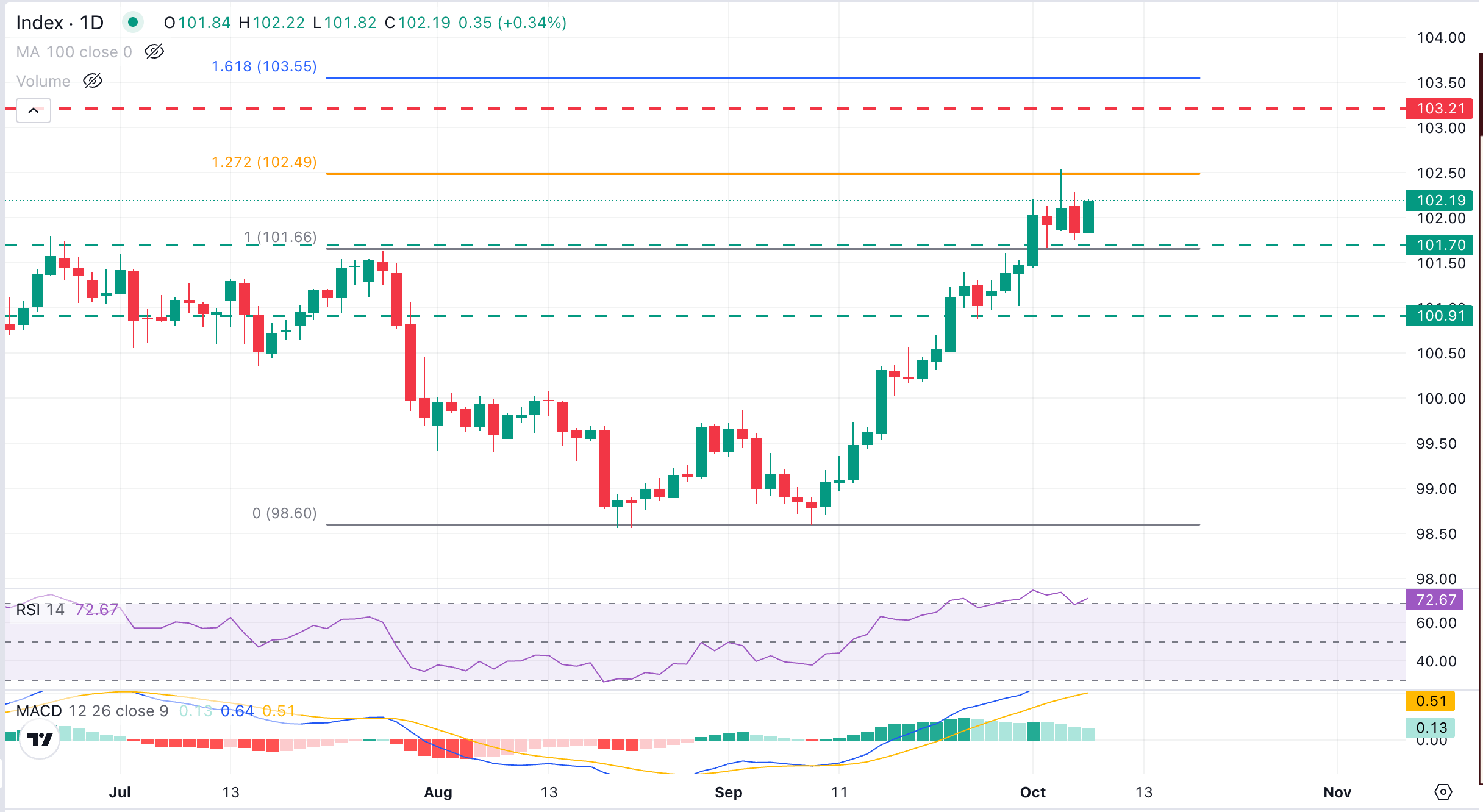
The daily chart shows the US Dollar Index (DXY) in a steady upward channel from early September lows, although the overbought Relative Strength Index (RSI) suggests that a consolidation or even some pullback should be considered. The Moving Average Convergence Divergence (MACD) remains at positive levels, which suggests that dips are likely to find buyers.
DXY bulls have met resistance at the 127.7% Fibonacci retracement of the July-August bearish cycle in the 102.50 area. Further up, a previous support-turned-resistance at the 103.20 area (March 2025 lows) is likely to offer some resistance ahead of the 161.8% Fibonacci resistance of the mentioned cycle, at the 103.60 area.
Downside attempts so far are contained above previous year-to-date highs near the 101.80 area. A bearish reaction below that level would bring the September 25 low, at the 100.90 area, into focus, ahead of the psychological 100 level.
Economic Indicator
FOMC Minutes
FOMC stands for The Federal Open Market Committee that organizes 8 meetings in a year and reviews economic and financial conditions, determines the appropriate stance of monetary policy and assesses the risks to its long-run goals of price stability and sustainable economic growth. FOMC Minutes are released by the Board of Governors of the Federal Reserve and are a clear guide to the future US interest rate policy.
Next release: Wed Oct 07, 2026 18:00
Frequency: Irregular
Consensus: -
Previous: -
Source: Federal Reserve
Minutes of the Federal Open Market Committee (FOMC) is usually published three weeks after the day of the policy decision. Investors look for clues regarding the policy outlook in this publication alongside the vote split. A bullish tone is likely to provide a boost to the greenback while a dovish stance is seen as USD-negative. It needs to be noted that the market reaction to FOMC Minutes could be delayed as news outlets don’t have access to the publication before the release, unlike the FOMC’s Policy Statement.
Economic Indicator
Fed Interest Rate Decision
The Federal Reserve (Fed) deliberates on monetary policy and makes a decision on interest rates at eight pre-scheduled meetings per year. It has two mandates: to keep inflation at 2%, and to maintain full employment. Its main tool for achieving this is by setting interest rates – both at which it lends to banks and banks lend to each other. If it decides to hike rates, the US Dollar (USD) tends to strengthen as it attracts more foreign capital inflows. If it cuts rates, it tends to weaken the USD as capital drains out to countries offering higher returns. If rates are left unchanged, attention turns to the tone of the Federal Open Market Committee (FOMC) statement, and whether it is hawkish (expectant of higher future interest rates), or dovish (expectant of lower future rates).
Read more.Last release: Wed Sep 16, 2026 18:00
Frequency: Irregular
Actual: 4%
Consensus: 4%
Previous: 3.75%
Source: Federal Reserve
Author

FXStreet Team
FXStreet
Composed of a group of economic journalists and FX experts, the FXStreet content team produces and oversees all content published on FXStreet. It provides a purely journalistic approach to the Forex market.