Alibaba stock runs to four-year high on AI outlook
- Alibaba lifts guidance on AI spending above $53 billion, three-year plan announced in February.
- BABA shares traded above $178 for the first time since October 2021.
- Shares of BABA have risen 107% YTD on Wednesday.
- Alibaba's long bear market ends as 100-week moving average supersedes 200-week counterpart for first time in more than three years.
Alibaba (BABA) stock has achieved lift-off on Wednesday as shares rise 9% to a four-year high. Management of China's e-commerce and cloud conglomerate says it will raise its outlays on AI spending above the $53 billion it announced in February.
Memory chip maker Micron Technology (MU) simultaneously slumped 2% in the US market despite besting Wall Street's quarterly consensus on earnings per share (EPS) by 6%. Shares of Micron are down 2% to $163 as of Wednesday morning.
The broader US equity market is muted and mixed despite good news on the housing front. US New Home Sales surged 20.5% MoM to 800K in August from 664K in July.
Alibaba stock soars on AI message
At the Alibaba Cloud conference on Wednesday, Alibaba CEO Eddie Wu said that the $53 billion announced in February wouldn't suffice.
“We are vigorously advancing a three-year, 380 billion [Yuan] AI infrastructure initiative with plans to sustain and further increase our investment according to our strategic vision in anticipation of the [AI] era," said Wu, according to Bloomberg.
Wu said that Alibaba would need to keep up as global players are expected to invest $5 trillion in AI over the next five years.
Alibaba is one of many Chinese corporations attempting to secure its own piece of the AI pie, separately from the large competition from US tech. 2025 began with China's DeepSeek LLM showing that the country could compete using much less resources. Search giant Baidu (BIDU) is also a main competitor as it seeks to build its own AI chips in order to reduce reliance on Nvidia's (NVDA) GPUs.
Alibaba has already developed an AI accelerator called a PPU that it claims can compete with Nvidia's H20 GPU, a second-tier chip that the US government specifically allows for export to China in order to keep the latter nation at a disadvantage in the AI race.
Chinese officials have a dim view of Nvidia's H20 chip and have told domestic corporations to stop importing it. Huawei has also developed the Ascend 910B chip for AI use cases.
Other reasons for optimism in Alibaba's prospects are that founder Jack Ma has returned to the good graces of Xi Jinping, and in its fiscal third quarter AI product revenue rose at a triple-digit clip for the sixth straight quarter.
Alibaba stock forecast
If Alibaba's gains last through Friday, this will be the eighth straight week of gains for the Hangzhou-based mega cap. BABA shares have spent years in purgatory since founder Ma was on the outs with Beijing following the failed Ant Group IPO in late 2020.
But now for the first time in more than three years, BABA's 100-week Simple Moving Average (SMA) has risen above the 200-week counterpart. This comes after the 50-week SMA did the same in May. Now, Alibaba's weekly moving averages are aligned in order of frequency as one would expect in an uptrend.
With light resistance near $182 from October 2021 in the crosshairs, bulls should expect that a break of that level will allow for a run-up to the $200 psychological level. The latter has worked as resistance and support in the past.
Those looking for an entry might wait for a pullback to the $145 past resistance level, but it is unclear whether BABA's momentum will allow a consolidation anytime soon. BABA stock has risen 107% year to date on Wednesday and does not look to be stopping despite an overbought weekly Relative Strength Index (RSI) reading of 80.
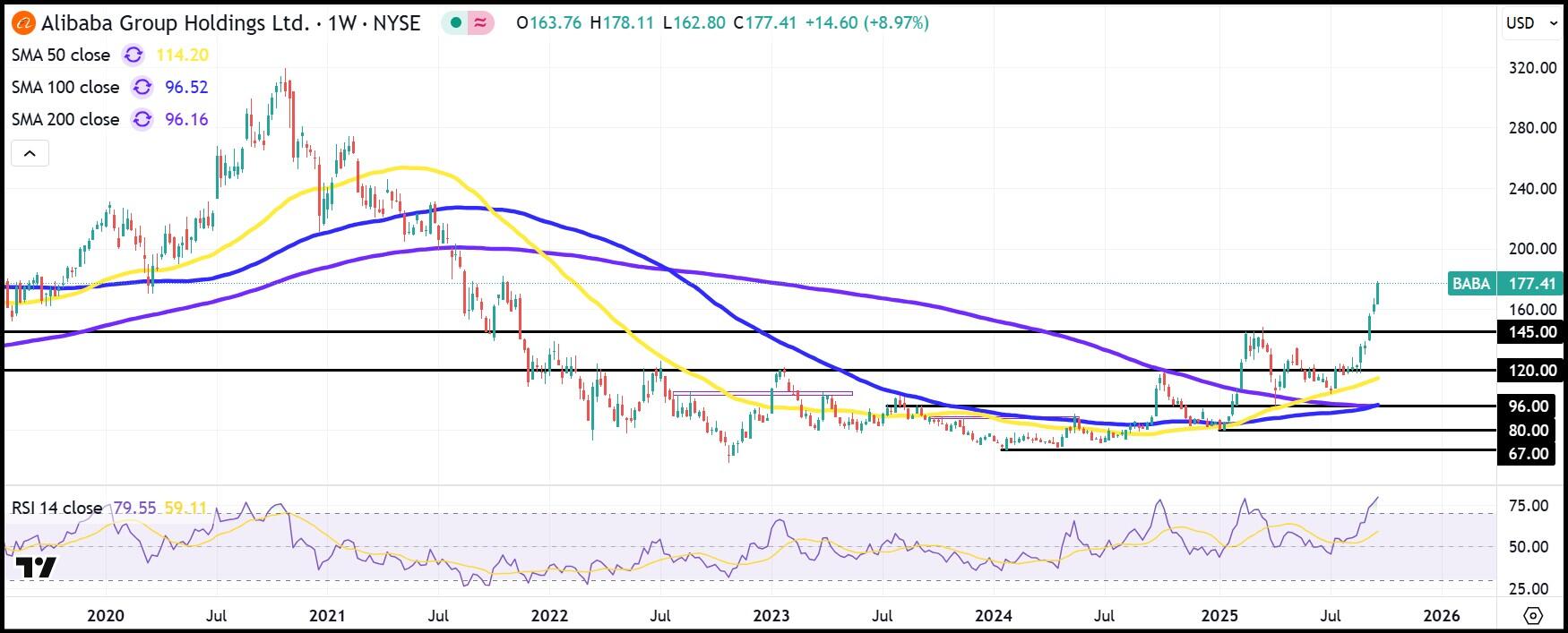
BABA weekly stock chart
Author

Clay Webster
FXStreet
Clay Webster grew up in the US outside Buffalo, New York and Lancaster, Pennsylvania. He began investing after college following the 2008 financial crisis.

















