|

Gold sellers eye reversal of November gains as $3,870 support comes into focus

  • Gold retreats sharply as hotter US inflation reinforces expectations for further Fed tightening.
  • Rising Treasury yields weigh on bullion, reversing much of its post-election recovery.
  • Sellers eye $3,870 support, while a sustained break could bring $3,800 into focus.
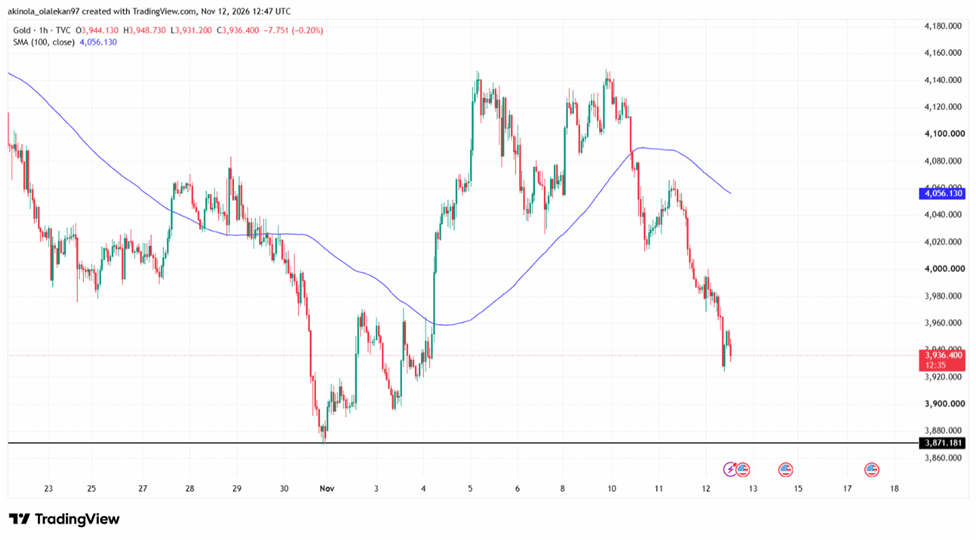
Gold started November strongly, recovering from around $3,870 to $4,148—a gain of approximately $278 per ounce.

The recovery followed the Democrats’ victory in the US midterm elections. Treasury yields declined, the Dollar weakened and Gold attracted buyers.  

That support has since faded as attention returned to US inflation and the Federal Reserve’s policy outlook.

Gold has fallen towards $3,938 from $4,148 in two days. Hotter-than-expected CPI, alongside Fed Governor Christopher Waller’s suggestion that a 50-basis-point December hike should be considered, strengthened expectations for further tightening.

Treasury yields rose sharply in response, with the US 10-year yield climbing from around 4.85% towards 5.00%. Higher yields increase the opportunity cost of holding non-yielding Gold, while a firmer Dollar adds further pressure.
Chart

The combination of elevated yields and expectations for further Fed tightening keeps the near-term outlook tilted towards sellers. A sustained break below $3,925 would expose the November low around $3,870. Losing that support would complete the reversal of the month’s recovery and bring $3,800 into focus.

Profit-taking on short positions could produce a rebound ahead of the weekend. However, a more durable recovery would require stronger evidence, such as easing Treasury yields, a softer Dollar or reduced expectations for Fed tightening. Until then, rebounds remain vulnerable to renewed selling.

Author

Olalekan Akinola

Olalekan Akinola

Independent Analyst

Olalekan Akinola is a financial-markets analyst and writer with five years of experience covering forex, commodities, and global macroeconomic developments.


More from Olalekan Akinola
Share:

Editor's Picks

AUD/USD hits eight-month lows below 0.6850 amid bullish USD

AUD/USD stays defensive below 0.6850, hitting an eight-month low in the Asian session on Thursday as the possibility of a steeper Fed rate hike in December helps the US Dollar hold near its highest level since April 2025. Geopolitical uncertainty also supports the safe-haven buck, while the RBA’s cautious, on-hold stance limits the Aussie.

USD/JPY eases from near 160.00 amid looming intervention risks, BoJ hike bets

USD/JPY retreats slightly from an over two-month high as the recent surge back to the 160.00 psychological mark prompted verbal warnings from Japanese authorities and sparked fears of direct FX intervention. Moreover, data showed that Japan’s wholesale inflation picked up again in October, strengthening the case for a BoJ hike in December and lifting the Japanese Yen. However, a bullish US Dollar, bolstered by odds of a jumbo Fed rate hike in December, could cap the pair's downside.


Gold falls below $4,000 as traders weigh a half-point Fed rate hike

Gold (XAU/USD) slips back below $4,000 on Thursday, giving up most of last week’s gains as bets on more aggressive Federal Reserve (Fed) interest rate hikes lift the US Dollar (USD) to a fresh year-to-date high.

Top Altcoins Price Forecast: Ripple, Cardano and Solana halt decline amid signs of exhaustion

Top altcoins, Ripple (XRP), Cardano (ADA), and Solana (SOL), hold steady on Thursday, halting the prevailing decline linked to hot US inflation data and the post-US midterms period.

Nvidia shares crash as Jensen Huang resigns as CEO
Nvidia (NVDA) shares collapsed in Thursday's premarket after longtime CEO and co-founder Jensen Huang resigned as CEO in the face of board scrutiny over several affairs. Nvidia shares have shed 10% at the time of writing as the leading AI chipmaker chose chief financial officer (CFO) Colette Kress as interim CEO.
What the US CPI headline doesn’t tell you about inflation

Brent crude has fallen about a third since mid-October on hopes the Iran war is ending, but diesel, freight and fertiliser costs haven't followed. Those costs reach US consumer prices in stages through 2027 and could keep inflation high after gasoline gets cheaper.