Gold rallies as Oil tumbles: A new leading correlation?
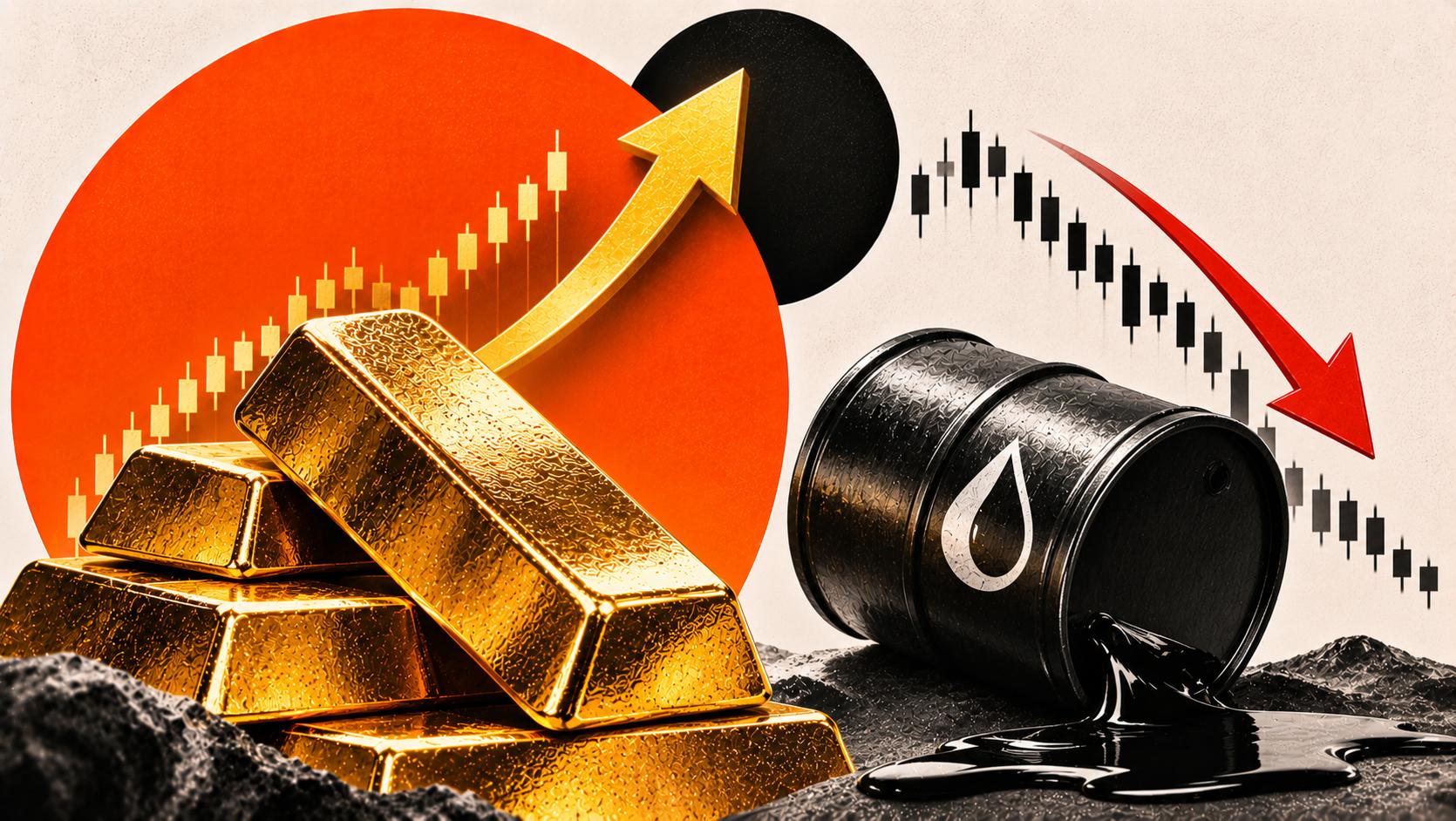
Spot Gold (XAU/USD) made quite an impressive comeback in the last couple of days, recovering from a yearly low of $3,870 to the $4,140 region. The advance seems more meaningful given the metal's preceding bearish trend, which has not fully reversed.
Gold bullish return explained
Multiple factors are playing in favor of the precious metal, but at the end of the day, they all share the same root.
United States (US) President Donald Trump has faced a massive rejection of his foreign policies in the mid-term elections. While the final results may take a couple more weeks, Democrats have seized control of Congress, gaining 7 seats in the Senate to a total of 54 representatives, and 30 seats in the House to clinch a majority of 240.
Americans got fed up with cost-of-living issues, all coming from President Trump’s obsession with ‘making America great again’. His plan to take control of global Oil sources and make the USA into the world’s largest Oil supplier failed the day he thought he could do in Iran what he did in Venezuela. It’s one thing to invade a developing country and another to mess around with the Middle East Islamic Republic.
Soaring Oil prices turned into hotter-than-tolerable inflation, and hence, the mid-term elections outcome.
And while the new Congress won’t be in place until January, expectations of a political gridlock in Washington weighed the US Dollar (USD) lower. The Dollar Index (DXY) fell to a one-month low, igniting demand for high-yielding assets.
Additionally, Oil prices are sharply down amid hopes the US and Iran will reach a diplomatic solution to the Middle East war. US government bond yields have also retreated, with the 10-year Treasury note currently yielding around 4.9%, reflecting hopes the worst of inflation is behind us.
Gold is benefiting from this picture and recovering its safe-haven status: the election’s outcome also led to a sharp sell-off on Wall Street, mostly in tech shares, which were also hit by the Democratic victory.
One more factor is the Fed's rate outlook: without expectations of continued inflationary pressures, the Federal Reserve (Fed) won’t need to hike rates. Indeed, market players still price in a December 25 basis points (bps) rate hike, but the odds have fallen from roughly 80% before the elections to 74% currently, according to the CME FedWatch Tool. Odds for additional rate hikes in 2027 have declined below 20%, according to the same tool.
XAU/USD Technical Outlook
The XAU/USD pair retreated from an intraday high of $4,147 and hovers around $4,110, still retaining a good chunk of its intraday gains. More relevantly, the pair develops above a daily descending trend line coming from $4,510, the September monthly high, broken this Wednesday. If the $4,060 price zone remains a firm downward barrier in the upcoming days, additional Gold gains will be on the table.
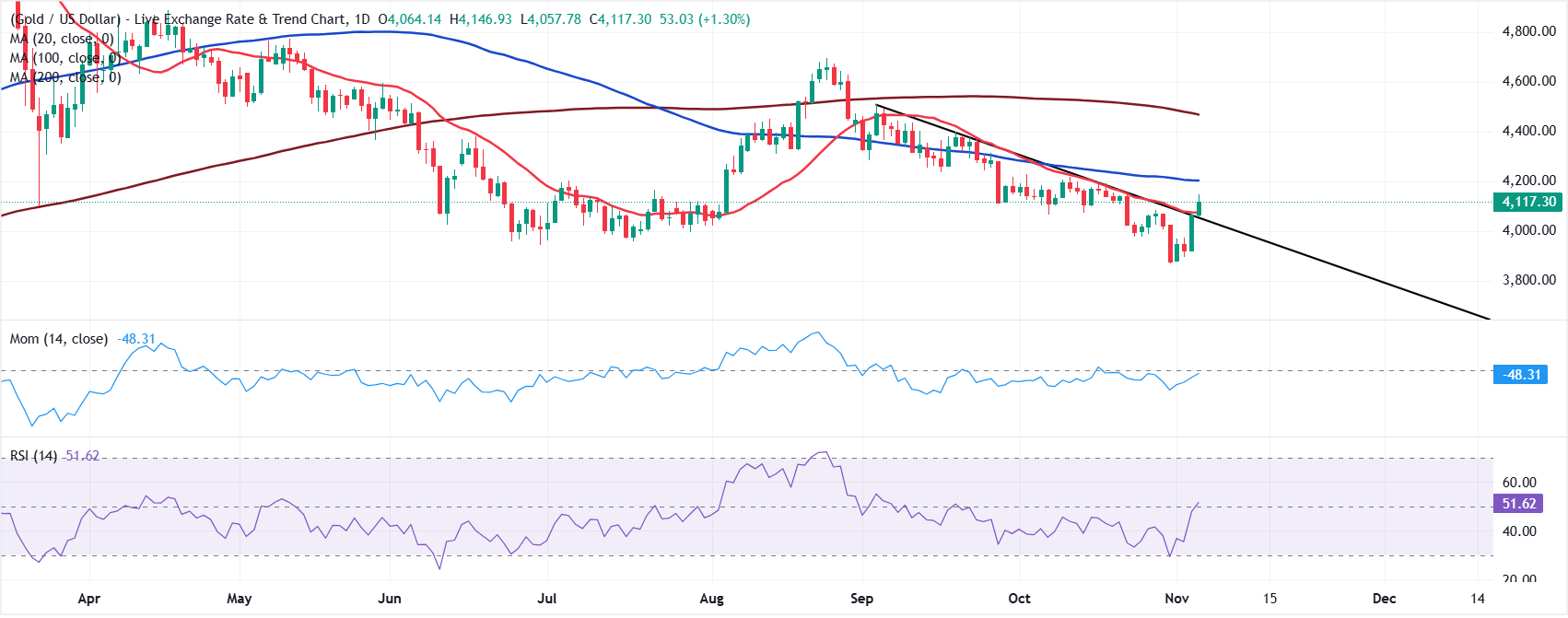
Technical readings in the daily chart show limited upward momentum and a tough path ahead for bulls: technical indicators have recovered from near oversold territory, but struggle to extend gains above their midlines. Price is currently above a mildly bearish 20-day Simple Moving Average (SMA) in the $4,070 zone, while a flat 100-day SMA holds just above $4,200. Moving averages losing their downward slopes also hint at higher highs ahead.
The intraday peak at $4,147 is the initial barrier for buyers: if XAU/USD surpasses it, sellers will become disappointed and are likely to unwind some positions, triggering even more gains. The next relevant resistance area is $4,220, while gains beyond that expose the $4,300 threshold.
Inflation FAQs
Inflation measures the rise in the price of a representative basket of goods and services. Headline inflation is usually expressed as a percentage change on a month-on-month (MoM) and year-on-year (YoY) basis. Core inflation excludes more volatile elements such as food and fuel which can fluctuate because of geopolitical and seasonal factors. Core inflation is the figure economists focus on and is the level targeted by central banks, which are mandated to keep inflation at a manageable level, usually around 2%.
The Consumer Price Index (CPI) measures the change in prices of a basket of goods and services over a period of time. It is usually expressed as a percentage change on a month-on-month (MoM) and year-on-year (YoY) basis. Core CPI is the figure targeted by central banks as it excludes volatile food and fuel inputs. When Core CPI rises above 2% it usually results in higher interest rates and vice versa when it falls below 2%. Since higher interest rates are positive for a currency, higher inflation usually results in a stronger currency. The opposite is true when inflation falls.
Although it may seem counter-intuitive, high inflation in a country pushes up the value of its currency and vice versa for lower inflation. This is because the central bank will normally raise interest rates to combat the higher inflation, which attract more global capital inflows from investors looking for a lucrative place to park their money.
Formerly, Gold was the asset investors turned to in times of high inflation because it preserved its value, and whilst investors will often still buy Gold for its safe-haven properties in times of extreme market turmoil, this is not the case most of the time. This is because when inflation is high, central banks will put up interest rates to combat it. Higher interest rates are negative for Gold because they increase the opportunity-cost of holding Gold vis-a-vis an interest-bearing asset or placing the money in a cash deposit account. On the flipside, lower inflation tends to be positive for Gold as it brings interest rates down, making the bright metal a more viable investment alternative.
Author

Valeria Bednarik
FXStreet
Valeria Bednarik was born and lives in Buenos Aires, Argentina. Her passion for math and numbers pushed her into studying economics in her younger years.