Focus – Gold stays fragile below 4,000 as rate-hike bets weigh
- Gold struggles to recover from a more-than-one-year low.
- Fed hike expectations and a 19-month-high US dollar keep pressure on prices.
- Focus turns to Wednesday's FOMC minutes for policy clues.
- The 3,700 region emerges as the next major support if the downtrend persists.


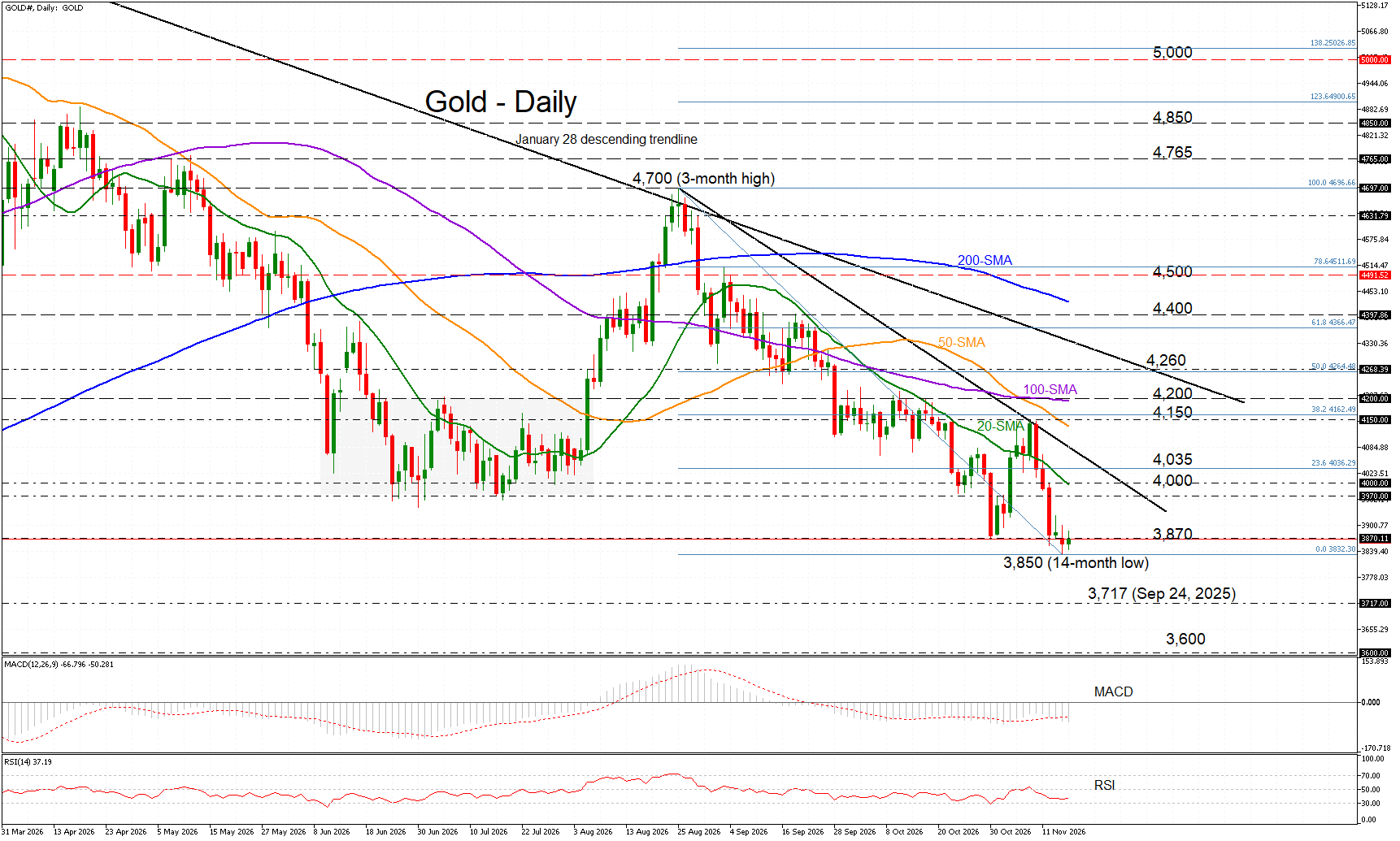
Gold is attempting to stabilize near 3,870 after sliding to its lowest level since October 2025. The precious metal remains under pressure following last week's near 4.6% decline, with buyers struggling to regain momentum after the sharp retreat from the 4,150 area.
The main headwind remains the stronger US dollar, which is hovering near 19-month highs as investors increasingly price in another Fed rate hike. A 25-basis-point increase in December is now almost fully discounted by markets following stronger-than-expected US inflation data and a series of hawkish comments from Fed officials. As a non-yielding asset, gold tends to suffer when interest-rate expectations and Treasury yields rise. Investors are also looking ahead to Wednesday's FOMC minutes for fresh signals on the policy outlook.
Geopolitical uncertainty in the Middle East continues to underpin demand for the dollar, limiting safe-haven flows into gold. Lower oil prices have provided only limited relief, with persistent risks around the Strait of Hormuz keeping both supply concerns and inflation risks on investors' radar. At the same time, volatility in technology and AI-related equities has led some investors to raise cash and reduce exposure across asset classes.
As long as markets continue to price further Fed tightening into 2027, risks remain tilted to the downside. A break below the yearly low near 3,850 could expose the September 24, 2025 low at 3,717, bringing the 3,600 area into focus next and extending the broader downtrend that has dominated much of the year.
Technically, both the MACD and RSI maintain a bearish bias, although the latter has started to stabilize above oversold territory, suggesting the pace of selling may ease. That could allow for a period of consolidation before the next major move.
Any recovery would likely need support from dip-buying demand and renewed central-bank purchases. In that case, gold could rebound toward the 4,000 area, where the 20-day SMA is currently located. A sustained break above the August 25 descending trendline near 4,035 would further improve sentiment and shift focus back toward the 4,150 region, where the latest selloff began. However, the longer-term descending trendline drawn from the January 28 high, currently intersecting around 4,200-4,260, remains the key resistance zone for any meaningful bullish reversal.
Author
Nicole joined Trading Point as a Market Analyst in January 2025. She holds a BA in English Literature from Kingston University, London, and an MA in Applied Linguistics (Research Methodology) from the University of Southampton with distinction.

















