EUR/USD remains under pressure despite recovery above 1.0800


3 key points
- EUR/USD records one of its steepest weekly declines, falling to levels last seen in April 2025 before staging a modest recovery above 1.0800.
- Diverging economic conditions keep the US Dollar supported, as resilient US growth and persistent inflation reinforce expectations of restrictive Federal Reserve policy.
- Falling Treasury yields and equity market weakness are limiting further Dollar gains, with investors monitoring developments across global financial markets.
EUR/USD struggles to recover as Fed policy expectations support the Dollar
The Euro continues to face selling pressure against the US Dollar despite staging a modest recovery above the 1.0800 psychological level. The pair recently recorded one of its weakest weekly performances in recent months, declining to levels last seen in April 2025 as investors reassessed the Federal Reserve's monetary policy outlook.
Persistent inflationary pressures and resilient economic activity in the United States have continued to reinforce expectations that the Federal Reserve may maintain a restrictive monetary policy for longer. This has provided underlying support for the Greenback, leaving the Euro vulnerable despite some positive economic developments across the Eurozone.
Diverging inflation and economic growth outlooks
Recent inflation figures in the United States have remained above the Federal Reserve's 2% target, while economic activity continues to demonstrate resilience. These developments have strengthened the argument for maintaining relatively restrictive monetary conditions.
In contrast, Eurozone inflation has climbed to 4%, increasing expectations that the European Central Bank could consider another interest rate hike at its December meeting. However, the possibility of further monetary tightening has so far failed to provide meaningful support for the Euro amid broader weakness against the US Dollar.
On the economic data front, the Euro received some support from November's Purchasing Managers' Index (PMI) report, which indicated continued expansion across the private sector. Nevertheless, the positive development has struggled to offset the impact of stronger US economic figures.
The latest US Gross Domestic Product (GDP) report showed that the economy expanded by 4.3%, significantly exceeding market expectations of 3.4%. Meanwhile, Core Personal Consumption Expenditures (PCE) inflation remained unchanged at 0.3%, matching forecasts.
The stronger-than-expected growth figure has reinforced expectations that the Federal Reserve could maintain its restrictive policy stance, supporting demand for the US Dollar.
Treasury yields and equity market weakness limit Dollar upside
Despite the broader fundamental support for the Greenback, declining US Treasury yields and weakness across global equity markets have limited its upside momentum.
At the time of writing, the US 10-year Treasury yield has retreated toward the 4.80% level, reflecting changing sentiment in the bond market.
Meanwhile, the S&P 500 has surrendered its recent recovery, falling toward the 6,000 psychological level, while the Nasdaq 100 continues to search for support after failing to sustain gains above 26,000.
The weakness across major equity indices suggests that investor sentiment remains fragile, with market participants closely monitoring the relationship between economic growth, inflation and expectations surrounding future Federal Reserve policy.
For EUR/USD, the combination of resilient US economic activity and persistent inflation continues to favour the US Dollar. However, further declines in Treasury yields could limit additional Dollar appreciation and potentially provide temporary relief for the Euro.
Looking ahead, traders will remain focused on incoming economic data, central bank communication and broader risk sentiment for fresh direction. The ability of EUR/USD to sustain its recovery above 1.0800 will be important in determining whether the recent decline is beginning to stabilise or whether bearish pressure will remain dominant.
Technical outlook
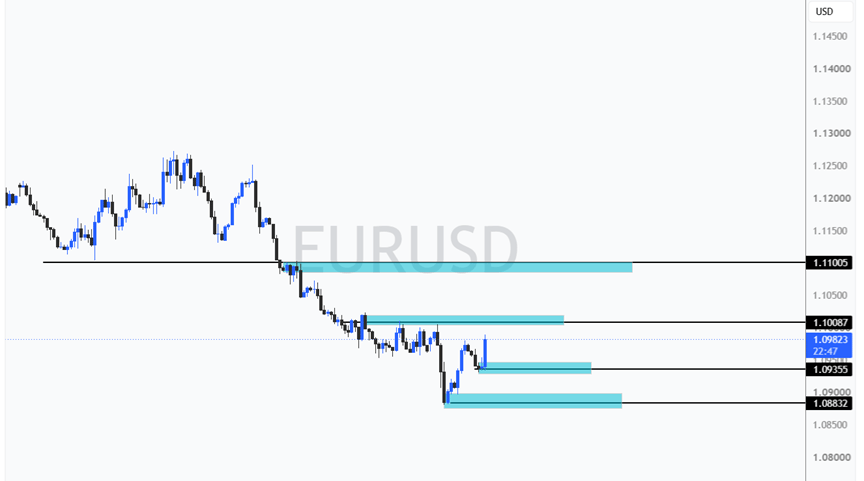
The EURUSD still remains under significant pressure from a broader perspective with the price action showing Lower Highs and Lower Lows. However, the latest price action suggests buyers could be making an attempt to recover some lost grounds after making a rebound around 1.0800
Bearish Scenario:
The overall market trend is bearish with a Resistance area around 1.1000 where sellers could regain control. Failure to see the price reverse around this areas could give the room for the price to rally towards 1.1100 which happens to be a turncoat resistance.
Potential Downside Targets:
- 1.0930-1.0940- Immediate support.
- 1.0880- 1.0890- Swing low and liquidity area.
- 1.0850- Possible extension should the swing low give way.
- A convincing break below 1.0880 will sustain further price pressure towards fresh lows.
Bullish Scenario:
The short-term bullish recovery will attempt to test resistance areas. Traders could wait to see if the price can convincingly break above the near-term resistance around 1.1000 for a possible break and retest scenario for a continuation towards 1.1100. Failure to overcome the resistance around 1.1000 could see the price fall towards support areas at 1.0935 and 1.0883.
Potential Upside Targets:
- 1.1000- Psychological Resistance.
- 1.1050- First meaningful upside objective.
- 1.1090-1.1100- Larger Resistance area.
A sustained move above 1.1050 would make the recovery more convincing.
Author
Erastus Adegbotolu
TradingPRO
Forex market analyst and educator with a strong focus on technical analysis and trader psychology.

















