While stock market celebrates Dem sweep, the AI trade deteriorates
- AI stocks fail to join the party on Wednesday.
- NASDAQ, Dow Jones and S&P 500 rally on Democratic sweep.
- Wall Street sentiment says that Democrats will place greater pressure on the AI data center buildout.


The US stock market is giddy on Wednesday as the Democratic Party's resounding success at the ballot box has translated into big stock index gains. A widespread belief that the heavy Democratic win, which is still being tabulated in many races, will usher in an end to President Donald Trump's tariffs and volatile trade policy has led the Dow Jones Industrial Average (DJIA) to surge 2.8%. The NASDAQ Composite and S&P 500 are also about 1.6% ahead just before lunchtime in New York.
The indexes are being helped by a sell-off in US Treasury yields as markets believe that divided Congress will engender lower deficits and spending.
While solar and healthcare stocks lead the charge on hopes that the new Congress will reinstitute industry subsidies, there is one noticeable loser on Wednesday: the AI trade.
AI stocks get no love from Democratic midterm win
The Defiance AI & Power Infrastructure ETF (AIPO) has sunk 7%, and the Roundhill Generative AI & Technology ETF (CHAT) has given up 2%. While there is little explicit mention of AI data center legislation from incoming Democrats, many of Tuesday's winners campaigned on bringing scrutiny to the industry.
More specifically, Democrats flipped at least five governors' races at the state level. Many of these states are important to the ongoing AI data center buildout that the industry is spending trillions of dollars on. These include Ohio, Georgia, Nevada and Texas. In the latter race, Democratic winner James Talarico called out SpaceX (SPCX) and Tesla (TSLA) CEO Elon Musk by name for spending hundreds of millions of dollars against him. And on Talarico's coattails, Democrat Gina Hinojosa surprised pollsters by beating current three-term governor Greg Abbott to take over the Texas governor's mansion.
If it's not just campaign rhetoric, then the Democratic win could mean new hurdles and less government help in establishing new data centers, which often incur severe backlash from local communities.
"Given much of US growth currently relies on the AI boom, stricter policy could start forming a headwind," ING strategists wrote in a client note following the midterm result.
"At the very least, data center builders are likely to have to offer more incentives to local communities," UBS analyst Paul Donovan said in a client note.
One specific policy that multiple Democratic candidates have mentioned is explicitly stating that the US federal government will not backstop major AI lenders if the industry runs into financial trouble. In other words, there won't be a bailout similar to the one that saved Wall Street after the Great Financial Crisis.
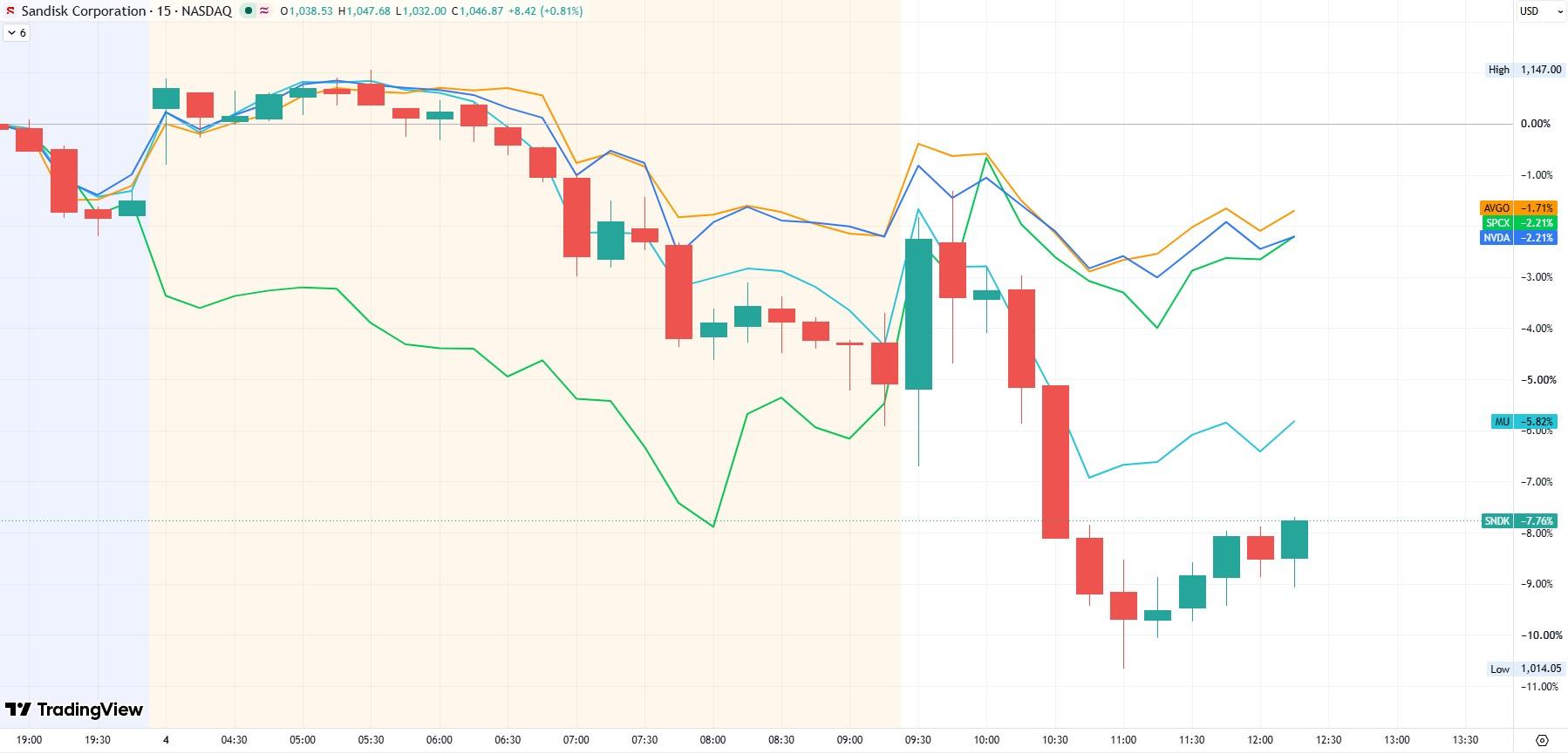
Nvidia (NVDA) and Broadcom (AVGO), two of the biggest semiconductor firms focused on AI, both dropped narrowly, but volatile memory chipmakers Micron (MU) and Sandisk (MU) fell 5% and 8%, respectively. While Nvidia and Broadcom both have other business focuses besides AI, the memory chipmakers trade narrowly on the outlook for AI.
Author
Clay Webster
FXStreet
Clay Webster grew up in the US outside Buffalo, New York and Lancaster, Pennsylvania. He began investing after college following the 2008 financial crisis.