USD/JPY Price Forecast: Rising 20-day EMA backs bullish bias
- USD/JPY rises to near 163.60 as the US Dollar rebounds.
- The Fed left interest rates unchanged and expressed a commitment to bring inflation down.
- The BoJ is highly anticipated to maintain the status quo on Friday.

The USD/JPY pair trades 0.1% higher at around 163.60 during the European trading session on Thursday. The pair rises as the US Dollar (USD) regains ground due to intensifying military aggression between the United States (US) and Iran.
At press time, the US Dollar Index (DXY), which tracks the Greenback’s value against six major currencies, trades 0.2% higher to near 101.00.
US Dollar Price Today
The table below shows the percentage change of US Dollar (USD) against listed major currencies today. US Dollar was the strongest against the Swiss Franc.
| USD | EUR | GBP | JPY | CAD | AUD | NZD | CHF | |
|---|---|---|---|---|---|---|---|---|
| USD | 0.17% | 0.21% | 0.10% | 0.04% | 0.04% | -0.19% | 0.24% | |
| EUR | -0.17% | 0.03% | -0.07% | -0.14% | -0.15% | -0.38% | 0.07% | |
| GBP | -0.21% | -0.03% | -0.09% | -0.17% | -0.17% | -0.40% | 0.06% | |
| JPY | -0.10% | 0.07% | 0.09% | -0.07% | -0.06% | -0.31% | 0.17% | |
| CAD | -0.04% | 0.14% | 0.17% | 0.07% | 0.00% | -0.23% | 0.23% | |
| AUD | -0.04% | 0.15% | 0.17% | 0.06% | -0.00% | -0.22% | 0.23% | |
| NZD | 0.19% | 0.38% | 0.40% | 0.31% | 0.23% | 0.22% | 0.49% | |
| CHF | -0.24% | -0.07% | -0.06% | -0.17% | -0.23% | -0.23% | -0.49% |
The heat map shows percentage changes of major currencies against each other. The base currency is picked from the left column, while the quote currency is picked from the top row. For example, if you pick the US Dollar from the left column and move along the horizontal line to the Japanese Yen, the percentage change displayed in the box will represent USD (base)/JPY (quote).
On Wednesday, the US Dollar fell vertically after the Federal Reserve’s (Fed) monetary policy announcement, in which it left interest rates unchanged in the range of 3.50%-3.75% and warned of upside inflation risks. Three of 12 rate-setting members dissented from the vote and voted for a 25-basis point (bps) interest rate hike.
Fed Chair Kevin Warsh said in the press conference that policymakers are committed to bringing inflation down and won’t hesitate to act when necessary. However, market experts doubt the Fed’s commitment.
Commerzbank’s Michael Pfister highlights that Chairman Kevin Warsh “made it clear that there is no soft inflation target and that the focus is firmly on delivering two percent,” reinforcing the Fed’s commitment to its goal. Yet Pfister notes that Warsh “sidestepped every question about how he intends to achieve this,” offering little guidance on the policy path. Commerzbank argues that, given this approach to communication, “it should come as no surprise that the US Dollar took a hit.”
On the Japanese Yen (JPY) front, investors await the Bank of Japan's (BoJ) monetary policy meeting, which is scheduled for Friday, after the release of Tokyo Consumer Price Index (CPI) data for July the same day.
Analysts at Commerzbank expect the BoJ to "leave its overnight call rate unchanged" at Friday’s monetary policy meeting, noting that "the market is pricing this in at 99.3%, and all analysts surveyed by Bloomberg agree." As a result, "that won’t be the deciding factor." Instead, the focus is on the policy message. Commerzbank argues that "a slightly hawkish tone – one that seriously brings October into play – could therefore be enough to surprise the market and support the Japanese yen." By contrast, "if, on the other hand, the same boilerplate language as usual is used, the yen is likely to hit new lows against the US dollar."
USD/JPY technical analysis
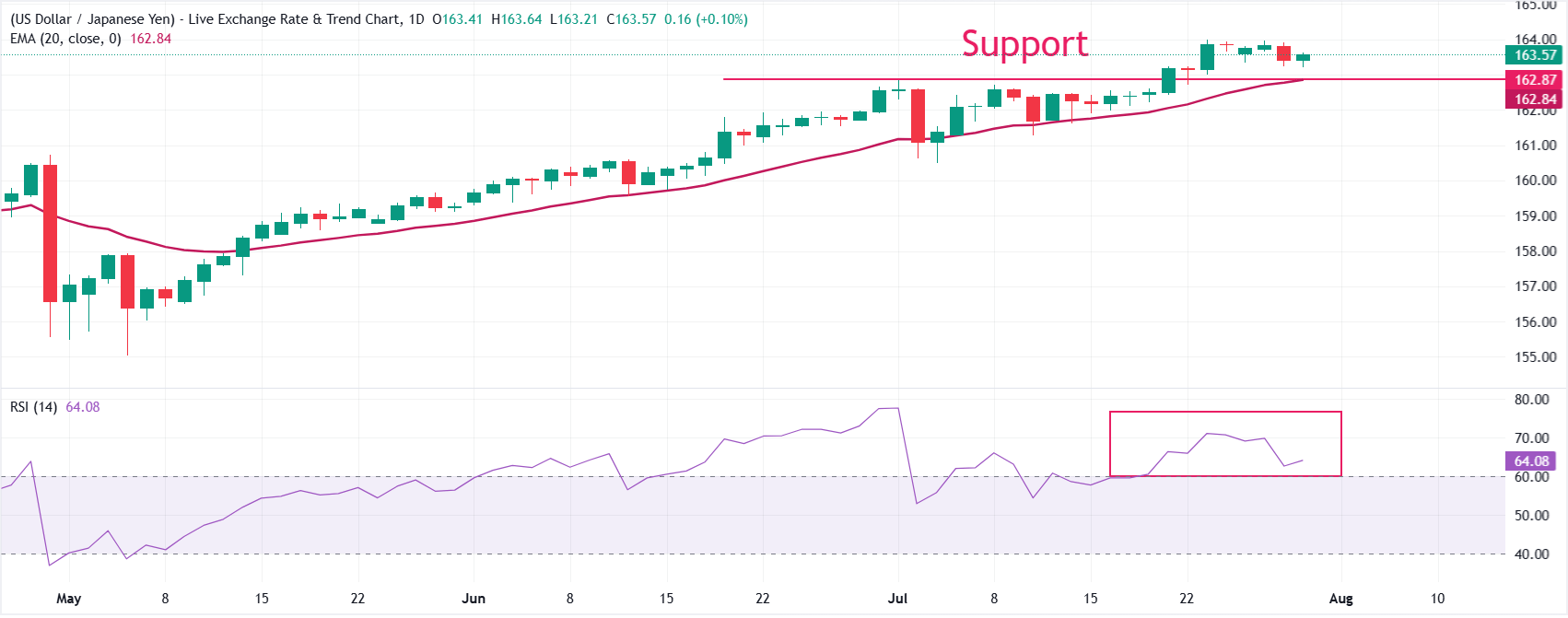
USD/JPY trades higher at around 163.56, maintaining a bullish near-term bias as spot holds above the 20-day exponential moving average (EMA) at 162.84. The pair continues to advance in a well-supported uptrend, with the EMA reinforcing underlying demand just beneath current levels.
The Relative Strength Index (RSI) at 64.06 sits in positive territory but shy of overbought, hinting that upward momentum remains constructive without yet showing signs of exhaustion.
Analysts at Societe Generale note that USD/JPY continues to trade within a contained range, with nearby technical markers clearly defined. They highlight "support 162.20, resistance 164.40" as the key levels currently framing price action.
As the whole atmosphere delivers positive vibes, the pair could extend its advance towards 165.00 if it manages a decisive break above the 164.40 hurdle.
(The technical analysis of this story was written with the help of an AI tool. Know more.)
Economic Indicator
BoJ Interest Rate Decision
The Bank of Japan (BoJ) announces its interest rate decision after each of the Bank’s eight scheduled annual meetings. Generally, if the BoJ is hawkish about the inflationary outlook of the economy and raises interest rates it is bullish for the Japanese Yen (JPY). Likewise, if the BoJ has a dovish view on the Japanese economy and keeps interest rates unchanged, or cuts them, it is usually bearish for JPY.
Read more.Next release: Fri Jul 31, 2026 03:00
Frequency: Irregular
Consensus: 1%
Previous: 1%
Source: Bank of Japan
Author

Sagar Dua
FXStreet
Sagar Dua is associated with the financial markets from his college days. Along with pursuing post-graduation in Commerce in 2014, he started his markets training with chart analysis.















