USD/INR remains subdued as speculation increases regarding a potential Fed rate cut
- The Indian Rupee gains ground in Monday’s early European session.
- Fed rate cut hopes and lower crude oil prices support the INR.
- The renewed US Dollar (USD) demand might limit Indian Rupee’s gains.
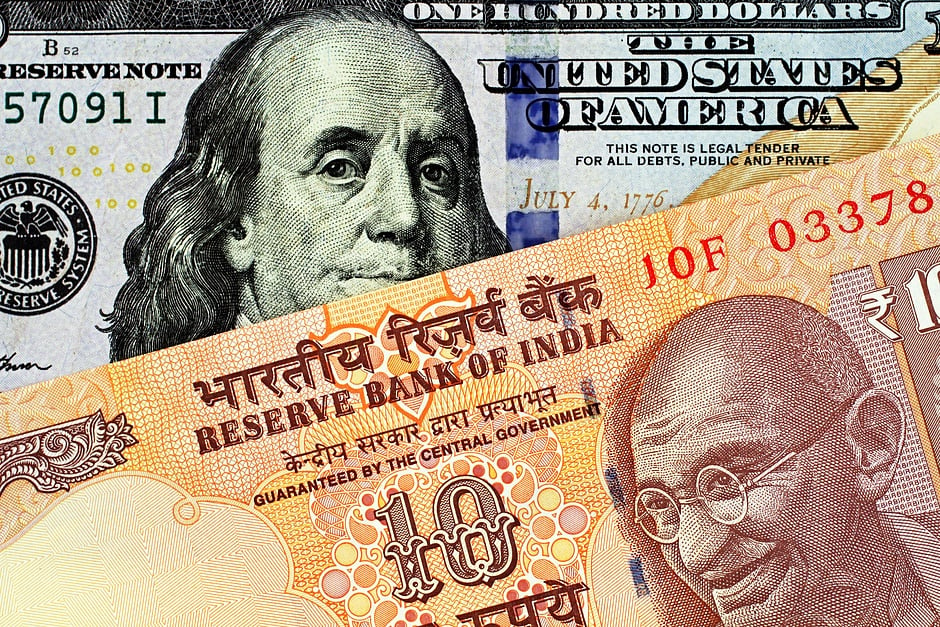

The Indian Rupee (INR) strengthens on Monday. The expectation that the US Federal Reserve (Fed) might cut the interest rate in September has lifted the INR. Lower US interest rates could boost capital flows into higher-yielding emerging market assets, benefiting the Indian Rupee. Additionally, the decline of crude oil prices from a four-week high supports the local currency and helps to alleviate the INR’s depreciation, as India is the world's third-biggest oil importer and consumer.
Nonetheless, the renewed US Dollar (USD) demand amid the cautious mood might undermine the INR. Looking ahead, investors await the Fed's Chair, Jerome Powell, who will testify on Tuesday. The attention will shift to the US Consumer Price Index (CPI) inflation data for June, which is due on Thursday.
Daily Digest Market Movers: Indian Rupee remains strong amid positive Indian economic outlook
- "Asian FX took a breather on the back of broad US Dollar weakness ... the risk for Asian currencies, though, remains skewed to the downside, with the Fed staying patient," said Lloyd Chan, senior currency analyst at MUFG Bank.
- Indian benchmark indices opened lower on Monday, with BSE Sensex slipping 161 points to 79,8835 points, while the Nifty50 index fell slightly by 0.06% to 24,310.
- Foreign Portfolio Investors (FPI) continued to show strong buying interest in Indian equities with net inflows of about $1 billion in the first week of July 2024, data with depositories showed.
- US Nonfarm Payrolls (NFP) came in stronger than expected, adding 206K net new jobs in June, according to the US Bureau of Labor Statistics (BLS) on Friday. The previous month saw a sharp downside revision to 218K from the initial reading of 272K.
- The US Average Hourly Earnings declined to 3.9% YoY in June, compared to the previous reading of 4.1%. The Unemployment Rate rose to 4.1% for the first time since December 2021.
- Financial markets are now pricing in a nearly 77% chance of a rate cut from the Fed in September, up from 70% before the US employment report, according to the CME FedWatch tool.
Technical analysis: USD/INR continues oscillating within a range
The Indian Rupee trades on a stronger note on the day. The uptrend of the USD/INR pair prevails in the long term as it is above the key 100-day Exponential Moving Average (EMA) on the daily timeframe.
In the near term, the pair has been capped within the familiar trading range for a couple of months already since March 21. The further consolidation looks favourable as the 14-day Relative Strength Index (RSI) hovers around the 50-midline, indicating neutral momentum.
The first bullish target to watch for USD/INR is 83.60, a high of July 4. Further north, the next hurdle is seen at the record time of 83.75. A decisive break above this level will see a rally to the 84.00 psychological level.
On the flip side, the potential support level is located at 83.35, the 100-day EMA. A breach of this level will expose the 83.00 round mark, followed by 82.82, a low of January 12.
US Dollar PRICE Today
The table below shows the percentage change of US Dollar (USD) against listed major currencies today. US Dollar was the weakest against the Canadian Dollar.
| USD | EUR | GBP | JPY | CAD | AUD | NZD | INR | |
|---|---|---|---|---|---|---|---|---|
| USD | 0.00% | -0.04% | 0.23% | -0.07% | 0.20% | 0.05% | -0.01% | |
| EUR | -0.01% | 0.16% | 0.56% | 0.24% | 0.35% | 0.37% | 0.08% | |
| GBP | 0.04% | -0.16% | 0.35% | 0.10% | 0.19% | 0.21% | 0.05% | |
| JPY | -0.23% | -0.56% | -0.35% | -0.29% | -0.00% | -0.02% | -0.49% | |
| CAD | 0.07% | -0.24% | -0.10% | 0.29% | 0.23% | 0.11% | -0.17% | |
| AUD | -0.20% | -0.35% | -0.19% | 0.00% | -0.23% | 0.02% | -0.28% | |
| NZD | -0.05% | -0.37% | -0.21% | 0.02% | -0.11% | -0.02% | -0.19% | |
| INR | 0.00% | -0.08% | -0.05% | 0.49% | 0.17% | 0.28% | 0.19% |
The heat map shows percentage changes of major currencies against each other. The base currency is picked from the left column, while the quote currency is picked from the top row. For example, if you pick the US Dollar from the left column and move along the horizontal line to the Japanese Yen, the percentage change displayed in the box will represent USD (base)/JPY (quote).
Indian economy FAQs
The Indian economy has averaged a growth rate of 6.13% between 2006 and 2023, which makes it one of the fastest growing in the world. India’s high growth has attracted a lot of foreign investment. This includes Foreign Direct Investment (FDI) into physical projects and Foreign Indirect Investment (FII) by foreign funds into Indian financial markets. The greater the level of investment, the higher the demand for the Rupee (INR). Fluctuations in Dollar-demand from Indian importers also impact INR.
India has to import a great deal of its Oil and gasoline so the price of Oil can have a direct impact on the Rupee. Oil is mostly traded in US Dollars (USD) on international markets so if the price of Oil rises, aggregate demand for USD increases and Indian importers have to sell more Rupees to meet that demand, which is depreciative for the Rupee.
Inflation has a complex effect on the Rupee. Ultimately it indicates an increase in money supply which reduces the Rupee’s overall value. Yet if it rises above the Reserve Bank of India’s (RBI) 4% target, the RBI will raise interest rates to bring it down by reducing credit. Higher interest rates, especially real rates (the difference between interest rates and inflation) strengthen the Rupee. They make India a more profitable place for international investors to park their money. A fall in inflation can be supportive of the Rupee. At the same time lower interest rates can have a depreciatory effect on the Rupee.
India has run a trade deficit for most of its recent history, indicating its imports outweigh its exports. Since the majority of international trade takes place in US Dollars, there are times – due to seasonal demand or order glut – where the high volume of imports leads to significant US Dollar- demand. During these periods the Rupee can weaken as it is heavily sold to meet the demand for Dollars. When markets experience increased volatility, the demand for US Dollars can also shoot up with a similarly negative effect on the Rupee.
Author
Lallalit Srijandorn
FXStreet
Lallalit Srijandorn is a Parisian at heart. She has lived in France since 2019 and now becomes a digital entrepreneur based in Paris and Bangkok.