Indian Rupee tumbles after RBI's policy, 20 bps away from all-time low
- The Indian Rupee declines significantly against the US Dollar, following the RBI’s monetary policy decision.
- The RBI has raised its key Repo Rate by 25 bps to 5.5%.
- India’s central bank shifts policy stance to 'calibrated tightening' from 'neutral'.

The Indian Rupee ((INR) weakens significantly against the US Dollar (USD), following the Reserve Bank of India’s (RBI) monetary policy meeting on Wednesday. The USD/INR pair jumps to near 96.80, the highest level seen in four months.
What happened at the RBI policy meeting?
In the policy meeting, the RBI decide to hike its Repo Rate by 25 basis points (bps) to 5.5%, the first hike since February 2023.
RBI Governor Sanjay Malhotra said in the monetary policy statement that the Monetray Policy Committee (MPC) decided to change policy stance to 'calibrated tightening' from 'neutral', siganling that the period of easy liquidity is over. On the inflation front, the Indian central bank has raised FY 27 retail Consumer Price Index (CPI) projections to 5.2% Year-on-Year (YoY) from 5% previously forecasted.
Regarding the global economic outlook, Malhotra said that “higher US Dollar, Middle East tensions, and trade uncertainty to keep global sentiment under pressure”. On the domestic front, Malhotra said, "NBFC growth rate has been quite robust, about 27% credit growth by banks to NBFCs and NBFC credit growth itself is also quite robust."
The RBI was already anticipated to hike interest rates even as inflationary pressures have remained well inside the central bank’s tolerance band of 2%-6%.
Strategists at Brown Brothers Harriman (BBH) said before the policy announcement that the “RBI to hike to defend INR and respond to stronger growth, with Q2 real GDP of 7.8% y/y beating the bank’s 6.4% forecast.”
Upbeat US Dollar also supports USD/INR pair
The US Dollar regains ground after a corrective move the previous day. As of writing, the US Dollar Index (DXY), which gauges the Greenback’s value against six major currencies, trades almost 0.5% higher at around 102.34.
Going forward, investors will focus on the Federal Open Market Committee (FOMC) minutes of the September policy meeting, which will be published at 18:00 GMT. In the policy meeting, the Fed hiked interest rates by 25 basis points (bps) and signaled at least one more this year.
The impact of FOMC minutes is expected to be limited on Fed interest rate expectations for the October meeting, as officials have already signlaed no urgency for another interest rate hike. However, they have ruled out the possibility of an additional hike in the remaining year.
According to the CME FedWatch tool, there is an almost 86% chance that the Fed will deliver at least one more interest rate hike by the year-end.
USD/INR Technical Analysis
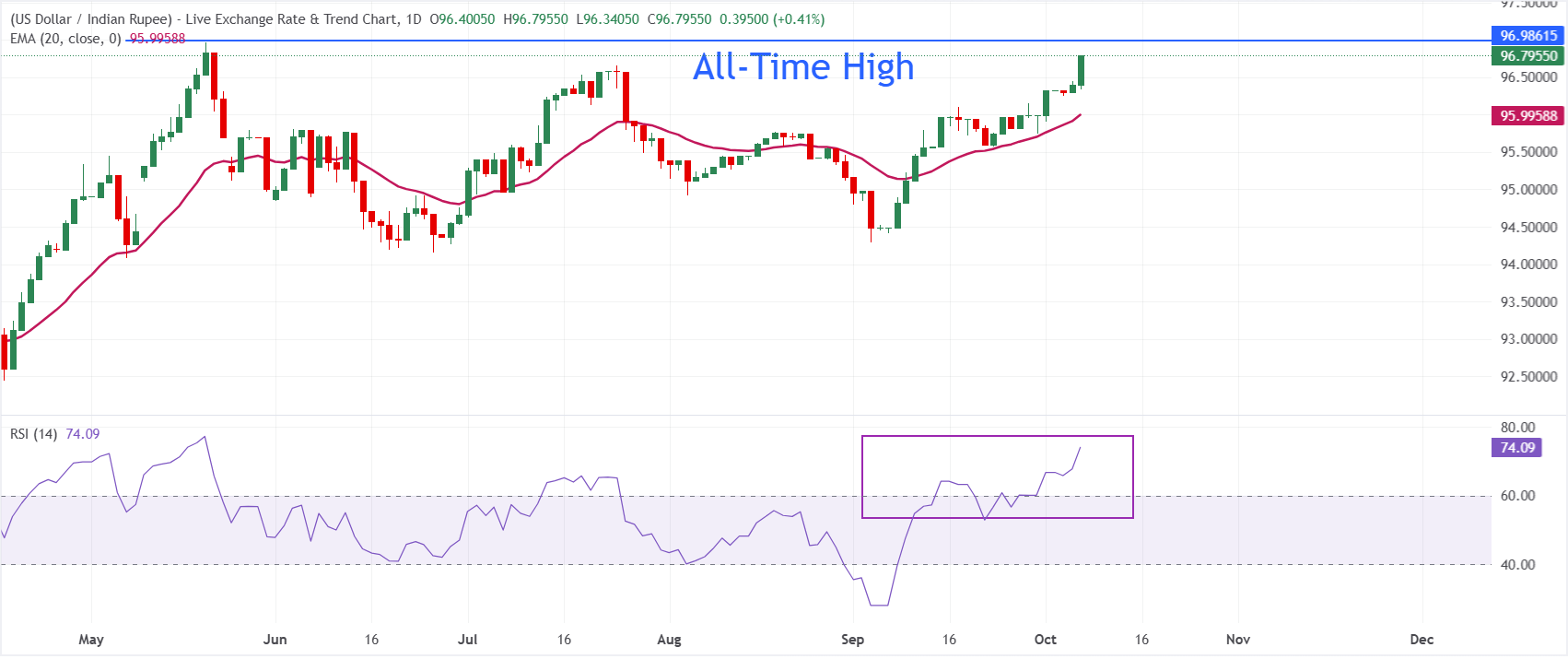
In the daily chart, USD/INR trades at 96.80. The pair holds a bullish near-term bias as price advances above the 20-period exponential moving average (EMA) at 96.00, suggesting a firm underlying demand zone just below the market. Momentum is stretched, with the 14-period Relative Strength Index (RSI) at 74.1, hinting at overbought conditions that could slow the pace of gains without yet signaling a clear reversal.
On the downside, immediate support is seen at 96.30 area as a near-term pivot, followed by the 20-day EMA at 96.00, which reinforces the broader constructive structure as long as it holds. On the upside, the pair approaches the all-time high near 97.00.
(The technical analysis of this story was written with the help of an AI tool. Know more.)
Economic Indicator
RBI Interest Rate Decision (Repo Rate)
The RBI Interest Rate Decision is announced by the Reserve Bank of India. If the bank is hawkish about the inflationary outlook of the economy and rises the interest rates, it is seen as positive, or bullish, for the INR, while a dovish outlook for the economy (or a rate cut) is seen as negative, or bearish, for the currency.
Read more.Last release: Wed Oct 07, 2026 04:30
Frequency: Irregular
Actual: 5.5%
Consensus: 5.5%
Previous: 5.25%
Source: Reserve Bank of India
Author

Sagar Dua
FXStreet
Sagar Dua is associated with the financial markets from his college days. Along with pursuing post-graduation in Commerce in 2014, he started his markets training with chart analysis.