US Treasury yields scale multi-year highs as inflation fears return
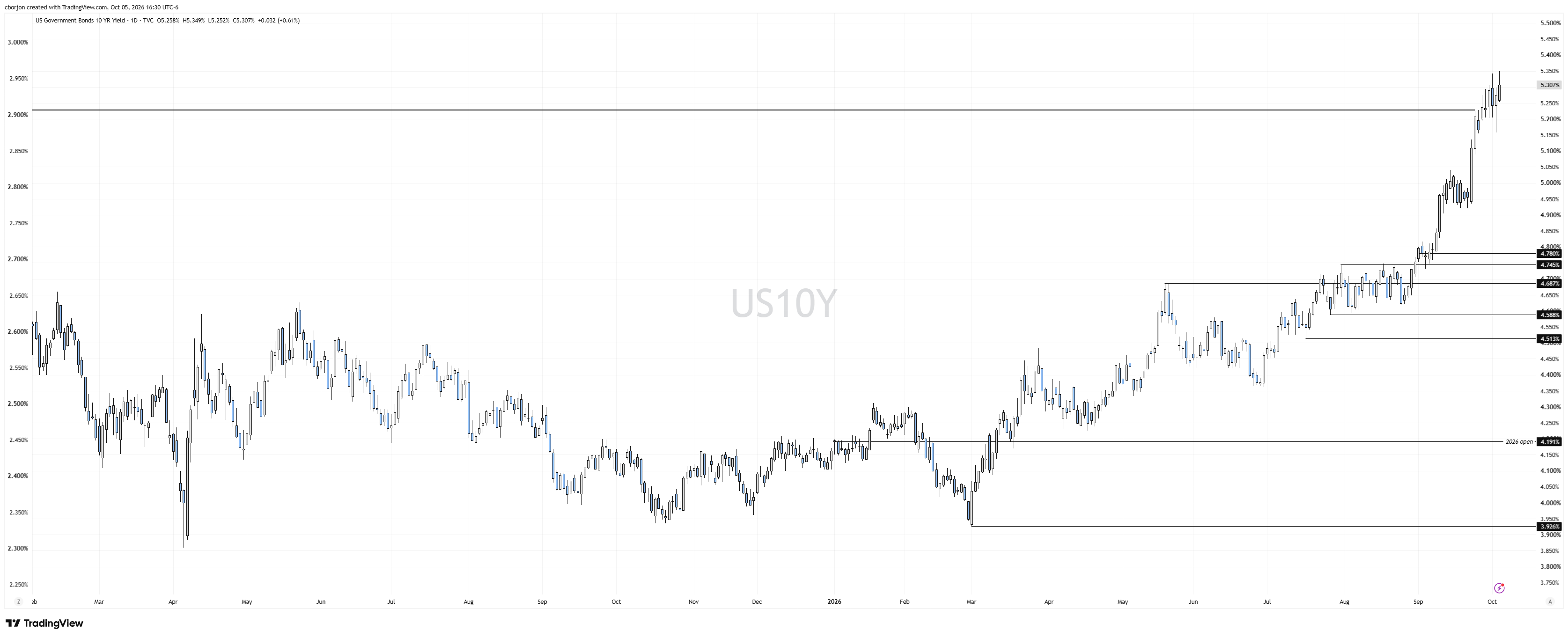
- US10-year yield climbs above 5.30% as bond selling intensifies.
- ISM prices paid jumps to 74.0 despite slower services growth.
- October Fed hold odds rise to 76% after weak payrolls.

US Treasury yields edged up at the beginning of the week, with the 30- and 10-year yields reaching multi-year highs as inflation expectations rose, as shown in a US Institute for Supply Management (ISM) survey indicating that business activity in the services sector slowed while input prices surged.
Rising input prices and France’s fiscal woes push global borrowing costs higher
The US 10-year Treasury note yield gains more than 3 basis points to 5.307%, amid growing fears that high energy prices may drive global bond yields higher.
The ISM Services PMI fell below estimates of 55, edging down from 55.4 to 54.9, while new orders and employment sub-components improved, but prices paid indicate that companies are reporting higher costs.
In addition, France’s fiscal crisis sent global bond yields higher amid investors' worries about next year’s budget.
Aside from this, in the commodity complex, West Texas Intermediate (WTI), the US Oil benchmark, fell more than 2% at $89.29 on Monday, due to the G7 agreeing to freeing over 100 million barrels of crude and diesel. This boosted supplies and eased pressure from the US as President Trump threatened to impose a ban on diesel exports.
Last Friday, US yields cooled following a weaker jobs report, which showed job creation of 29K, missing forecasts of 90K.
Ahead, traders eye the release of the ADP Employment Change 4-week average figures on Tuesday, followed by the unveiling of the FOMC monetary policy meeting minutes on Wednesday.
Chances of a Federal Reserve interest rate hike this month were diminished by recent cooler-than-expected inflation data. Money markets were last pricing in roughly a 76% probability that rates would remain unchanged at the Fed's October 27-28 meeting, according to Prime Terminal.
US 10-year daily chart
Interest rates FAQs
Interest rates are charged by financial institutions on loans to borrowers and are paid as interest to savers and depositors. They are influenced by base lending rates, which are set by central banks in response to changes in the economy. Central banks normally have a mandate to ensure price stability, which in most cases means targeting a core inflation rate of around 2%. If inflation falls below target the central bank may cut base lending rates, with a view to stimulating lending and boosting the economy. If inflation rises substantially above 2% it normally results in the central bank raising base lending rates in an attempt to lower inflation.
Higher interest rates generally help strengthen a country’s currency as they make it a more attractive place for global investors to park their money.
Higher interest rates overall weigh on the price of Gold because they increase the opportunity cost of holding Gold instead of investing in an interest-bearing asset or placing cash in the bank. If interest rates are high that usually pushes up the price of the US Dollar (USD), and since Gold is priced in Dollars, this has the effect of lowering the price of Gold.
The Fed funds rate is the overnight rate at which US banks lend to each other. It is the oft-quoted headline rate set by the Federal Reserve at its FOMC meetings. It is set as a range, for example 4.75%-5.00%, though the upper limit (in that case 5.00%) is the quoted figure. Market expectations for future Fed funds rate are tracked by the CME FedWatch tool, which shapes how many financial markets behave in anticipation of future Federal Reserve monetary policy decisions.
Author

Christian Borjon Valencia
FXStreet
Markets analyst, news editor, and trading instructor with over 14 years of experience across FX, commodities, US equity indices, and global macro markets.