US 10-year yield hits a 19-year high as Fed Governor Barr backs hikes
- US10Y tops 5.05%, its highest since 2007, after Fed Governor Barr's speech.
- Strong PMIs and a Crude Oil rebound lift the odds of an October hike.

Federal Reserve (Fed) Governor Michael Barr made on Wednesday the case for more rate increases, saying the risks to getting inflation back to 2% have grown while the risks to jobs have eased. His remarks followed S&P Global's flash Purchasing Managers Index (PMI) surveys, the earliest monthly read on US business activity, which came in well above forecast. The surveys' measures of prices rose to the highest since October 2022. Brent Crude Oil rose back above $100 a barrel after five straight daily falls, as Iranian President Pezeshkian used his United Nations (UN) speech to rule out negotiating under pressure.
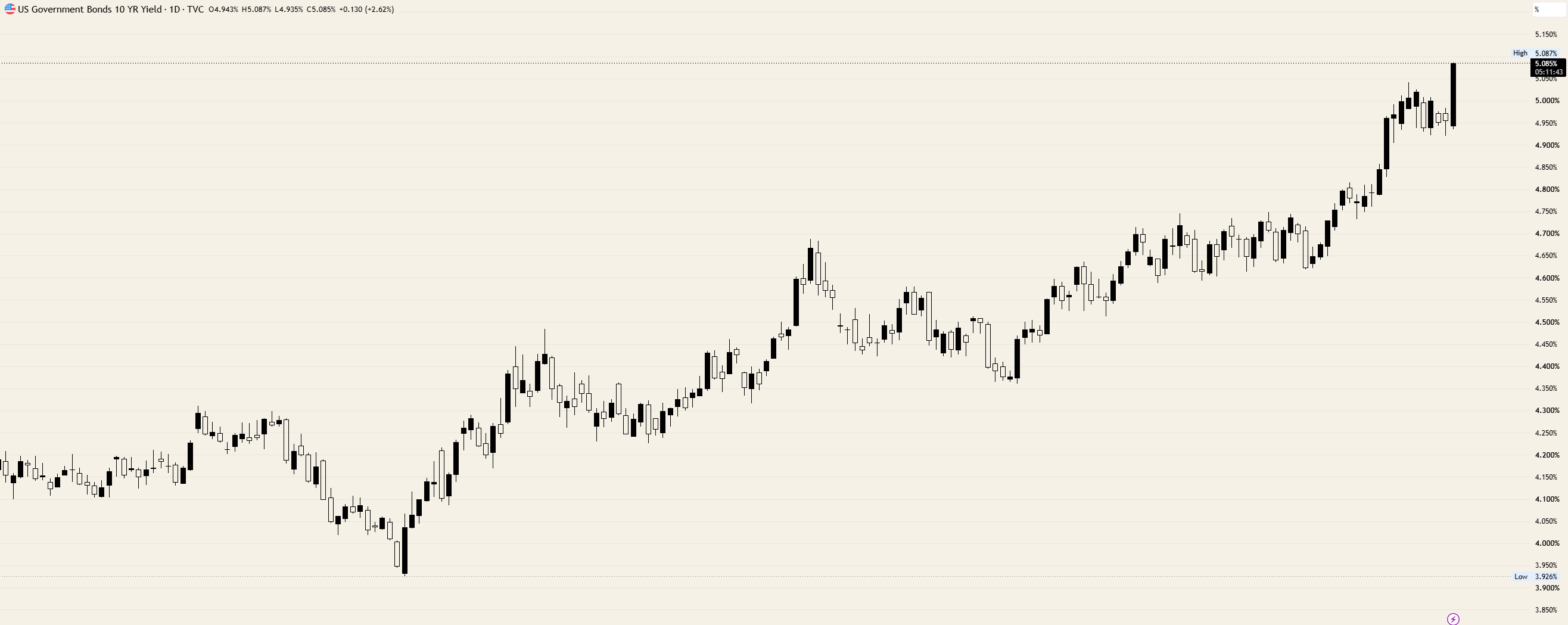
Rate futures, the contracts traders use to bet on the Fed's next move, now give an increase on October 28 about a 73% chance. When the Fed actually raised rates on September 16, the 10-year fell back under 5% the next day, so a speech and a survey have now done more to it than the increase did.
The 10-year yield is trading just under 5.10%, at the top of its range for the session and above its mid-September highs just over 5%. Its daily closes had stayed just under 5% for four sessions after the Fed's increase. The run started from just above 4.60% in late August, and the two-year and 30-year yields are higher alongside it.
US 10-Year yield, daily chart
Interest rates FAQs
Interest rates are charged by financial institutions on loans to borrowers and are paid as interest to savers and depositors. They are influenced by base lending rates, which are set by central banks in response to changes in the economy. Central banks normally have a mandate to ensure price stability, which in most cases means targeting a core inflation rate of around 2%. If inflation falls below target the central bank may cut base lending rates, with a view to stimulating lending and boosting the economy. If inflation rises substantially above 2% it normally results in the central bank raising base lending rates in an attempt to lower inflation.
Higher interest rates generally help strengthen a country’s currency as they make it a more attractive place for global investors to park their money.
Higher interest rates overall weigh on the price of Gold because they increase the opportunity cost of holding Gold instead of investing in an interest-bearing asset or placing cash in the bank. If interest rates are high that usually pushes up the price of the US Dollar (USD), and since Gold is priced in Dollars, this has the effect of lowering the price of Gold.
The Fed funds rate is the overnight rate at which US banks lend to each other. It is the oft-quoted headline rate set by the Federal Reserve at its FOMC meetings. It is set as a range, for example 4.75%-5.00%, though the upper limit (in that case 5.00%) is the quoted figure. Market expectations for future Fed funds rate are tracked by the CME FedWatch tool, which shapes how many financial markets behave in anticipation of future Federal Reserve monetary policy decisions.
Author

Joshua Gibson
FXStreet
Joshua joins the FXStreet team as an Economics and Finance double major from Vancouver Island University with twelve years' experience as an independent trader focusing on technical analysis.