Silver Price Forecast: XAG/USD surges to near $43.75 as US Dollar remains in corrective phase
- Silver price soars to near $43.75 amid continued correction in the US Dollar.
- ING anticipated that the USD Index rally near 104.60 looks almost done.
- The Fed is certain to hike interest rates in its next gathering in December.

Silver price (XAG/USD) extends its two-day recovery on Friday, surging almost 5% to near $43.75 in the Asian trade. The white metal outperforms after a long underperformance as the US Dollar’s (USD) rally has come to a halt.
As of writing, the US Dollar Index (DXY), which gauges the Greenback’s value against six major currencies, trades 0.11% down to near 103.66. The DXY has corrected from its almost 20-month high of 104.57 posted earlier this week.
Technically, some correction in the US Dollar makes the Silver price an attractive risk-reward bet for investors.
ING highlighted this week that the DXY would struggle to extend the rally, and the fresh advance relies upon upcoming Federal Reserve (Fed) meeting in December and the Consumer Price Index (CPI) data for November.
Dollar rally tests key DXY resistance ahead of Fed and US inflation data
Analysts at ING highlight that the Dollar’s latest surge has carried the DXY index to a previously flagged target, noting that “in recent weeks, we floated a DXY target of 104.60, which has just about been hit.” They argue that, with “the prospect of a hot October core PCE print on Wednesday, and now perhaps a better-supported tech environment, it is certainly hard to fight dollar strength this week.” At the same time, ING cautions that “the dollar has come a long way in a short space of time,” suggesting that “some early month-end flows in thinning holiday markets might be responsible for Monday's outsized dollar gains.”
Looking ahead, ING stresses that “we still see 104.60 as an important resistance area for the DXY and would be surprised if gains can be sustained above it this week.” In their view, “a more sustainable pullback in the dollar, however, may have to wait until the Fed meeting on 9 December or the November CPI data on 10 December, where base effects could start to see year-on-year headline CPI fall sharply.”
Broadly, the outlook of the Silver still appears bearish as the Fed is almost certain to hike interest rates in the December meeting and deliver another in the January meeting.
Theoretically, higher Fed interest rates bode poorly for non-yielding assets, such as Silver.
Silver Technical Analysis
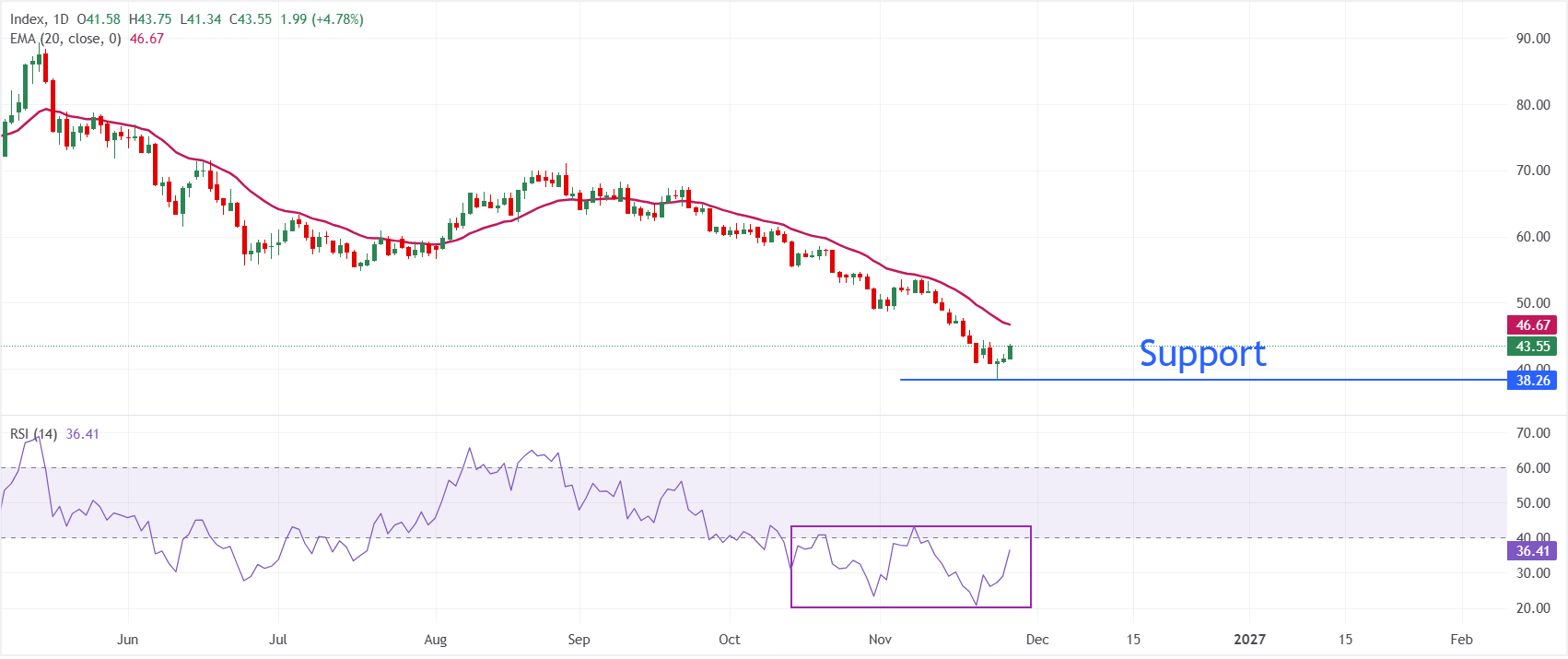
In the daily chart, XAG/USD trades at $43.55, retaining a bearish near-term tone as it remains below the 20-day exponential moving average (EMA) at $46.67. The location of price under this short-term trend gauge suggests rallies are still being capped by overhead supply, while the Relative Strength Index (RSI) near 36 has recovered from oversold territory but continues to hint at only modestly improving momentum rather than a full-fledged reversal.
On the topside, initial resistance is located at the 20-day EMA at $46.67, and a sustained break above this level would be needed to ease the current downside bias and open the way for a more constructive recovery phase. With no nearby technical supports defined in the provided dataset, the metal remains vulnerable to further slippage as long as it trades under the EMA, leaving sellers in control unless dip-buying interest emerges at lower, yet-to-be-established chart levels.
(The technical analysis of this story was written with the help of an AI tool. Know more.)
Silver FAQs
Silver is a precious metal highly traded among investors. It has been historically used as a store of value and a medium of exchange. Although less popular than Gold, traders may turn to Silver to diversify their investment portfolio, for its intrinsic value or as a potential hedge during high-inflation periods. Investors can buy physical Silver, in coins or in bars, or trade it through vehicles such as Exchange Traded Funds, which track its price on international markets.
Silver prices can move due to a wide range of factors. Geopolitical instability or fears of a deep recession can make Silver price escalate due to its safe-haven status, although to a lesser extent than Gold's. As a yieldless asset, Silver tends to rise with lower interest rates. Its moves also depend on how the US Dollar (USD) behaves as the asset is priced in dollars (XAG/USD). A strong Dollar tends to keep the price of Silver at bay, whereas a weaker Dollar is likely to propel prices up. Other factors such as investment demand, mining supply – Silver is much more abundant than Gold – and recycling rates can also affect prices.
Silver is widely used in industry, particularly in sectors such as electronics or solar energy, as it has one of the highest electric conductivity of all metals – more than Copper and Gold. A surge in demand can increase prices, while a decline tends to lower them. Dynamics in the US, Chinese and Indian economies can also contribute to price swings: for the US and particularly China, their big industrial sectors use Silver in various processes; in India, consumers’ demand for the precious metal for jewellery also plays a key role in setting prices.
Silver prices tend to follow Gold's moves. When Gold prices rise, Silver typically follows suit, as their status as safe-haven assets is similar. The Gold/Silver ratio, which shows the number of ounces of Silver needed to equal the value of one ounce of Gold, may help to determine the relative valuation between both metals. Some investors may consider a high ratio as an indicator that Silver is undervalued, or Gold is overvalued. On the contrary, a low ratio might suggest that Gold is undervalued relative to Silver.
Author
Sagar Dua
FXStreet
Sagar Dua is associated with the financial markets from his college days. Along with pursuing post-graduation in Commerce in 2014, he started his markets training with chart analysis.
















