Silver Price Forecast: XAG/USD finds support near 200-week SMA
- Silver attracts fresh buyers following a sharp sell-off earlier in the week.
- The metal remains below its 50-week and 100-week SMAs, keeping the bearish bias intact.
- The 200-week SMA near $39.88 offers immediate support.

Silver (XAG/USD) attracts fresh buyers on Friday after this week’s sell-off pushed the metal to $38.20 on Wednesday, its lowest level since August 2025. At the time of writing, Silver trades around $43.24, up 4.10% on the day and on track for its first weekly gain in three weeks.
A calmer mood in stock markets helps the white metal regain ground. Earlier in the week, the tech sell-off prompted some investors to sell precious metals to raise cash and cover losses elsewhere. As tech shares stabilise, that selling pressure appears to be easing.
The pickup in risk appetite also pushes US Treasury yields higher, lending support to the US Dollar (USD), which remains underpinned by a hawkish Federal Reserve (Fed) outlook. Traders are pricing in a rate hike in December and betting on further increases in early 2027.
The combination of higher interest rates and a stronger Dollar could limit Silver’s recovery, with technical indicators suggesting that sellers still have the upper hand.
Technical analysis
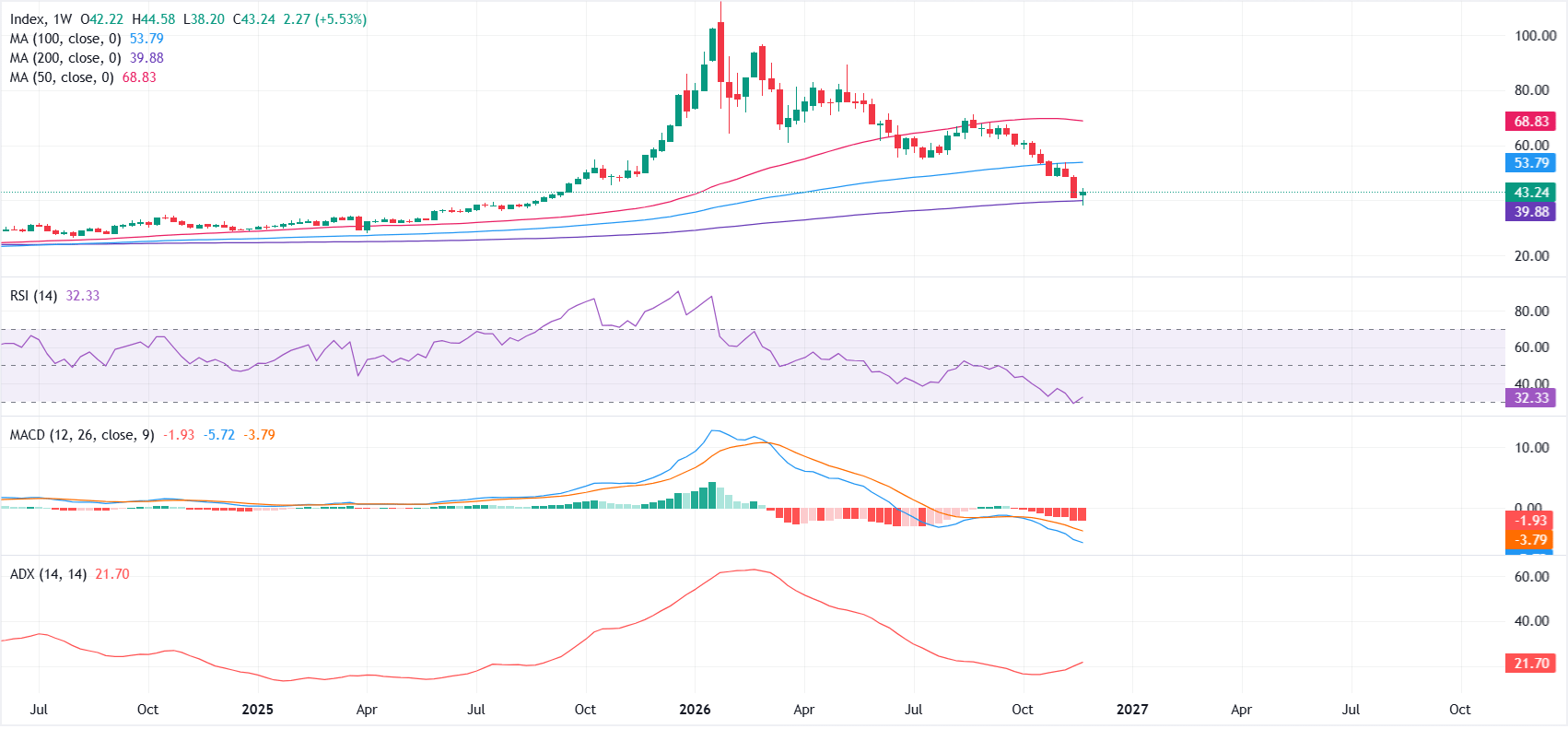
On the weekly chart, XAG/USD keeps a bearish near-term bias as it holds well below the 100-week Simple Moving Average (SMA) and the 50-week SMA. The pair, however, has recovered above the longer-term 200-week SMA at $39.88 after briefly dipping below it, suggesting the broader uptrend is still undergoing a corrective phase.
The Relative Strength Index (RSI) hovers near 32, on the weak side of neutral and close to oversold territory, while the Moving Average Convergence Divergence (MACD) remains below zero with a negative reading and subdued Average Directional Index (ADX), together suggesting soft downside momentum rather than an aggressive selloff.
On the topside, initial resistance emerges at the 100-week SMA near $53.79, with a more distant barrier at the 50-week SMA around $68.83, where any sustained recovery would likely stall unless momentum improves markedly.
On the downside, the first meaningful support sits at the 200-week SMA at $39.88, and a decisive break lower would expose the metal to deeper weakness, with the RSI’s proximity to oversold levels suggesting that further losses from there could become increasingly vulnerable to a corrective bounce.
(The technical analysis of this story was written with the help of an AI tool. Know more.)
Silver FAQs
Silver is a precious metal highly traded among investors. It has been historically used as a store of value and a medium of exchange. Although less popular than Gold, traders may turn to Silver to diversify their investment portfolio, for its intrinsic value or as a potential hedge during high-inflation periods. Investors can buy physical Silver, in coins or in bars, or trade it through vehicles such as Exchange Traded Funds, which track its price on international markets.
Silver prices can move due to a wide range of factors. Geopolitical instability or fears of a deep recession can make Silver price escalate due to its safe-haven status, although to a lesser extent than Gold's. As a yieldless asset, Silver tends to rise with lower interest rates. Its moves also depend on how the US Dollar (USD) behaves as the asset is priced in dollars (XAG/USD). A strong Dollar tends to keep the price of Silver at bay, whereas a weaker Dollar is likely to propel prices up. Other factors such as investment demand, mining supply – Silver is much more abundant than Gold – and recycling rates can also affect prices.
Silver is widely used in industry, particularly in sectors such as electronics or solar energy, as it has one of the highest electric conductivity of all metals – more than Copper and Gold. A surge in demand can increase prices, while a decline tends to lower them. Dynamics in the US, Chinese and Indian economies can also contribute to price swings: for the US and particularly China, their big industrial sectors use Silver in various processes; in India, consumers’ demand for the precious metal for jewellery also plays a key role in setting prices.
Silver prices tend to follow Gold's moves. When Gold prices rise, Silver typically follows suit, as their status as safe-haven assets is similar. The Gold/Silver ratio, which shows the number of ounces of Silver needed to equal the value of one ounce of Gold, may help to determine the relative valuation between both metals. Some investors may consider a high ratio as an indicator that Silver is undervalued, or Gold is overvalued. On the contrary, a low ratio might suggest that Gold is undervalued relative to Silver.
Author
Vishal Chaturvedi
FXStreet
I am a macro-focused research analyst with over four years of experience covering forex and commodities market. I enjoy breaking down complex economic trends and turning them into clear, actionable insights that help traders stay ahead of the curve.