Silver Price Forecast: Bullish harami faces $43.95 breakout test
- XAG/USD surges over 5% after last week's steep selloff.
- Potential bullish harami requires confirmation above $43.95 to strengthen the recovery.
- A break above $44.25 exposes $45.00, while $41.13 remains critical support.

Silver (XAG/USD) begins the week on a positive note after crashing over 16% last week, surging more than 5% on Monday as the white metal trades at $43.18 at the time of writing.
XAG/USD Price Forecast: Technical outlook
The precious metals segment is finding a tailwind from falling US yields and Nvidia news. Worth noting that Silver is rallying despite overall US Dollar strength.
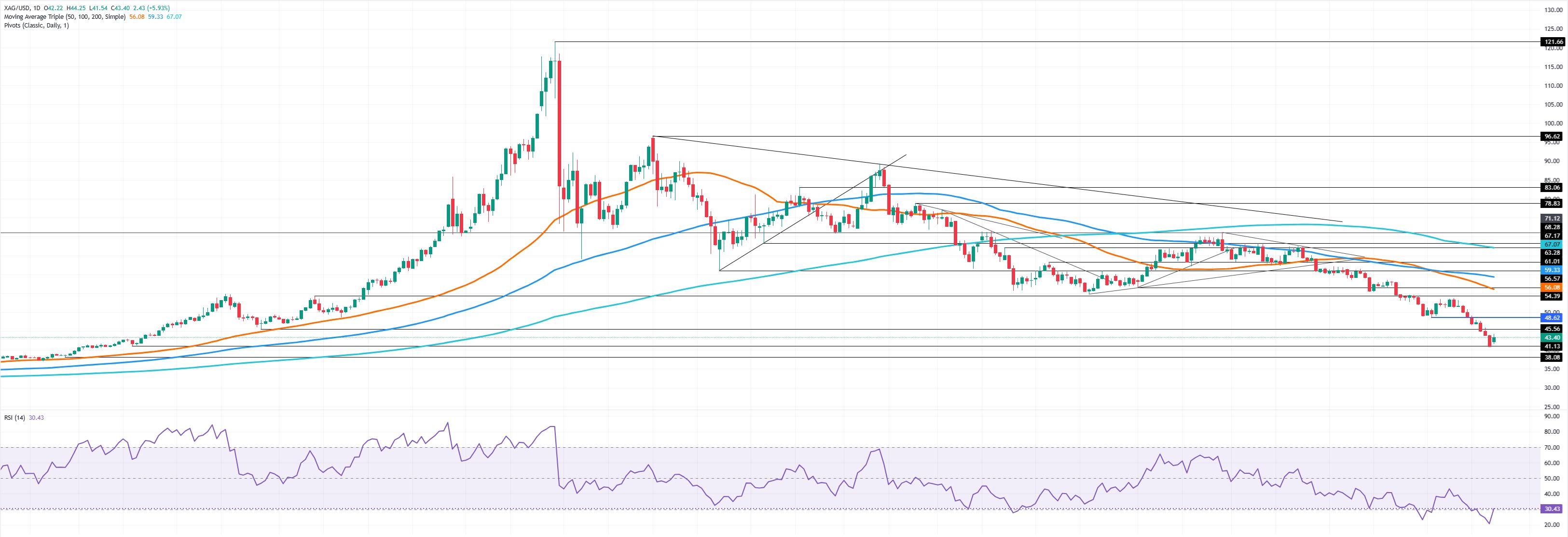
With that said, XAG/USD is forming a ‘bullish harami’ candle pattern, which would be confirmed once the white metal ends the session above last Friday’s high of $43.95. In that outcome, Silver’s next resistance would be the November 3 swing low, now turned resistance, at $44.25. Above is the $45.00 mark, followed by the $50.00 milestone.
On the downside, Silver’s downtrend will resume once the white metal surpasses the September 17, 2025, swing low of $41.13, ahead of the $40.00 mark. Beneath this key level is the August 27, 2025, daily low of $38.08.
XAG/USD Price Chart – Daily
(This story was corrected on November 23 at 20:25 GMT to say that Silver is rallying despite overall US Dollar strength, not weakness.)
Silver FAQs
Silver is a precious metal highly traded among investors. It has been historically used as a store of value and a medium of exchange. Although less popular than Gold, traders may turn to Silver to diversify their investment portfolio, for its intrinsic value or as a potential hedge during high-inflation periods. Investors can buy physical Silver, in coins or in bars, or trade it through vehicles such as Exchange Traded Funds, which track its price on international markets.
Silver prices can move due to a wide range of factors. Geopolitical instability or fears of a deep recession can make Silver price escalate due to its safe-haven status, although to a lesser extent than Gold's. As a yieldless asset, Silver tends to rise with lower interest rates. Its moves also depend on how the US Dollar (USD) behaves as the asset is priced in dollars (XAG/USD). A strong Dollar tends to keep the price of Silver at bay, whereas a weaker Dollar is likely to propel prices up. Other factors such as investment demand, mining supply – Silver is much more abundant than Gold – and recycling rates can also affect prices.
Silver is widely used in industry, particularly in sectors such as electronics or solar energy, as it has one of the highest electric conductivity of all metals – more than Copper and Gold. A surge in demand can increase prices, while a decline tends to lower them. Dynamics in the US, Chinese and Indian economies can also contribute to price swings: for the US and particularly China, their big industrial sectors use Silver in various processes; in India, consumers’ demand for the precious metal for jewellery also plays a key role in setting prices.
Silver prices tend to follow Gold's moves. When Gold prices rise, Silver typically follows suit, as their status as safe-haven assets is similar. The Gold/Silver ratio, which shows the number of ounces of Silver needed to equal the value of one ounce of Gold, may help to determine the relative valuation between both metals. Some investors may consider a high ratio as an indicator that Silver is undervalued, or Gold is overvalued. On the contrary, a low ratio might suggest that Gold is undervalued relative to Silver.
Author
Christian Borjon Valencia
FXStreet
Markets analyst, news editor, and trading instructor with over 14 years of experience across FX, commodities, US equity indices, and global macro markets.