Indian Rupee egdes up as hawkish Fed bets recede
- The Indian Rupee edges up against the US Dollar as traders reassess hawkish Fed bets.
- The US Dollar and US Treasury Yields remain firm despite hawkish Fed prospects cool down.
- Investors keenly await the RBI’s monetary policy.

The Indian Rupee (INR) opens marginally higher against the US Dollar (USD) after an extended weekend. Indian markets were closed on Friday due to Mahatma Gandhi Jayanti. The USD/INR pair ticks down to near 96.29 as traders have trimmed Federal Reserve (Fed) interest rate expectations for the policy meeting this month, a scenario that improves the appeal of riskier assets, such as the Indian Rupee. Still, the pair is close to its over two-month high of 96.32 posted last week.
According to the CME FedWatch tool, the odds of the Fed leaving interest rates unchanged in the October policy meeting have increased to 82.3% from 35.8% seen last week.
Financial markets scale back hawkish Fed expectations after the release of the United States (US) Nonfarm Payrolls (NFP) data for September, which showed a moderate job growth.
What US NFP report showed
On Friday, the US Bureau of Labor Statistics (BLS) showed that the economy created 29K fresh jobs in September, fewer than 90K estimates and the previous reading of 133K, revised lower from 162K. The Unemployment Rate increased to 4.2%, while it was expected to remain steady at 4.1%.
Average Hourly Earnings, a key measure of wage growth, grew by 3% Year-on-Year (YoY), unexpectedly slower than the August reading of 3.1%. The data was expected to rise at a faster pace of 3.2%.
Moderate job wage growth forced financial markets to reassess their hawkish Fed expectations.
However, US Treasury Yields and the US Dollar remain firm due to elevated inflation projections and French fiscal risks.
As of writing, 10-year US Treasury Yields are marginally down at around 5.27% but not so far from its two-decade high of 5.34% posted last week. In the Asian trade, the US Dollar Index (DXY), which gauges the Greenback’s value against six major currencies, posts a fresh yearly high near 102.53.
Higher US Treasury Yields and the US Dollar could weigh on the Indian currency in the near term.
RBI’s monetary policy awaited
This week, the major trigger for the Indian Rupee will be the Reserve Bank of India’s (RBI) monetary policy announcement on Wednesday.
Analysts at MUFG/BTMU reiterate that they are “officially forecasting RBI to keep rates on hold,” but emphasise that “more importantly we have already been calling for the central bank to start its hiking cycle from December so ultimately we think it’s just a matter of time before policy rates move higher.” They “see a good chance RBI will also move its stance away from neutral to signal a tightening bias,” underscoring a shift in the policy signal even if the near-term decision is unchanged.
In terms of the projected magnitude, MUFG/BTMU note that “we have 50bps of rate hikes in our forecast profile, and have mentioned that there could be a risk of 75bps in total this cycle,” pointing to a backdrop where “growth is strong, liquidity is abundant, credit growth is picking up, fiscal policy is supportive, while higher commodity prices and adverse weather conditions lend inflation risk to the upside in India.” They add that “we are forecasting RBI to hike rates by 50bps this cycle with some risk of 75bps, although we note pricing in the rates market is quite rich already,” suggesting that markets may already be pricing in a relatively aggressive tightening path.
Technical Analysis: USD/INR stays firmly above 20-day EMA
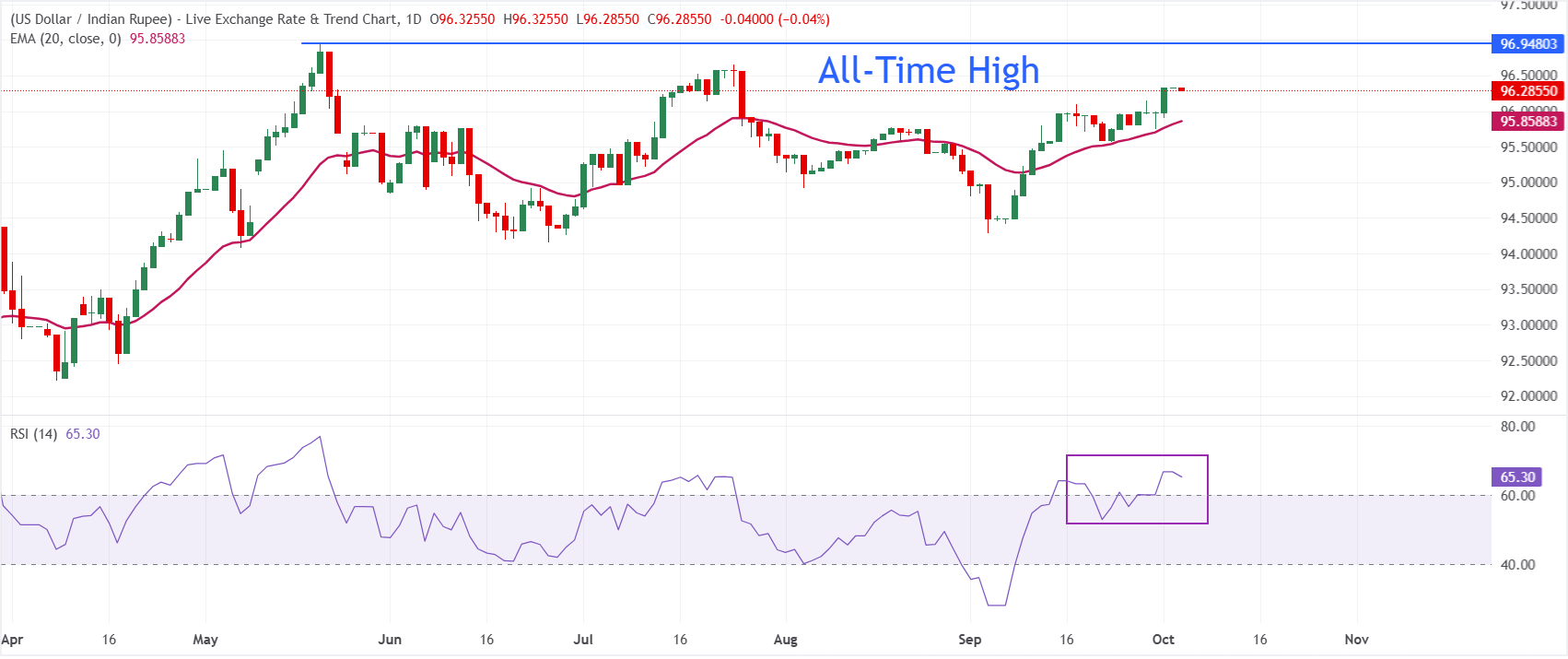
In the daily chart, USD/INR trades at 96.29, maintaining a bullish near-term bias as spot holds above the 20-period exponential moving average (EMA) at 95.86. The pair is consolidating near recent highs, and the Relative Strength Index (14) at 65.30 is approaching overbought territory, suggesting that upside momentum is strong but could be nearing a stretched zone.
On the downside, initial support is located at the 20-day EMA at 95.86, where any pullback would likely be tested before deeper losses emerge. On the upside, the pair aims to revisit the all-time high near 97.00
(The technical analysis of this story was written with the help of an AI tool. Know more.)
Economic Indicator
Nonfarm Payrolls
The Nonfarm Payrolls release presents the number of new jobs created in the US during the previous month in all non-agricultural businesses; it is released by the US Bureau of Labor Statistics (BLS). The monthly changes in payrolls can be extremely volatile. The number is also subject to strong reviews, which can also trigger volatility in the Forex board. Generally speaking, a high reading is seen as bullish for the US Dollar (USD), while a low reading is seen as bearish, although previous months' reviews and the Unemployment Rate are as relevant as the headline figure. The market's reaction, therefore, depends on how the market assesses all the data contained in the BLS report as a whole.
Read more.Last release: Fri Oct 02, 2026 12:30
Frequency: Monthly
Actual: 29K
Consensus: 90K
Previous: 162K
Source: US Bureau of Labor Statistics
America’s monthly jobs report is considered the most important economic indicator for forex traders. Released on the first Friday following the reported month, the change in the number of positions is closely correlated with the overall performance of the economy and is monitored by policymakers. Full employment is one of the Federal Reserve’s mandates and it considers developments in the labor market when setting its policies, thus impacting currencies. Despite several leading indicators shaping estimates, Nonfarm Payrolls tend to surprise markets and trigger substantial volatility. Actual figures beating the consensus tend to be USD bullish.
Author

Sagar Dua
FXStreet
Sagar Dua is associated with the financial markets from his college days. Along with pursuing post-graduation in Commerce in 2014, he started his markets training with chart analysis.