Gold stalls as high Oil prices lift US Treasury yields
- Gold falls 0.54% to $4,141 as US Dollar strength pressures bullion.
- WTI rises above $99, lifting 10-year Treasury yields to 5.144%.
- October Fed hike odds stand at 16%, while December reaches 92%.

Gold (XAU/USD) falls about 0.54% on Monday as the Greenback drifts higher and market mood shifts to neutral amid tensions in the Middle East, sparking a risein Oil prices, with West Texas Intermediate (WTI) bouncing off daily lows beneath $97 to $99.30. At the time of writing, XAU/USD trades at $4,140.
XAU/USD retreats as rising energy prices and Treasury yields overshadow fading October Fed hike bets
The yellow metal began the week on a lower note as the US Dollar drifts higher even though last week’s US hot-inflation data, particularly the Producer Price Index (PPI), triggered a leg down on the Greenback as money markets priced out a rate hike in October.
Geopolitics continued to play its role as Iran’s navy reported attacks from the US military at the Konarak naval base, reporting that two soldiers were injured, according to Al Jazeera.
That pushed WTI prices higher and US Treasury yields higher. The US 10-year T-note yield is up six basis points at 5.144%.
This week, the US economic docket will be absent of speeches from Federal Reserve (Fed) officials during October’s Federal Open Market Committee (FOMC) blackout period. But economic data will be released, like the ADP Employment Change 4-week average, jobless claims and S&P Global Flash PMIs.
Worth noting that the White House National Economic Adviser Kevin Hassett said that inflation looks like “it is needing some work” at CNBC.
Even though Gold is used as a hedge against high inflation, rising US yields undermine the yellow metal due to its non-yielding nature.
Money markets trimmed the odds of an October Fed rate hike to 16% following September's 25-basis-point increase. For the December meeting, the odds are nearly 92%, according to Prime Terminal data.

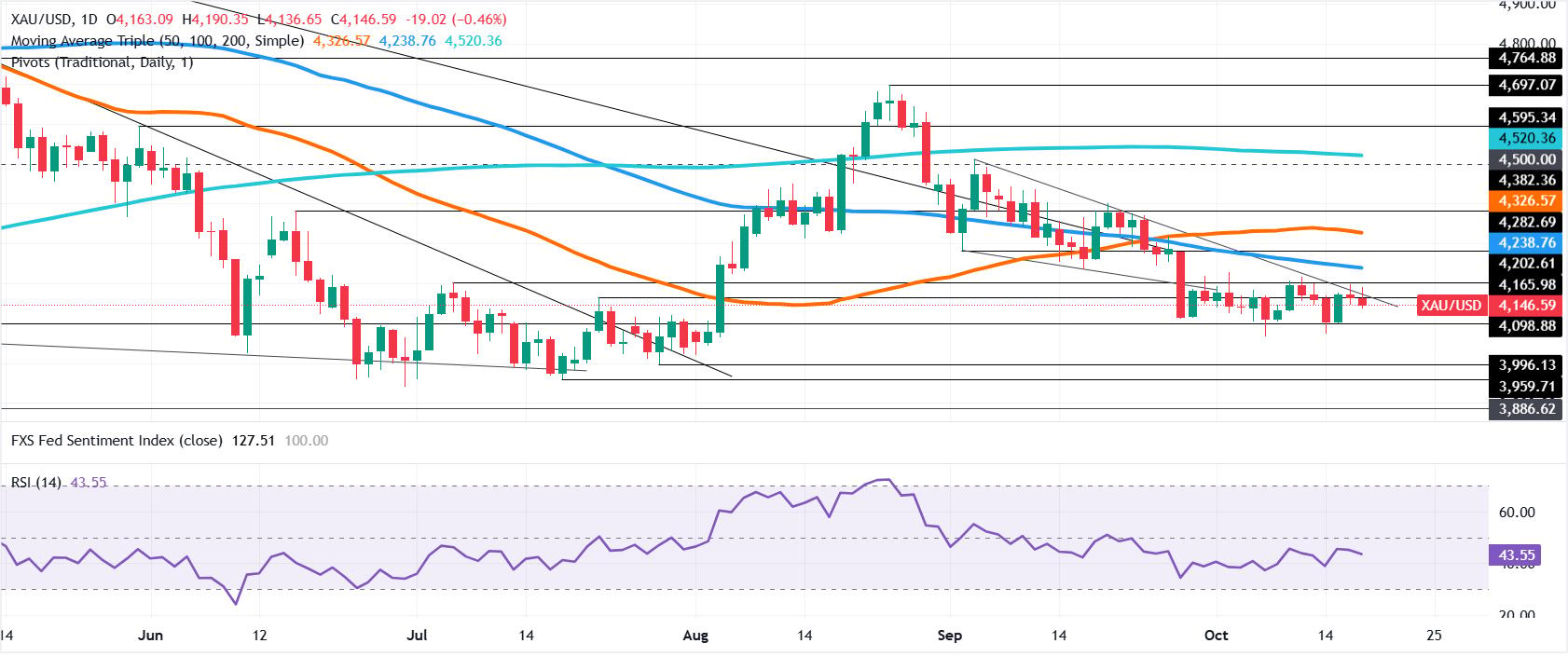
XAU/USD technical analysis: Gold trapped within $4,100-$4,200
Gold continues to trade laterally within the $4,100-$4,200 range, and although it appears to have bottomed near the range’s lower end, nothing is certain amid growing speculation that the Fed could increase rates in December.
The Relative Strength Index (RSI) remains bearish, though it has shifted to a flattish level, indicating that neither buyers nor sellers are in charge.
For a bullish reversal, XAU/USD’s first resistance is at $4,200, followed by the 100-day Simple Moving Average (SMA) at $4,238. Above that is the 50-day SMA at $4,326, followed by the $4,500 mark.
If XAU/USD continues lower, initial support is at $4,100. If sellers push Gold below that level, it would put the October 14 low of $4,073 in play, followed by the July 29 cycle low at $3,996, ahead of the July 17 low at $3,959. The yearly low at $3,941 lies below these levels.
Fed FAQs
Monetary policy in the US is shaped by the Federal Reserve (Fed). The Fed has two mandates: to achieve price stability and foster full employment. Its primary tool to achieve these goals is by adjusting interest rates. When prices are rising too quickly and inflation is above the Fed’s 2% target, it raises interest rates, increasing borrowing costs throughout the economy. This results in a stronger US Dollar (USD) as it makes the US a more attractive place for international investors to park their money. When inflation falls below 2% or the Unemployment Rate is too high, the Fed may lower interest rates to encourage borrowing, which weighs on the Greenback.
The Federal Reserve (Fed) holds eight policy meetings a year, where the Federal Open Market Committee (FOMC) assesses economic conditions and makes monetary policy decisions. The FOMC is attended by twelve Fed officials – the seven members of the Board of Governors, the president of the Federal Reserve Bank of New York, and four of the remaining eleven regional Reserve Bank presidents, who serve one-year terms on a rotating basis.
In extreme situations, the Federal Reserve may resort to a policy named Quantitative Easing (QE). QE is the process by which the Fed substantially increases the flow of credit in a stuck financial system. It is a non-standard policy measure used during crises or when inflation is extremely low. It was the Fed’s weapon of choice during the Great Financial Crisis in 2008. It involves the Fed printing more Dollars and using them to buy high grade bonds from financial institutions. QE usually weakens the US Dollar.
Quantitative tightening (QT) is the reverse process of QE, whereby the Federal Reserve stops buying bonds from financial institutions and does not reinvest the principal from the bonds it holds maturing, to purchase new bonds. It is usually positive for the value of the US Dollar.
Author

Christian Borjon Valencia
FXStreet
Markets analyst, news editor, and trading instructor with over 14 years of experience across FX, commodities, US equity indices, and global macro markets.

















