Gold rebounds from 15-month low but Fed risks linger
- Gold rebounds on Friday as buying interest returns following a volatile week.
- Traders have fully priced in a December Fed rate hike, with next week’s US jobs data in focus.
- The daily technical structure remains bearish, with prices holding below key moving averages.

Gold (XAU/USD) trades on the front foot on Friday but struggles to extend its gains as the US Dollar (USD) regains ground. The metal remains on track to snap a two-week losing streak, with dip-buying and short covering appearing to drive the rebound from Wednesday’s low of $3,427, its weakest level in more than a year.
At the time of writing, XAU/USD trades around $3,636, up 1.90% on the day after touching an intraday high of $3,685.
Has Gold found a bottom, or is this a short-term bounce?
Gold often draws buyers when risk appetite wanes, but the recent tech sell-off prompted some investors to sell bullion to raise cash and cover losses elsewhere. Investors also turned to US government bonds, driving Treasury yields lower and weighing on the Greenback. However, broader market sentiment appears to be improving as tech stocks stabilise.
A hawkish Federal Reserve (Fed) remains the main hurdle to a sustained recovery in Gold. Traders remain positioned for a series of rate hikes after several Fed officials called for tighter policy to bring inflation back to 2%.
This week’s data only strengthened those expectations. Core Personal Consumption Expenditures (PCE) inflation rose to 3.3% YoY in October, its fastest pace since late 2023, while third-quarter Gross Domestic Product (GDP) growth was revised up to an annualized 4.3% from 3.4%.
Inflation risks tied to higher energy prices remain a concern as tensions in the Middle East persist. Recent attacks on tankers in the Strait of Hormuz and on Saudi energy infrastructure have renewed concerns about Oil supplies.
Traders see a December rate hike as nearly certain and put the odds of another increase in January at around 65%, according to the CME FedWatch Tool. Higher borrowing costs make Gold less attractive because it pays no interest.
The prospect of higher interest rates in the US also supports the US Dollar, making bullion more expensive for buyers using other currencies. The US Dollar Index (DXY), which tracks the Greenback’s value against a basket of six major currencies, trades around 103.93, up 0.13% on the day and not far from Monday’s 20-month high of 104.53.
At this stage, it’s too early to call a bottom in Gold. Further US Dollar strength could limit the rebound, and another tech sell-off could bring back selling pressure if worries about AI spending flare up again.
What to watch next
With no major US economic data due for the rest of the day, attention turns to next week’s calendar. Friday’s US Nonfarm Payrolls (NFP) report is the main event. The Job Openings and Labor Turnover Survey (JOLTS) and the Institute for Supply Management (ISM) Manufacturing Purchasing Managers’ Index (PMI) are due Tuesday, followed by the ISM Services PMI on Thursday. With a December rate hike largely priced in, the data could further shape expectations for January.
Technical Analysis: XAU/USD eyes $3,700 as selling pressure eases
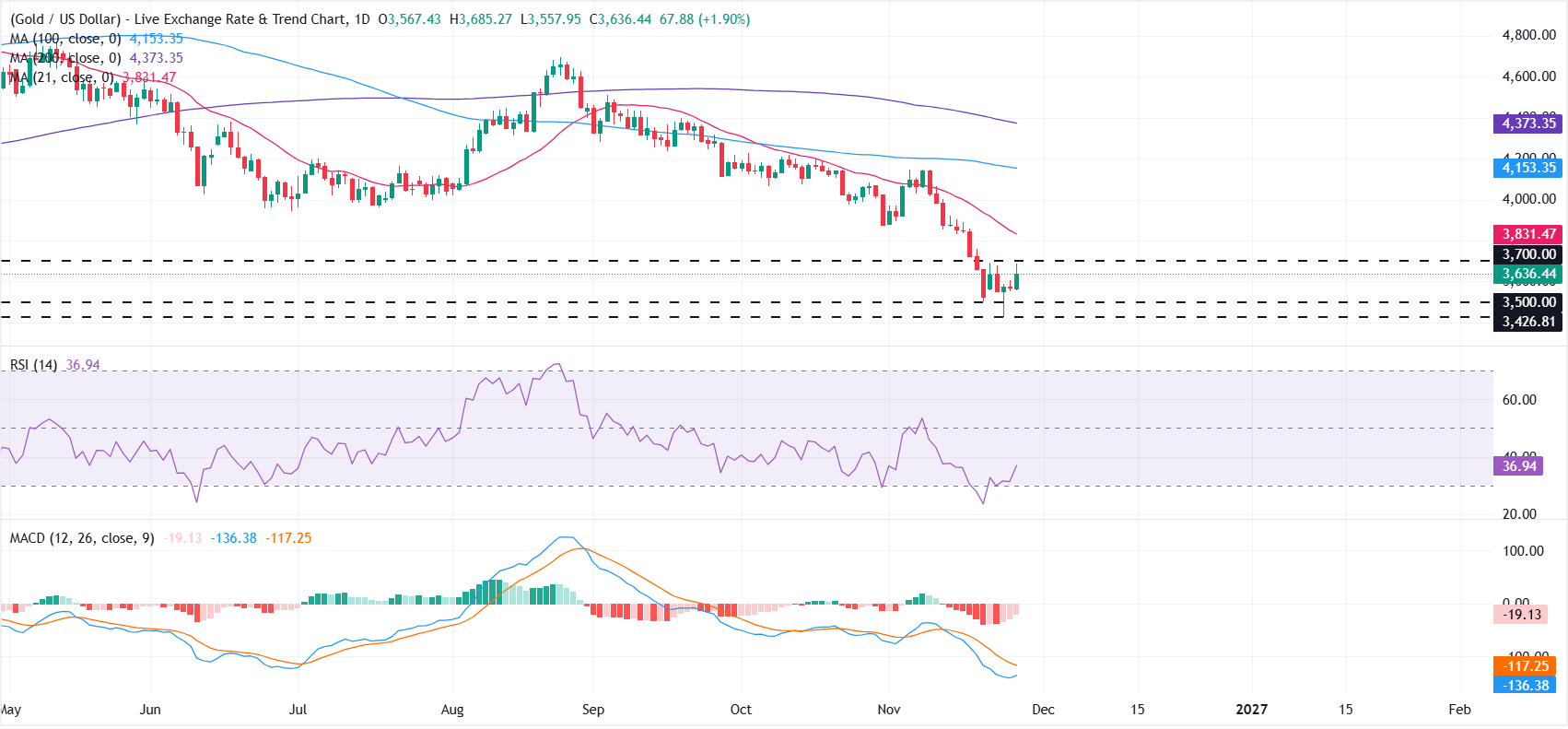
On the daily chart, XAU/USD maintains a bearish bias despite the latest rebound, with prices holding below the 21-day, 100-day and 200-day Simple Moving Averages (SMAs). The cluster of medium- and long-term SMAs above spot suggests rallies are likely to be capped, while the Relative Strength Index (RSI) has recovered from oversold territory but remains below the neutral 50 mark at around 39.
The Moving Average Convergence Divergence (MACD) indicator remains in negative territory, with the line below its signal and a weakly negative histogram, hinting that downside momentum is still dominant, albeit not aggressive.
On the topside, immediate resistance lies at the $3,700 psychological level, followed by the 21-day SMA at $3,833. Further resistance emerges at the 100-day and 200-day SMAs at $4,154 and $4,374, respectively.
On the downside, initial support lies at $3,500, followed by Wednesday’s low near $3,427. A sustained break below the latter would leave Gold vulnerable to a further extension of the downtrend.
(The technical analysis of this story was written with the help of an AI tool. Know more.)
Gold FAQs
Gold has played a key role in human’s history as it has been widely used as a store of value and medium of exchange. Currently, apart from its shine and usage for jewelry, the precious metal is widely seen as a safe-haven asset, meaning that it is considered a good investment during turbulent times. Gold is also widely seen as a hedge against inflation and against depreciating currencies as it doesn’t rely on any specific issuer or government.
Central banks are the biggest Gold holders. In their aim to support their currencies in turbulent times, central banks tend to diversify their reserves and buy Gold to improve the perceived strength of the economy and the currency. High Gold reserves can be a source of trust for a country’s solvency. Central banks added 1,136 tonnes of Gold worth around $70 billion to their reserves in 2022, according to data from the World Gold Council. This is the highest yearly purchase since records began. Central banks from emerging economies such as China, India and Turkey are quickly increasing their Gold reserves.
Gold has an inverse correlation with the US Dollar and US Treasuries, which are both major reserve and safe-haven assets. When the Dollar depreciates, Gold tends to rise, enabling investors and central banks to diversify their assets in turbulent times. Gold is also inversely correlated with risk assets. A rally in the stock market tends to weaken Gold price, while sell-offs in riskier markets tend to favor the precious metal.
The price can move due to a wide range of factors. Geopolitical instability or fears of a deep recession can quickly make Gold price escalate due to its safe-haven status. As a yield-less asset, Gold tends to rise with lower interest rates, while higher cost of money usually weighs down on the yellow metal. Still, most moves depend on how the US Dollar (USD) behaves as the asset is priced in dollars (XAU/USD). A strong Dollar tends to keep the price of Gold controlled, whereas a weaker Dollar is likely to push Gold prices up.
Author
Vishal Chaturvedi
FXStreet
I am a macro-focused research analyst with over four years of experience covering forex and commodities market. I enjoy breaking down complex economic trends and turning them into clear, actionable insights that help traders stay ahead of the curve.