Gold recovers from post-NFP low as US Dollar trims gains
- Gold briefly tumbles below $4,400 after the NFP release before staging a recovery.
- US Nonfarm Payrolls rose by 162K in August, well above the 56K market forecast.
- The $4,500 mark acts as immediate resistance, followed by the 200-day SMA near $4,534.

Gold (XAU/USD) remains under pressure on Friday after stronger-than-expected United States (US) Nonfarm Payrolls (NFP) data revive expectations of a Federal Reserve (Fed) rate hike. The metal tumbled to an intraday low near $4,365 and was down more than 2% at one stage before recovering as the US Dollar (USD) and Treasury yields lost momentum. At the time of writing, XAU/USD trades around $4,435, down 0.85% on the day.
The US economy added 162K jobs in August, well above market expectations for a 56K increase. July’s figure was revised higher to a gain of 21K from the previously reported 23K decline, while June payrolls were revised to 31K from 20K. The Unemployment Rate held steady at 4.1%, as expected.
The US Dollar and Treasury yields jumped following the employment report but have since struggled to extend their gains, helping Gold recover from its intraday low. The US Dollar Index (DXY), which tracks the Greenback’s value against a basket of six major currencies, trades around 99.17 after rising as high as 99.36.
Meanwhile, the benchmark 10-year Treasury yield eases to around 4.77% after retesting 4.81%, its highest level since October 2023, touched earlier this week.
The strong payroll gains allow the Fed to focus more closely on the inflation side of its mandate, putting next week’s US Consumer Price Index (CPI) and Producer Price Index (PPI) data firmly in focus. The upbeat employment report reverses some of the dovish repricing triggered by less-hawkish comments from Fed Governor Christopher Waller on Thursday.
Waller said he is “finally seeing some signs of disinflation,” adding that the “current rate setting could get us back to 2% inflation.” He also said the “rate decision in September hinges on August inflation” and that “if August inflation data comes in hot, I would consider a rate hike.”
According to the CME FedWatch Tool, markets now price in around a 60% chance of a 25-basis-point rate hike at the September 15-16 meeting, up from 50% before the NFP release.
Analysts at OCBC remain “constructive” on Gold, but caution that the near-term path is likely to stay “highly sensitive to Fed repricing.” They highlight that “next week’s CPI and PPI should be more decisive in determining whether the recent disinflation trend is sufficient to keep the Fed on hold.” OCBC experts also note that “geopolitical tensions remain supportive at the margin,” but warn that “higher oil prices are a two-sided risk if they feed back into inflation expectations and yields.”
Technical analysis: Buyers eye 200-day SMA
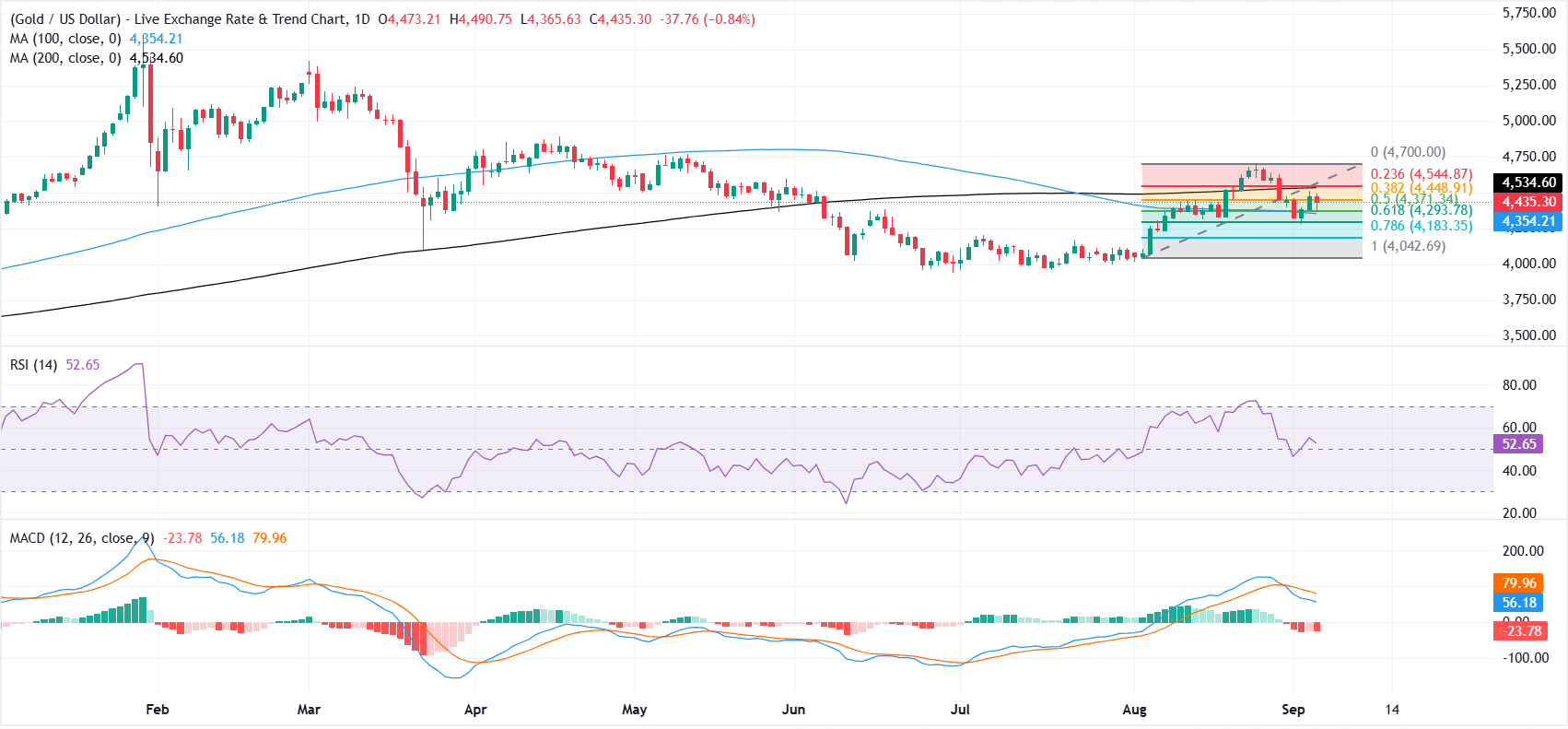
XAU/USD holds just above the 50.0% Fibonacci retracement at $4,371 but is still capped beneath the 200-day Simple Moving Average (SMA) at $4,534. This configuration suggests a corrective tone within a broader downbeat backdrop, with the 100-day SMA at $4,353 offering nearby trend support. The Relative Strength Index (RSI) on the daily chart is at 49, sitting near neutral, while the Moving Average Convergence Divergence (MACD) remains negative and below its signal line, hinting that upside attempts could fade under the weight of overhead resistance.
On the topside, initial resistance is seen at the 38.2% Fibonacci retracement at roughly $4,448, ahead of a dense cap formed by the 200-day SMA around $4,534 and the 23.6% retracement near $4,544. On the downside, immediate support emerges at the 50.0% retracement at $4,371, with further cushions at the 61.8% level around $4,293 and the 78.6% retracement near $4,183. A break below these steps would expose the prior swing floor around the 100.0% retracement at $4,042.
(The technical analysis of this story was written with the help of an AI tool. Know more.)
Nonfarm Payrolls FAQs
Nonfarm Payrolls (NFP) are part of the US Bureau of Labor Statistics monthly jobs report. The Nonfarm Payrolls component specifically measures the change in the number of people employed in the US during the previous month, excluding the farming industry.
The Nonfarm Payrolls figure can influence the decisions of the Federal Reserve by providing a measure of how successfully the Fed is meeting its mandate of fostering full employment and 2% inflation. A relatively high NFP figure means more people are in employment, earning more money and therefore probably spending more. A relatively low Nonfarm Payrolls’ result, on the either hand, could mean people are struggling to find work. The Fed will typically raise interest rates to combat high inflation triggered by low unemployment, and lower them to stimulate a stagnant labor market.
Nonfarm Payrolls generally have a positive correlation with the US Dollar. This means when payrolls’ figures come out higher-than-expected the USD tends to rally and vice versa when they are lower. NFPs influence the US Dollar by virtue of their impact on inflation, monetary policy expectations and interest rates. A higher NFP usually means the Federal Reserve will be more tight in its monetary policy, supporting the USD.
Nonfarm Payrolls are generally negatively-correlated with the price of Gold. This means a higher-than-expected payrolls’ figure will have a depressing effect on the Gold price and vice versa. Higher NFP generally has a positive effect on the value of the USD, and like most major commodities Gold is priced in US Dollars. If the USD gains in value, therefore, it requires less Dollars to buy an ounce of Gold. Also, higher interest rates (typically helped higher NFPs) also lessen the attractiveness of Gold as an investment compared to staying in cash, where the money will at least earn interest.
Nonfarm Payrolls is only one component within a bigger jobs report and it can be overshadowed by the other components. At times, when NFP come out higher-than-forecast, but the Average Weekly Earnings is lower than expected, the market has ignored the potentially inflationary effect of the headline result and interpreted the fall in earnings as deflationary. The Participation Rate and the Average Weekly Hours components can also influence the market reaction, but only in seldom events like the “Great Resignation” or the Global Financial Crisis.
Author

Vishal Chaturvedi
FXStreet
I am a macro-focused research analyst with over four years of experience covering forex and commodities market. I enjoy breaking down complex economic trends and turning them into clear, actionable insights that help traders stay ahead of the curve.