Gold hovers near 14-month low as traders brace for US PCE inflation data
- Gold trades near a 14-month low ahead of a busy US economic calendar on Wednesday.
- Markets await US PCE inflation and preliminary Q3 GDP figures amid a hawkish Fed outlook.
- The technical outlook remains bearish despite oversold conditions, with the $3,500 level acting as immediate support.


Gold (XAU/USD) consolidates losses on Wednesday as traders turn cautious ahead of the US Personal Consumption Expenditures (PCE) Price Index, due at 13:30 GMT. At the time of writing, XAU/USD trades around $3,531, just above the 14-month low of $3,502 hit last week.
The metal has now given back all the gains recorded at the start of the week as the initial optimism over Jensen Huang’s return as Nvidia CEO fades and doubts about whether the AI boom can last resurface, putting global equities back under pressure.
As risk appetite wanes, some investors are selling Gold to raise cash and meet margin calls. Investors are also moving into US government bonds, pushing Treasury yields lower. Bullion is getting little relief from the drop in yields as the US Dollar (USD) holds firm.
The benchmark 10-year US Treasury yield slips to 4.85%, its lowest since November 9. The US Dollar Index (DXY) holds near 104.00, close to the 20-month high of 104.59 it touched on Monday.
A hawkish Federal Reserve (Fed) outlook remains a bigger challenge for Gold. Markets are pricing in back-to-back rate hikes as policymakers warn of persistent inflation risks. That puts the spotlight on Wednesday’s PCE data, the final update on the Fed’s preferred inflation measure before policymakers meet in December.
Analysts at Commerzbank highlight that “the focus today will be on the October PCE deflator.” They note that “the Bloomberg consensus expects headline PCE inflation to pick up to 3.8% yoy from 3.6% in September,” while “the core PCE deflator is expected at 3.2% yoy from 3.1% previously.”
Despite the data risk, Commerzbank points out that “the Fed funds futures continue to fully price in a 25bp rate hike in December” and that “they are pricing in a total hike of 62bp by end-2027.”
A hotter-than-expected PCE reading could reinforce bets on further rate hikes after December, lifting the US Dollar and putting more pressure on Gold. A softer print could temper those expectations and give bullion some room to recover.
Alongside the inflation data, markets will also be watching the first estimate of US third-quarter Gross Domestic Product (GDP), with the economy expected to grow at an annualized rate of 3.4%, matching the previous quarter’s pace.
Technical analysis: Sellers remain in control as RSI holds below 30
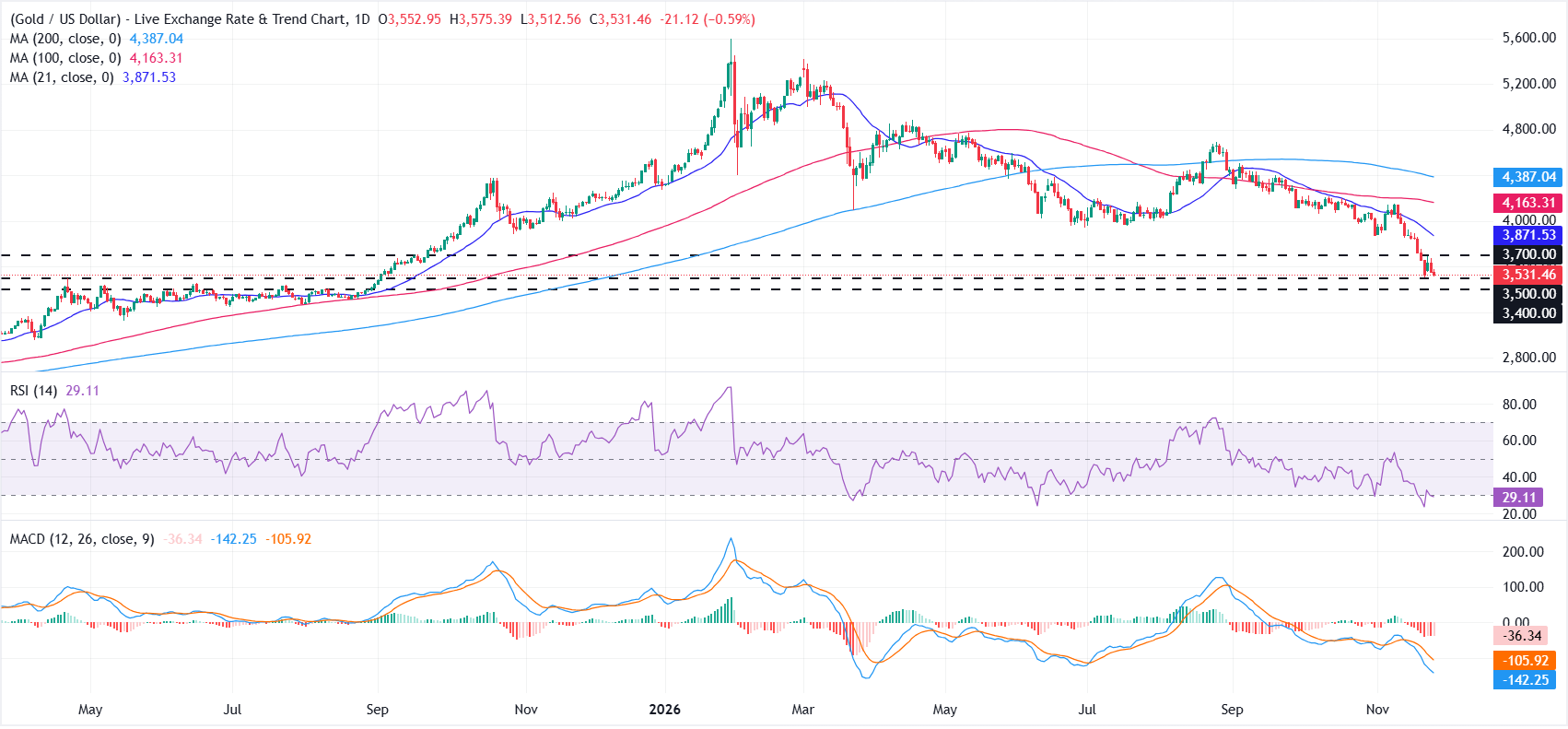
On the daily chart, XAU/USD maintains a clear bearish bias as price holds well below the 21-day, 100-day and 200-day Simple Moving Averages (SMAs). The cluster of overhead SMAs reinforces a capped tone. At the same time, the Relative Strength Index (RSI) at 29 sits in oversold territory, hinting that the latest leg lower is stretched but not yet showing a convincing rebound. The Moving Average Convergence Divergence (MACD) indicator remains negative, with weak momentum that suggests downside pressure is still dominant despite the oversold reading.
On the topside, initial resistance emerges at the horizontal barrier near $3,700, ahead of the 21-day SMA at $3,871, with further resistance seen at the 100-day SMA at $4,163 and the 200-day SMA at $4,387. On the downside, immediate support is found at $3,500, followed by a deeper structural floor around $3,400. A decisive break below this zone would open the path to further losses, while holding above it could allow for a corrective bounce back toward the $3,700 resistance area.
(The technical analysis of this story was written with the help of an AI tool. Know more.)
Inflation FAQs
Inflation measures the rise in the price of a representative basket of goods and services. Headline inflation is usually expressed as a percentage change on a month-on-month (MoM) and year-on-year (YoY) basis. Core inflation excludes more volatile elements such as food and fuel which can fluctuate because of geopolitical and seasonal factors. Core inflation is the figure economists focus on and is the level targeted by central banks, which are mandated to keep inflation at a manageable level, usually around 2%.
The Consumer Price Index (CPI) measures the change in prices of a basket of goods and services over a period of time. It is usually expressed as a percentage change on a month-on-month (MoM) and year-on-year (YoY) basis. Core CPI is the figure targeted by central banks as it excludes volatile food and fuel inputs. When Core CPI rises above 2% it usually results in higher interest rates and vice versa when it falls below 2%. Since higher interest rates are positive for a currency, higher inflation usually results in a stronger currency. The opposite is true when inflation falls.
Although it may seem counter-intuitive, high inflation in a country pushes up the value of its currency and vice versa for lower inflation. This is because the central bank will normally raise interest rates to combat the higher inflation, which attract more global capital inflows from investors looking for a lucrative place to park their money.
Formerly, Gold was the asset investors turned to in times of high inflation because it preserved its value, and whilst investors will often still buy Gold for its safe-haven properties in times of extreme market turmoil, this is not the case most of the time. This is because when inflation is high, central banks will put up interest rates to combat it. Higher interest rates are negative for Gold because they increase the opportunity-cost of holding Gold vis-a-vis an interest-bearing asset or placing the money in a cash deposit account. On the flipside, lower inflation tends to be positive for Gold as it brings interest rates down, making the bright metal a more viable investment alternative.
Author
Vishal Chaturvedi
FXStreet
I am a macro-focused research analyst with over four years of experience covering forex and commodities market. I enjoy breaking down complex economic trends and turning them into clear, actionable insights that help traders stay ahead of the curve.