Gold gains on geopolitics as Fed hike bets shift to December
- Gold recovers to above $4,130 as falling yields offset a hawkish Fed.
- Strait of Hormuz tension keeps WTI elevated despite Trump remarks.
- Markets price in an 81% chance of a 25 bps Fed rate hike in December.

Gold (XAU/USD) price edges higher on Thursday, underpinned by lower US Treasury yields and a weaker US Dollar, even as Federal Reserve (Fed) officials support further tightening by the US central bank. At the time of writing, XAU/USD trades at $4,130, up 0.48%, after bottoming near $4,103.
Bullion rises on falling US yields, despite Fed hawkish rhetoric
The Middle East crisis continues to pressure on inflation as energy prices remain high, pushing global bond yields to multi-year record highs. Explosions around the Strait of Hormuz keep West Texas Intermediate (WTI), the US crude benchmark, at $90.85, up over 2%, which posted earlier gains of more than 4% if not for comments by US President Donald Trump.
Trump said that the US won’t attack Iran before the midterm elections. Nevertheless, an Axios report showed that US and Israeli officials said that Iranian leaders are suspicious of Trump’s comments, adding that Iranian leaders want to avoid a third surprise attack.
Federal Reserve policymakers made some hawkish comments but failed to provide forward guidance on October. St. Louis Fed President Alberto Musalem commented that inflation is high and that the strength of the labor market suggests the Fed must focus on tackling it.
Fed is hawkish but patient at the same time
Earlier, Fed Governor Christopher Waller eyed additional rate hikes but stressed that they do not need to be consecutive, shutting the door on the October meeting.
Money markets show that a rate hike in the October 27-28 meeting is a long shot. But for December, the odds are near 81% that the Fed will raise rates by 25 basis points.
On the data front, Initial Jobless Claims for the week ending October 3 came in at 197K, below forecasts of 200K and the prior week's 199K, suggesting an ongoing low-hire, low-fire jobs market.
Next for Gold traders, they must be attentive to geopolitical developments, the behavior of US Treasury yields and the US Dollar. Regarding US economic data, the University of Michigan Consumer Sentiment survey for October is expected to provide clues about households’ views on the economy and inflation.
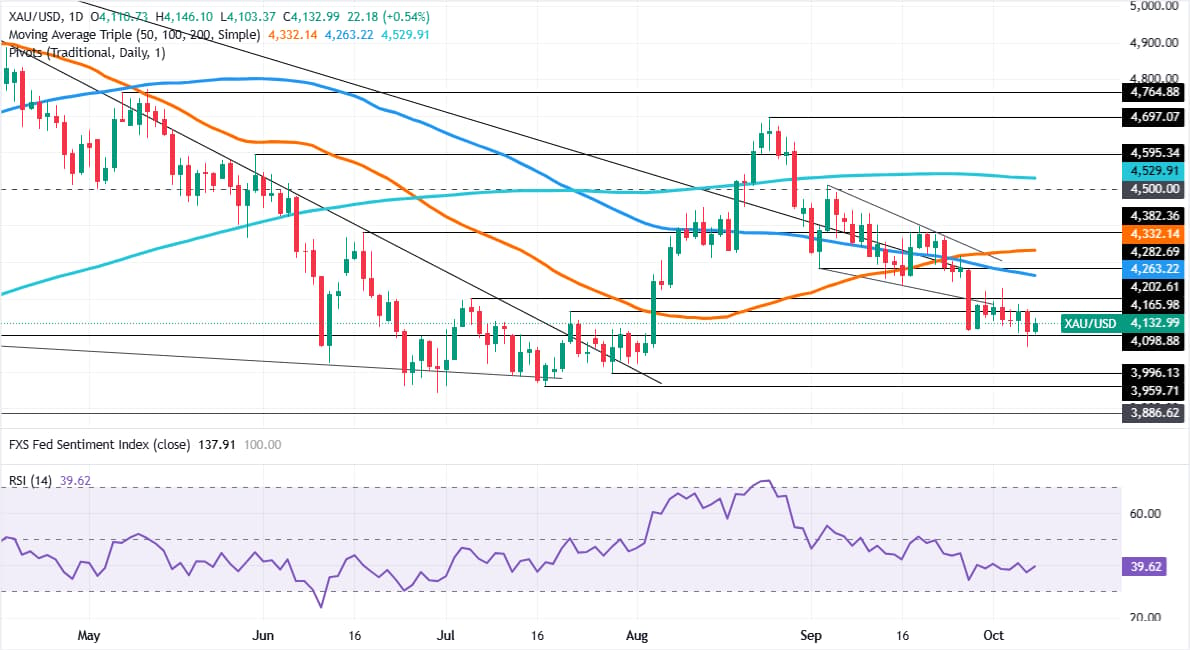
XAU/USD technical analysis: Gold bearish bias intact, below $4,200
Price action reaffirms that the downtrend remains intact, even though Gold buyers stepped in, pushing spot prices above $4,100. Worth noting that Wednesday's candle engulfs the price action of the day, an indication that a ‘bullish harami’ looms. Nevertheless, further confirmation is needed, like a decisive breakout of key resistance levels, before XAU turns bullish
The Relative Strength Index (RSI) remains bearish, indicating further downside.
Therefore, Gold’s first support is $4,100. Below the next stop is $4,000, ahead of the July 29 swing low of $3,996 and then it challenges the year-to-date (YTD) low of $3,941.
Should XAU/USD reclaim $4,200, this clears the path to test the confluence of the 100- and 50-day Simple Moving Averages (SMAs), each at $ 4,263 and $4,332, respectively. Once those levels are cleared, the next stop is $4,500, ahead of the 200-day SMA at $4,529.
Gold FAQs
Gold has played a key role in human’s history as it has been widely used as a store of value and medium of exchange. Currently, apart from its shine and usage for jewelry, the precious metal is widely seen as a safe-haven asset, meaning that it is considered a good investment during turbulent times. Gold is also widely seen as a hedge against inflation and against depreciating currencies as it doesn’t rely on any specific issuer or government.
Central banks are the biggest Gold holders. In their aim to support their currencies in turbulent times, central banks tend to diversify their reserves and buy Gold to improve the perceived strength of the economy and the currency. High Gold reserves can be a source of trust for a country’s solvency. Central banks added 1,136 tonnes of Gold worth around $70 billion to their reserves in 2022, according to data from the World Gold Council. This is the highest yearly purchase since records began. Central banks from emerging economies such as China, India and Turkey are quickly increasing their Gold reserves.
Gold has an inverse correlation with the US Dollar and US Treasuries, which are both major reserve and safe-haven assets. When the Dollar depreciates, Gold tends to rise, enabling investors and central banks to diversify their assets in turbulent times. Gold is also inversely correlated with risk assets. A rally in the stock market tends to weaken Gold price, while sell-offs in riskier markets tend to favor the precious metal.
The price can move due to a wide range of factors. Geopolitical instability or fears of a deep recession can quickly make Gold price escalate due to its safe-haven status. As a yield-less asset, Gold tends to rise with lower interest rates, while higher cost of money usually weighs down on the yellow metal. Still, most moves depend on how the US Dollar (USD) behaves as the asset is priced in dollars (XAU/USD). A strong Dollar tends to keep the price of Gold controlled, whereas a weaker Dollar is likely to push Gold prices up.
Author

Christian Borjon Valencia
FXStreet
Markets analyst, news editor, and trading instructor with over 14 years of experience across FX, commodities, US equity indices, and global macro markets.
















