Gold sinks as stock rout fails to spark haven demand
- Gold tumbles 1.20% to $4,016 as Wall Street stocks retreat.
- US GDP grows 3.4%, while Core PCE inflation remains elevated at 3.1%.
- December Fed hike odds stand at 81% despite easing geopolitical tensions.
Gold (XAU/USD) extends its losses on Thursday, down over 1.20% as the US equity markets fall and investors rotate into defensive stocks, while solid US economic data reinforced speculation that the Federal Reserve (Fed) could increase rates in December. XAU/USD trades at $4,016 after hitting a daily low of $4,005.
XAU/USD extends losses as strong US growth reinforces December Fed tightening expectations
The Greenback is extending its losses, with the US Dollar Index (DXY), which tracks the buck's performance against six peers, down 0.12% at 102.03. This was sparked by the Federal Reserve’s decision to hold rates unchanged and by the lack of forward guidance from Fed Chair Kevin Warsh.
During the press conference, Warsh announced changes to future FOMC meetings. In 2027, the central bank will hold eight meetings, but one will be dedicated to broad monetary policy strategy. In 2028, the FOMC monetary policy meetings would be just six.
Following the decision, money markets priced in an 84% chance of a 25-basis-point rate hike. Since then, they trimmed the odds to 81%, according tp Prime Terminal.
Gold prices rose to $4,035 before making a U-turn to current levels on the release of US data. Gross Domestic Product (GDP) figures in Q3 rose by 3.4% YoY, above forecasts of 3.2% and up from 2.2% in the previous quarter. Also, the Fed’s preferred gauge of inflation, the Core Personal Consumption Expenditures (PCE) Price Index, rose to 3.1% YoY as expected, signaling the Fed has work to do on its price stability mandate.
After economic growth and inflation data, the jobs market is faring well, with Initial Jobless Claims for the week ending October 24 cooling from 195K to 194K, below forecasts of 199K.
Tensions in the Middle East eased after US Vice President JD Vance sought to revive peace negotiations by writing to Mohsen Rezaei, head of Iran's Supreme National Security Council. Even though Oil prices drifted lower, bullion has failed to recover amid expectations of higher interest rates.
The US 10-year Treasury yield is flat at 4.999%, after reaching a low of 4.949%. This, along with uncertainty about the outcome of the November 3 US midterm elections, keeps Gold prices steady.
Next week, the docket will feature the ISM Manufacturing and Services PMI, Factory Orders, the JOLTS survey, Initial Jobless Claims and October’s Nonfarm Payrolls data.
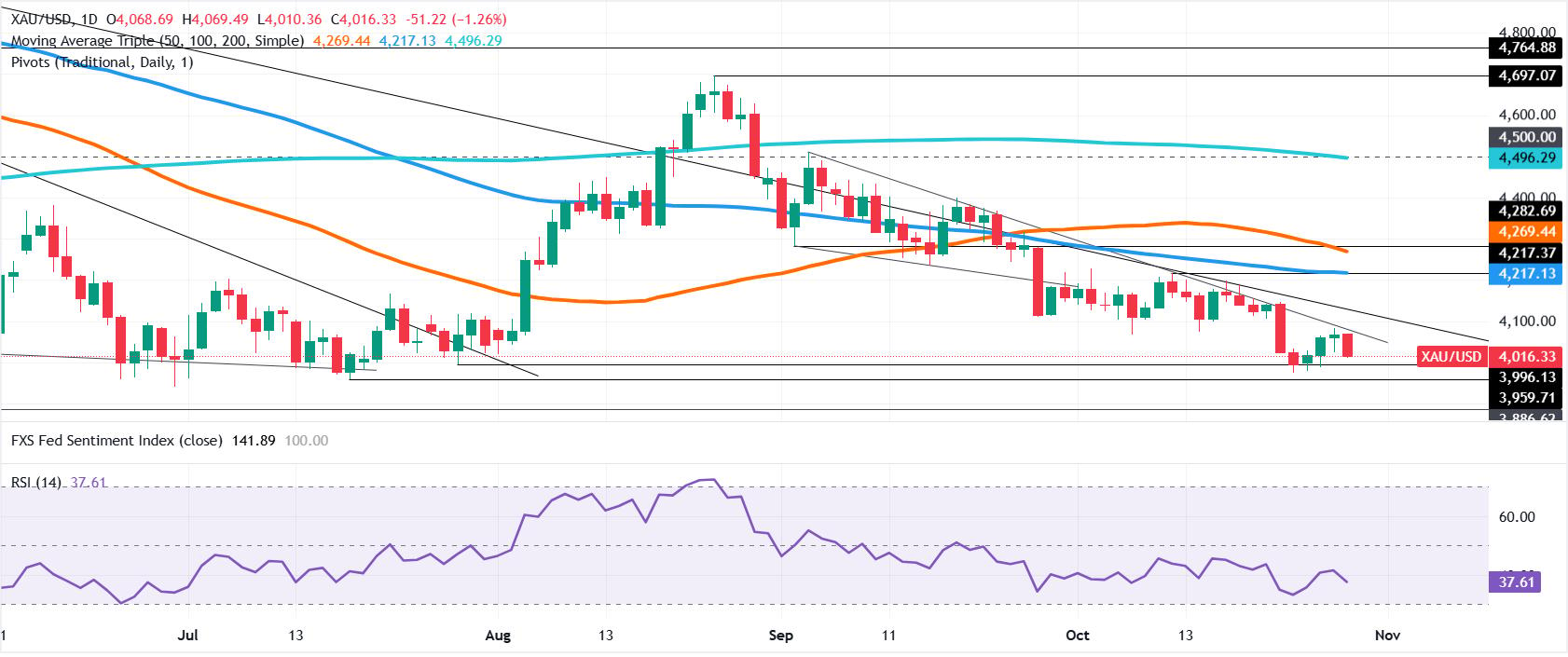
XAU/USD technical outlook: Drops towards $4,000 as sellers eye YTD low beneath $3,970
Gold price shows sellers are dominating the action as XAU/USD falls below Wednesday's daily low of $4,025, poised to test last week’s low of $3,975 if Gold dives below $4,000. Momentum favors further downside as the Relative Strength Index (RSI) edges lower towards oversold territory.
On the other hand, buyers can reclaim some control if Gold clears the $4,100 mark. Once done, the next stop is $4,200, followed by the 100-day and the 50-day Simple Moving Averages (SMAs) at $4,217 and $4,269, respectively.
Fed FAQs
Monetary policy in the US is shaped by the Federal Reserve (Fed). The Fed has two mandates: to achieve price stability and foster full employment. Its primary tool to achieve these goals is by adjusting interest rates. When prices are rising too quickly and inflation is above the Fed’s 2% target, it raises interest rates, increasing borrowing costs throughout the economy. This results in a stronger US Dollar (USD) as it makes the US a more attractive place for international investors to park their money. When inflation falls below 2% or the Unemployment Rate is too high, the Fed may lower interest rates to encourage borrowing, which weighs on the Greenback.
The Federal Reserve (Fed) holds eight policy meetings a year, where the Federal Open Market Committee (FOMC) assesses economic conditions and makes monetary policy decisions. The FOMC is attended by twelve Fed officials – the seven members of the Board of Governors, the president of the Federal Reserve Bank of New York, and four of the remaining eleven regional Reserve Bank presidents, who serve one-year terms on a rotating basis.
In extreme situations, the Federal Reserve may resort to a policy named Quantitative Easing (QE). QE is the process by which the Fed substantially increases the flow of credit in a stuck financial system. It is a non-standard policy measure used during crises or when inflation is extremely low. It was the Fed’s weapon of choice during the Great Financial Crisis in 2008. It involves the Fed printing more Dollars and using them to buy high grade bonds from financial institutions. QE usually weakens the US Dollar.
Quantitative tightening (QT) is the reverse process of QE, whereby the Federal Reserve stops buying bonds from financial institutions and does not reinvest the principal from the bonds it holds maturing, to purchase new bonds. It is usually positive for the value of the US Dollar.
Author

Christian Borjon Valencia
FXStreet
Markets analyst, news editor, and trading instructor with over 14 years of experience across FX, commodities, US equity indices, and global macro markets.

















