Gold drifts below $4,000 as high US yields fuel December Fed hike odds
- Gold slips below $4,000, extending losses for a second day.
- US Core CPI holds at 0.3% MoM, exceeding expectations for a third month.
- December Fed hike odds reach 87% as US Treasury yields hit 5%.

Gold (XAU/USD) price extends losses for the second straight day on Wednesday as traders fully price in a rate hike by the Federal Reserve (Fed) following a hotter-than-expected US inflation report and hawkish comments by Fed policymakers. At the time of writing, XAU/USD trades at $3,999, down 0.70%.
Gold extends losses due to high US inflation, surging Treasury yields and hawkish Fed rhetoric
Inflation data in the United States (US) exceeded forecasts, with the Consumer Price Index (CPI) rising 0.4% MoM in October, down from 0.6% but above the 0.3% estimate. However, the focal point was underlying CPI, as Fed Governor Christopher Waller warned that he would prefer a 50 bps rate hike if core inflation reached 0.3%. Core CPI was 0.3% MoM for the third consecutive month, above estimates of 0.2%, prompting investors to fully price in a 25 bps rate increase at the December meeting.
According to the CME FedWatch Tool, market participants price in an 87% chance that the Fed will raise rates by 0.25%, and a slim 13% chance of a 0.50% hike.
Consequently, bullion prices edged lower, as the non-yielding metal tends to fare well amid lower interest rate scenarios.
The US 10-year Treasury yield rose nearly 12 basis points to 5%, a tailwind for the Greenback. The US Dollar Index (DXY), which measures the value of the buck against a basket of six currencies, is up 0.67% at 102.90, a yearly high.
Other Fed officials were hawkish, with Philadelphia Fed Anna Paulson saying that the “Fed will move more aggressively if inflation landscape worsens,” while Dallas Fed Lorie Logan added that it’s possible to hike rates “more rapidly.”
Conversely, Fed Governor Michelle Bowman and Kansas City Fed President Jeffrey Schmid adopted a more cautious approach, though both stressed that inflation is high. Bowman said that persistent inflation suggests there is more work to do, while Schmid said that there are concerning price trends, excluding the whole energy story.
Ahead, the US economic docket will feature Initial Jobless Claims, housing data and Fed speeches on Thursday, ahead of Friday’s Producer Price Index (PPI).
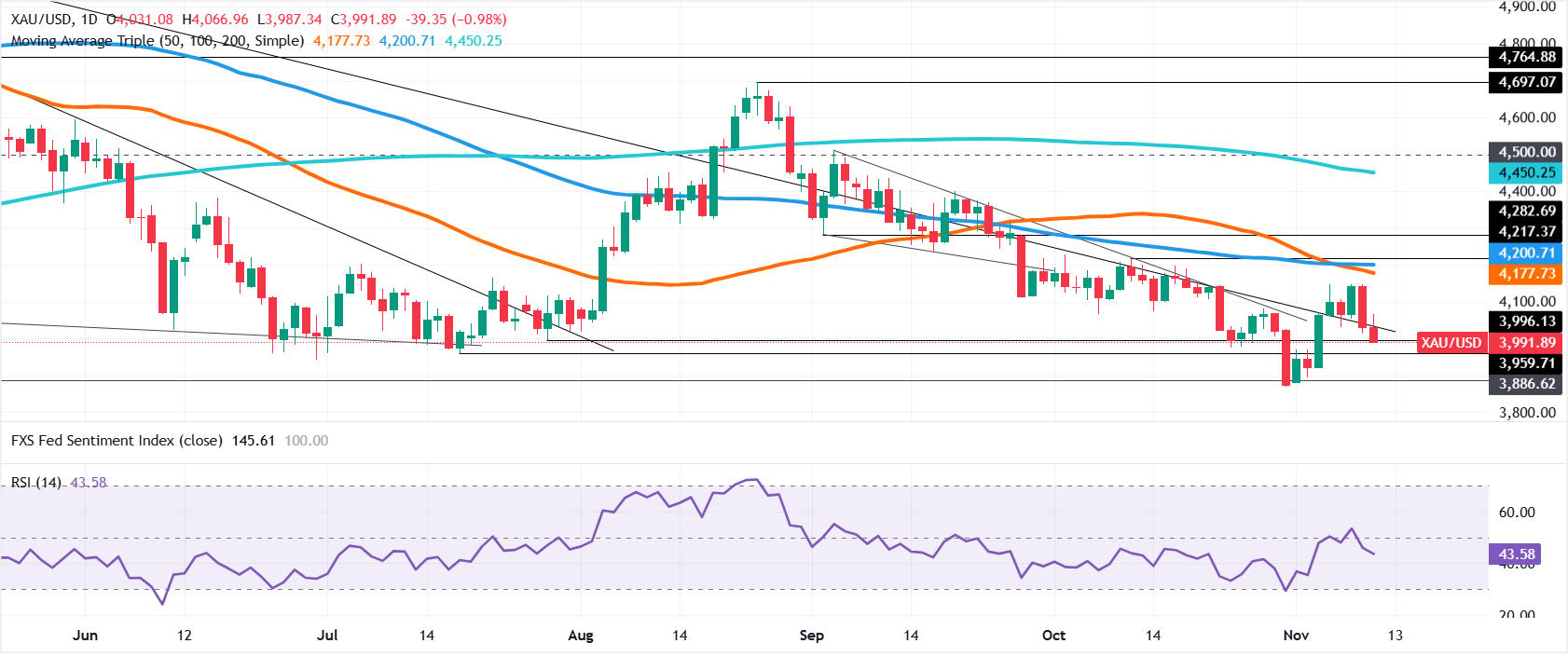
XAU/USD technical outlook: Gold tumbles beneath $4,000, further downside eyed
Gold has cleared the $4,000 threshold, with five-day lows in sight, as sellers gain momentum. Price action shows a lower low for the third straight trading day, suggesting further downside.
The Relative Strength Index (RSI) is also turning bearish, an indication that bears are in charge.
With that said, XAU/USD's first support is the November 4 daily low of $3,919, followed by the October 30 year-to-date low of $3,879. On the flip side, the first key resistance is $4,000. A breach of the latter paves the way for a move toward the psychological $4,050 area, followed by $4,100. Above, the next area of interest is the confluence of the 50- and 100-day Simple Moving Averages (SMAs), at $4,177 and $4,200, respectively.
Gold FAQs
Gold has played a key role in human’s history as it has been widely used as a store of value and medium of exchange. Currently, apart from its shine and usage for jewelry, the precious metal is widely seen as a safe-haven asset, meaning that it is considered a good investment during turbulent times. Gold is also widely seen as a hedge against inflation and against depreciating currencies as it doesn’t rely on any specific issuer or government.
Central banks are the biggest Gold holders. In their aim to support their currencies in turbulent times, central banks tend to diversify their reserves and buy Gold to improve the perceived strength of the economy and the currency. High Gold reserves can be a source of trust for a country’s solvency. Central banks added 1,136 tonnes of Gold worth around $70 billion to their reserves in 2022, according to data from the World Gold Council. This is the highest yearly purchase since records began. Central banks from emerging economies such as China, India and Turkey are quickly increasing their Gold reserves.
Gold has an inverse correlation with the US Dollar and US Treasuries, which are both major reserve and safe-haven assets. When the Dollar depreciates, Gold tends to rise, enabling investors and central banks to diversify their assets in turbulent times. Gold is also inversely correlated with risk assets. A rally in the stock market tends to weaken Gold price, while sell-offs in riskier markets tend to favor the precious metal.
The price can move due to a wide range of factors. Geopolitical instability or fears of a deep recession can quickly make Gold price escalate due to its safe-haven status. As a yield-less asset, Gold tends to rise with lower interest rates, while higher cost of money usually weighs down on the yellow metal. Still, most moves depend on how the US Dollar (USD) behaves as the asset is priced in dollars (XAU/USD). A strong Dollar tends to keep the price of Gold controlled, whereas a weaker Dollar is likely to push Gold prices up.
Author

Christian Borjon Valencia
FXStreet
Markets analyst, news editor, and trading instructor with over 14 years of experience across FX, commodities, US equity indices, and global macro markets.