Gold defies US Dollar surge as US yield slide revives Bullion demand
- Gold gains as falling Treasury yields offset stronger US Dollar.
- Markets swing toward October hold after softer inflation data.
- Middle East escalation risks keep safe-haven demand firmly alive.

Gold price drifted higher, posting modest gains of over 0.40% on Thursday as US Treasury yields dove after Wednesday's inflation data, triggering a trimming of hawkish Fed bets for the October meeting. The XAU/USD trades at $4,175, up 0.4%.

XAU/USD advances as softer inflation trims October Fed hike expectations
On Wednesday, the Federal Reserve's (Fed) preferred inflation measure, the Core Personal Consumption Expenditures (PCE) Price Index, came in at 3.4% YoY, unchanged and below forecasts of a 3.3% jump.
Since this report, money markets have made a U-turn, with traders now expecting a near 70% chance of an interest rate hold, while the odds for a December rate hike stand at 83%, according to Prime Terminal.
Despite this, the US Dollar Index (DXY), which measures the American currency value against six others, is up 0.61% at 102.08.
Fed officials, led by Vice Chairman Philip Jefferson, crossed the wires, saying the economy is near maximum employment while stressing that patience is needed regarding rate adjustments. Meanwhile, Minneapolis Fed President Neel Kashkari remained hawkish, calling for additional hikes.
On the data front, the US ISM Manufacturing PMI in September ticked lower from 54.6 to 54.5, missing forecasts of 55. However, the Prices Paid sub-component soared from 71.1 to 77.1, an indication that inflationary pressure is building. The employment index sub-component also advanced from 51.2 to 52.7.
US jobless claims for the week ending October 26 were 197K, below forecasts of 200K and down from the previous week's 198K.
Given the backdrop, traders should expect further downside in Gold, but the rise of US Treasuries keeps yields lower, a tailwind for the non-yielding metal. The US 10-year Treasury yield is down more than 4 basis points at 5.243%.
Oil prices are rallying amid growing speculation that the US-Iran conflict might escalate after the US midterm elections in November. The Wall Street Journal reported that the US will send 10K more troops to the Middle East and that Trump expects to resume bombing Iran in November.
It's worth noting that China’s Oil product exports are being curtailed in favor of shoring up domestic demand. That could potentially tighten fuel markets that are already dealing with supply shortages worldwide.
The US economic calendar ahead includes the September Nonfarm Payrolls report and additional Fed remarks.
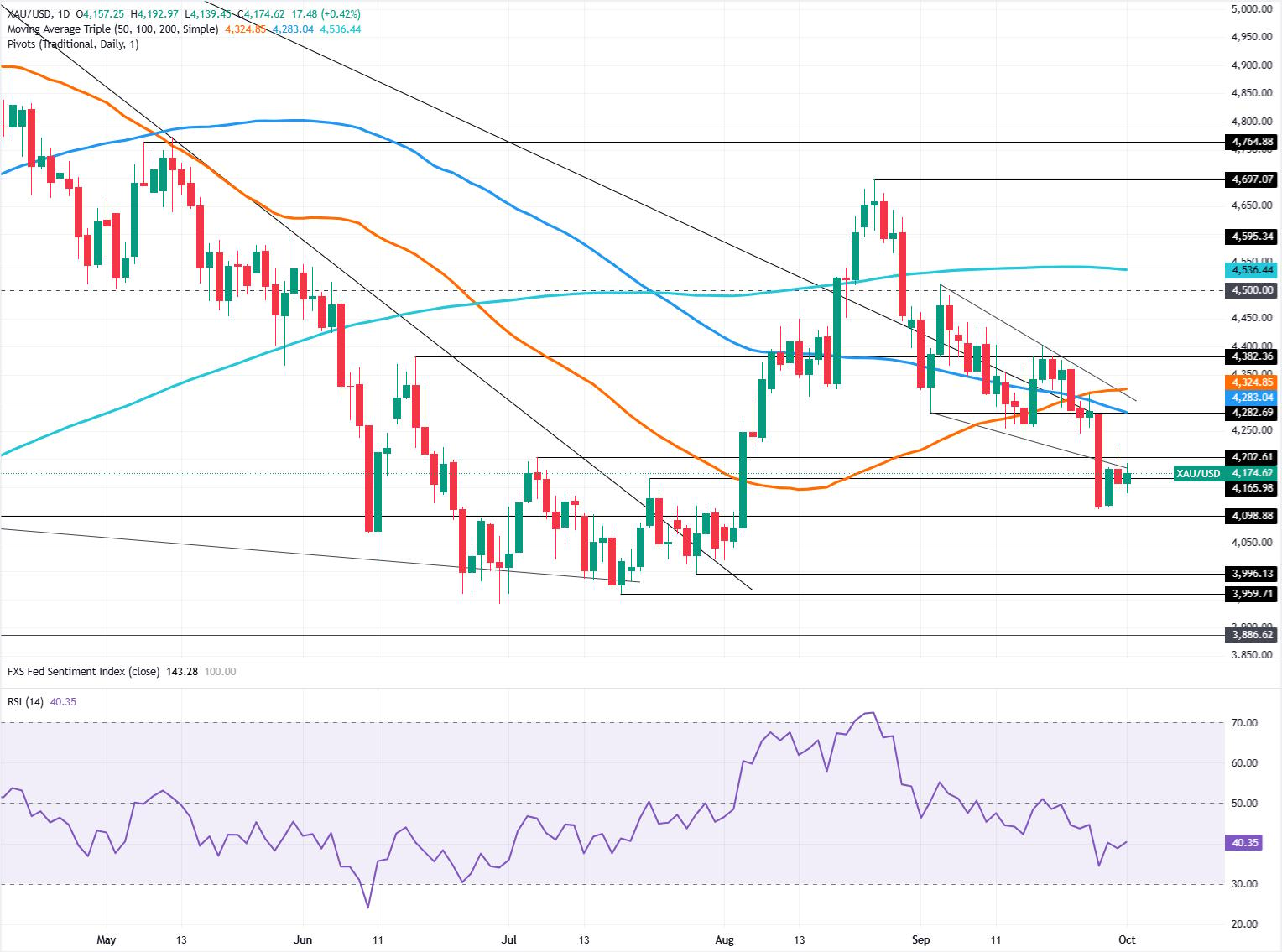
XAU/USD technical analysis: Gold struggles at $4,200, consolidates near $4,170
Price action shows Gold facing strong resistance at $4,200 after a breakout to the downside of a potential Bullish Wedge, which, once negated, opened the door for further losses.
Momentum is moving in favor of buyers, but overall, it remains bearish as the Relative Strength Index (RSI) is below the 50 neutral level.
For a bullish continuation, XAU/USD must reclaim the $4,200 mark. Once done, this opens the path to challenge the 100-day Simple Moving Average (SMA) at $4,283, ahead of $4,300. Once cleared, the next key resistance is the 50-day SMA at $4,324.
On the other hand, the path of least resistance, Gold’s first support is the low of the day (LOD) at $4,139, which, once breached, could test $4,100. Below there, the next support is the July 29 swing low of $3,996, followed by the July 17 low at $3,959. Once those levels are hurdled, the next area of interest is the year-to-date (YTD) low at $3,941.
Gold FAQs
Gold has played a key role in human’s history as it has been widely used as a store of value and medium of exchange. Currently, apart from its shine and usage for jewelry, the precious metal is widely seen as a safe-haven asset, meaning that it is considered a good investment during turbulent times. Gold is also widely seen as a hedge against inflation and against depreciating currencies as it doesn’t rely on any specific issuer or government.
Central banks are the biggest Gold holders. In their aim to support their currencies in turbulent times, central banks tend to diversify their reserves and buy Gold to improve the perceived strength of the economy and the currency. High Gold reserves can be a source of trust for a country’s solvency. Central banks added 1,136 tonnes of Gold worth around $70 billion to their reserves in 2022, according to data from the World Gold Council. This is the highest yearly purchase since records began. Central banks from emerging economies such as China, India and Turkey are quickly increasing their Gold reserves.
Gold has an inverse correlation with the US Dollar and US Treasuries, which are both major reserve and safe-haven assets. When the Dollar depreciates, Gold tends to rise, enabling investors and central banks to diversify their assets in turbulent times. Gold is also inversely correlated with risk assets. A rally in the stock market tends to weaken Gold price, while sell-offs in riskier markets tend to favor the precious metal.
The price can move due to a wide range of factors. Geopolitical instability or fears of a deep recession can quickly make Gold price escalate due to its safe-haven status. As a yield-less asset, Gold tends to rise with lower interest rates, while higher cost of money usually weighs down on the yellow metal. Still, most moves depend on how the US Dollar (USD) behaves as the asset is priced in dollars (XAU/USD). A strong Dollar tends to keep the price of Gold controlled, whereas a weaker Dollar is likely to push Gold prices up.
Author

Christian Borjon Valencia
FXStreet
Markets analyst, news editor, and trading instructor with over 14 years of experience across FX, commodities, US equity indices, and global macro markets.

















