GBP/USD technical bias remains bearish while below 1.2400
- GBP/USD bears could be lurking and ready to move in while below 1.2400.
- US data remains a thorn in the side of the US Dollar bulls.

GBP/USD is higher on the day having traded up to 1.2377 in recent trade while the US Dollar tails off and gives flight to risky assets and risk-on forex such as GBP. The Great British Pound rallied from a low of 1.2312 as interest rate sentiment for the Bank of England continues to support the currency despite the bearish technical developments on the charts (more on that below),
Meanwhile, there are a number of themes in play: The US Dollar, for one, has been under pressure following yet more disinflationary economic data on Thursday that has shown that the US economy is losing momentum. Then, the Yen has been rebounding as traders continued to bet the Bank of Japan, BoJ, will shift away from an ultra-loose monetary policy.
United States of America's disinflationary backdrop
In terms of data, yesterday, the Federal Reserve's Beige Book showed that since the previous report, overall economic activity hasd remained relatively stable and overall, contacts expected little growth in the coming months.
Key notes
Selling prices increased at a modest or moderate pace in most districts, though many said that the pace of increases had slowed from that of recent reporting periods.
Employment continued to grow at a modest to moderate pace for most districts.
On balance, contacts generally expected little growth in the months ahead.
Wage pressures remained elevated across districts, though five reserve banks reported that these pressures had eased somewhat.
Prior to that release, the Producer Price Index, PPI, and Retail Sales, which showed disinflationary tendencies in the data, reinforced expectations that the Federal Reserve will continue to reduce its tightening pace in upcoming meetings.
It is also worth noting that the US Atlanta Fed GDPNow Q4: 3.5% (prev 4.1%).
Meanwhile, on Thursday, while the Philadelphia Federal Reserve's monthly manufacturing survey showed a notable improvement in the prices paid index, which skidded to 24.5 in January from 36.3 last month, the reading, however, which is a key measure of inflation at the producer level, was the lowest since August 2020.
The fourth-quarter earnings outlook also ''looks bleak'', as reported by Reuters: ''Companies are reporting earnings 2.6% above expectations, compared to a long-term average of 4.1% since 1994 and 5.3% for the past four quarters, according to IBES data from Refinitiv.''
US Dollar on the backfoot
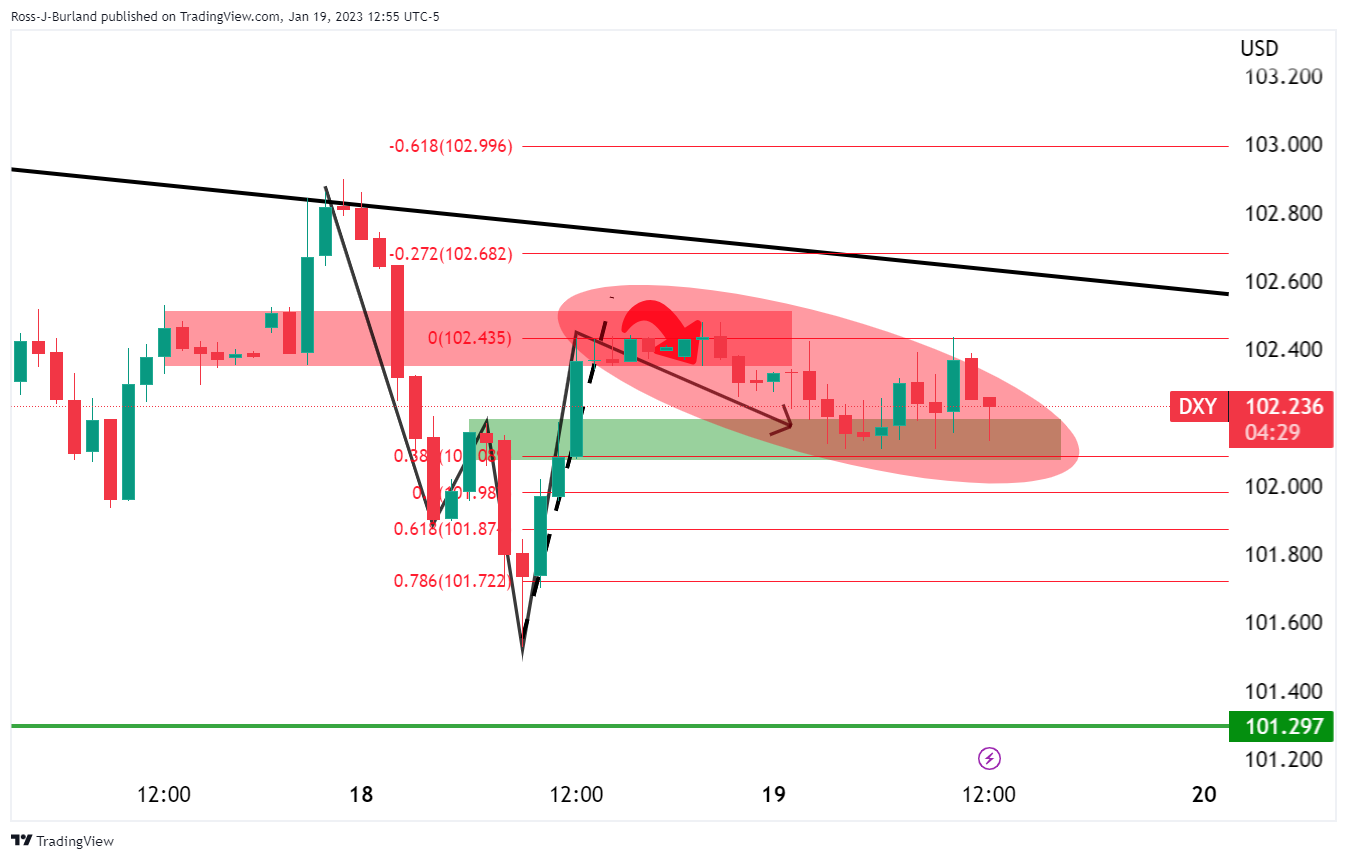
The US Dollar index, DXY, has subsequently been unable to pick itself up from the floor, an area on the charts that was highlighted as a downside target as follows:
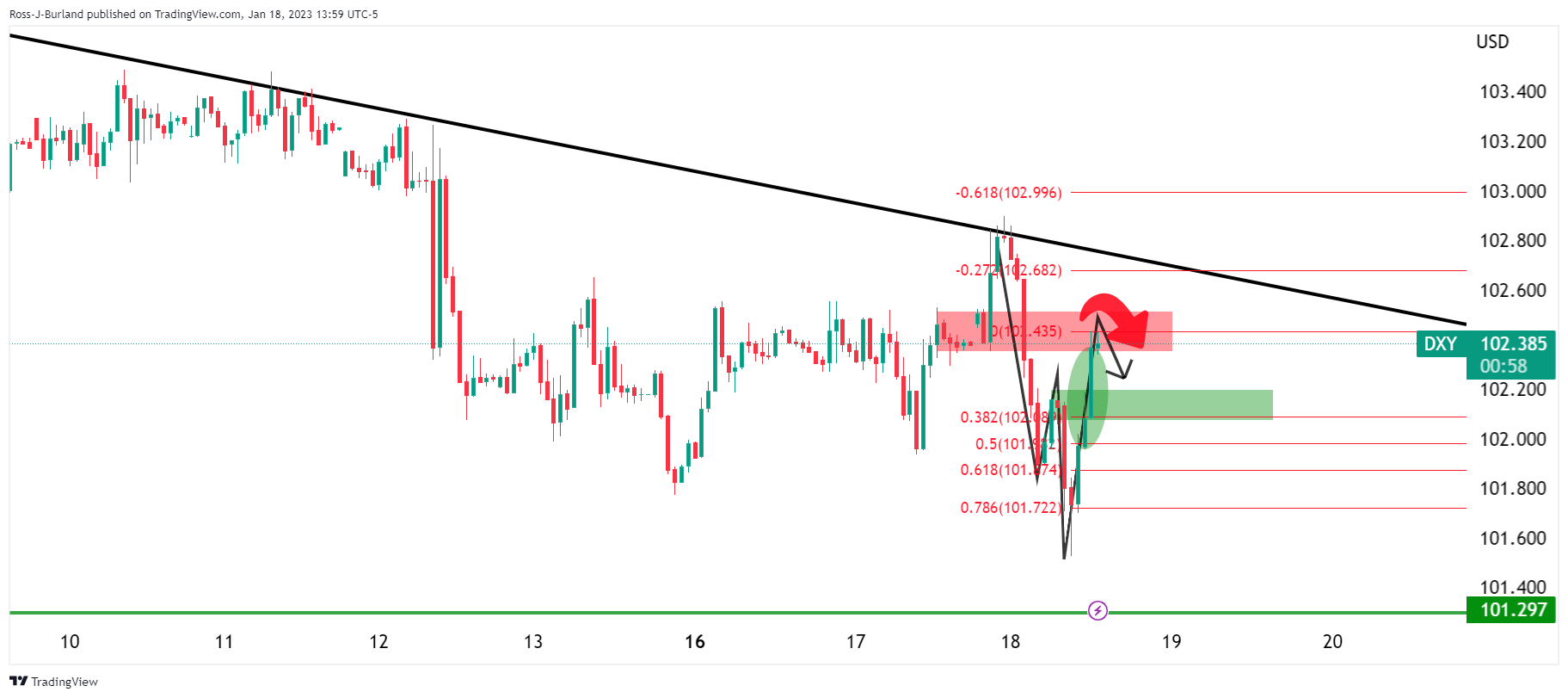
''The DXY index, above, shows the US Dollar meeting resistance in a W-formation on the hourly chart. A correction of the bid could be expected to meet the 102.00/20s in the coming sessions as the price reverts to the neckline of the pattern in a 38.2% Fibonacci correction.''
US Dollar index update:
Bank of England outlook supports GBP/USD
Nevertheless, the British Pound Sterling has been unable to really take off on its own accord despite the United Kingdom's Consumer Price Index showing the prior day that it remains near 40-year highs. Specifically, the data showed yesterday that there was an increase in services inflation and accelerating food/drink prices which will be a cause for some concern for the Bank of England's policy-makers. Analysts at ING Bank, making remarks on the Consumer Price Index said "it's important to note that core services jumped from 6.4% to 6.8%, a development that the BoE should particularly take into consideration, and when added to wage data should tilt the balance towards a 50 bps hike in February."
Therefore, a hawkish Bank of England could still inject some resilience into the pound. The Bank of England's Governor Andrew Bailey argued at the start of the week that a shortage of workers in the labour market posed a “major risk to inflation coming down”.
''The implication is that the Bank of England could remain more hawkish on its policy decisions this year,'' analysts at Rabobank said. ''We expect another 50 bps rate hike in February and then three more 25 bps moves as the Bank struggles to slice the final few percentage points from services sector inflation, which will be most impacted by wage growth,'' the analysts at Rabobank argued.
GBP/USD technical analysis
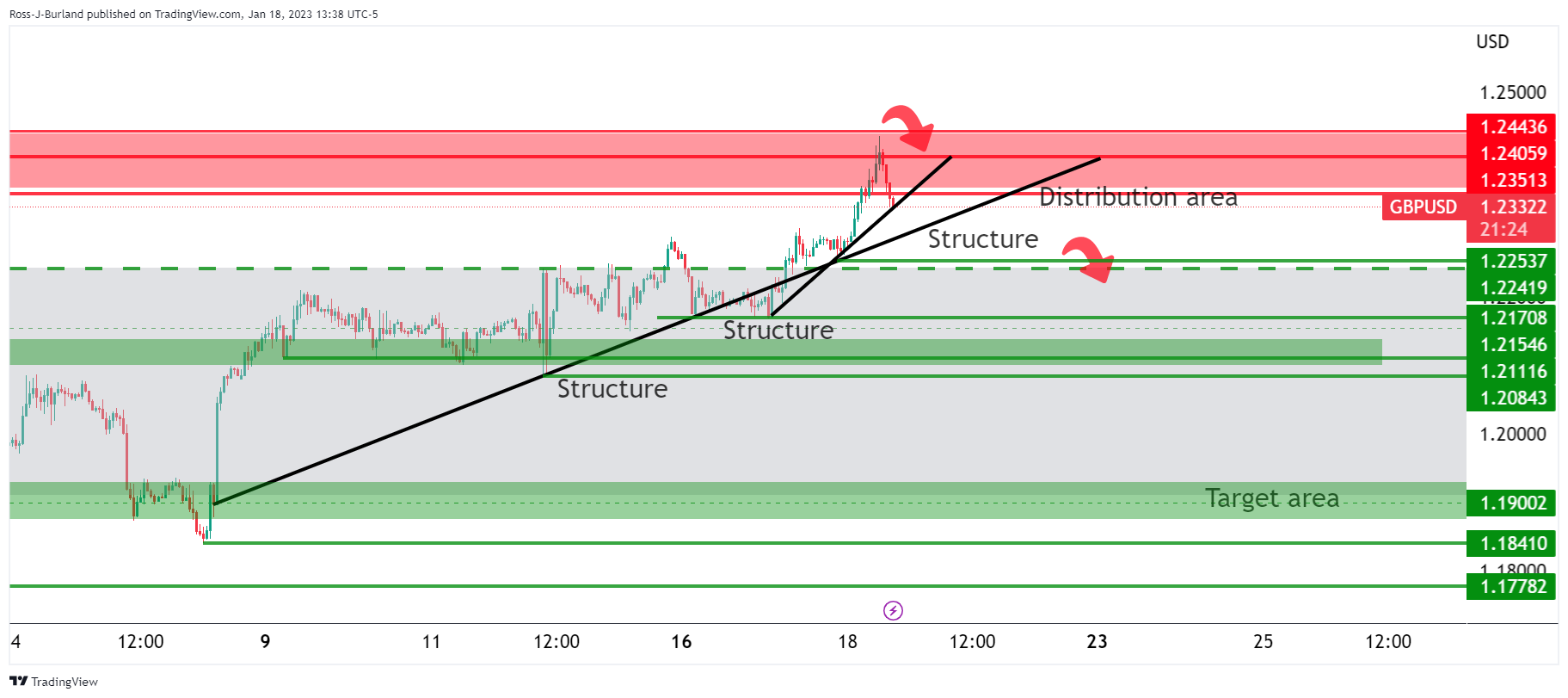
On the hourly time frame, it was noted yesterday that GBP/USD's micro-trendline support guarded structure around 1.2250. A break there was explained to be a key development if it occurred, as it would open the risk of a blow-off in GBP/USD to test 1.2170 and then 1.2080 structure.
GBP/USD update
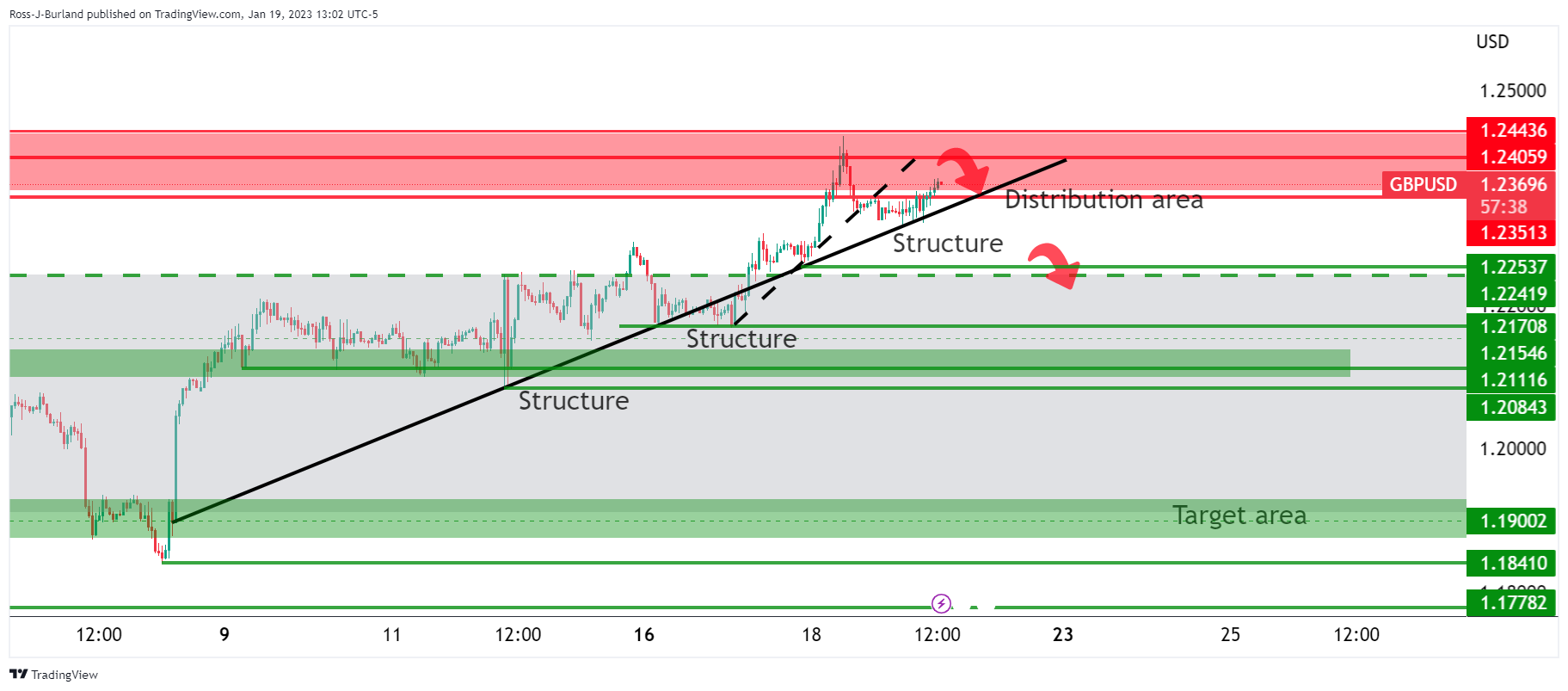
As seen, the GBP/USD price has indeed broken the micro trendline. It is perfectly natural for the subsequent price action, as a function of the market, to eat into prior highs and that is what we are seeing: mitigation of price imbalances left behind:
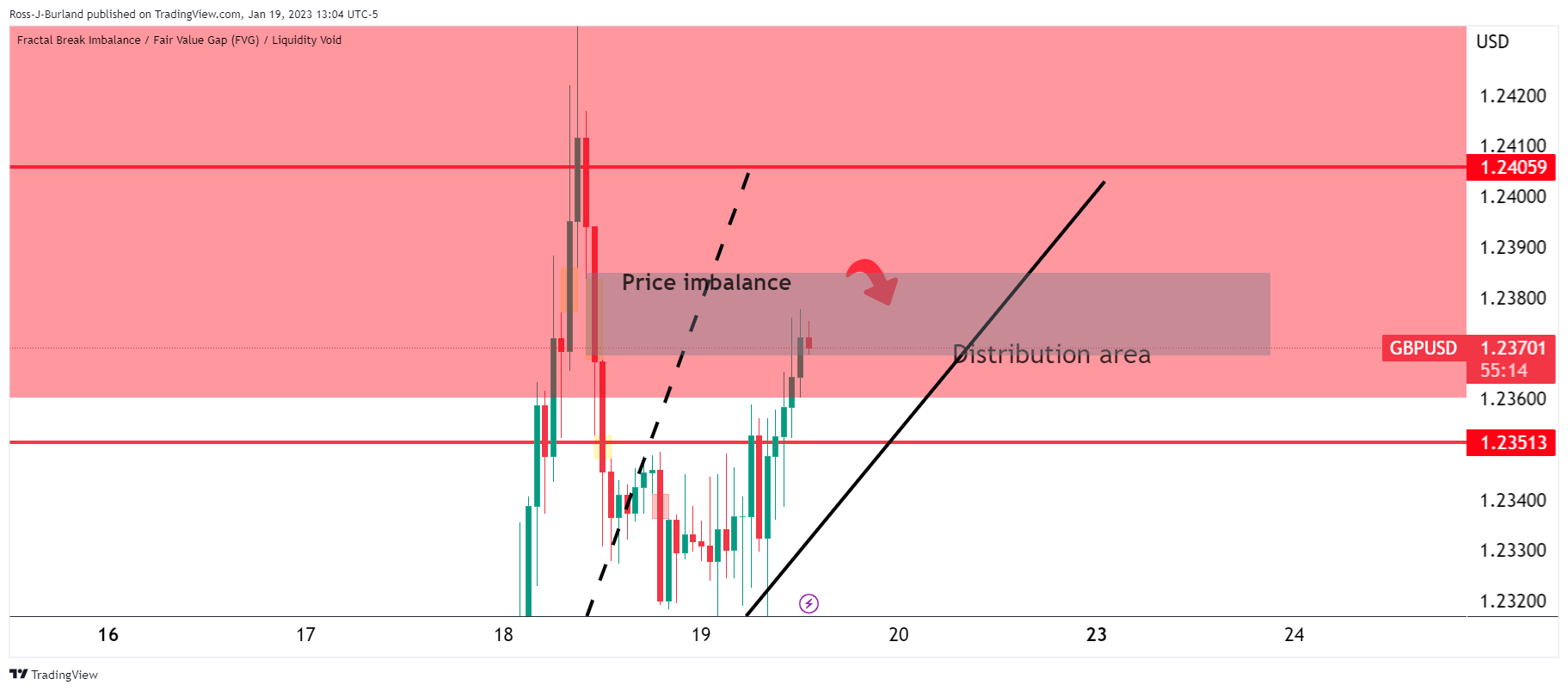
Therefore, the technical bias for GBP/USD remains bearish while below 1.2400.
Author

Ross J Burland
FXStreet
Ross J Burland, born in England, UK, is a sportsman at heart. He played Rugby and Judo for his county, Kent and the South East of England Rugby team.
















