GBP/USD Price Forecast: Brief pause after vertical fall near 1.3000
- GBP/USD edges down to near 1.3100 as the US Dollar rebounds.
- The US core PCE inflation reading arrives higher at 3.3% YoY vs. 3.2% estimates.
- BoE’s Mann advocates more interest rate hikes.


The British Pound (GBP) trades marginally lower at around 1.3100 against the US Dollar (USD) during the European trading session on Thursday. The GBP/USD pair edges down as the US Dollar regains ground after a two-day corrective move.
As of writing, the US Dollar Index (DXY), which gauges the Greenback’s value against six major currencies, is up 0.13% to near 103.85, closer to its almost 21-month of 104.57 posted on Monday.
The US Dollar attracts bids amid expectations that the Federal Reserve (Fed) will continue its monetary tightening cycle for a longer period.
Hawkish Fed expectations are backed by hot United States (US) Personal Consumption Expenditure (PCE) Price Index report for October, which showed on Wednesday that the core figure grew by 3.3% Year-on-Year (YoY), faster than 3.2% estimates and the previous reading of 3.1%.
According to the CME FedWatch tool, traders look certain that the Fed will hike interest rates in the December policy meeting and see an almost 60% chance of delivering another in the January gathering.
On the British Pound front, Bank of England (BoE) Monetary Policy Committee (MPC) Member Catherine Mann has advocated for more interest rate hikes, citing upside inflation risks.
BoE’s Mann backs earlier and larger hikes, lifting GBP rate expectations
BoE’s Mann scores 9.4/10 on FXS Speechtracker, above the historic 8.8/10 baseline, signaling a distinctly more hawkish stance. The emphasis that energy futures have not been a good guide and that inflation expectations have an upward bias reinforces the case for tighter policy and supports GBP on the rates channel.
The assertion that the optimal response is to hike more and sooner, alongside doubts that squeezed profit margins can keep restraining inflation, points to a preference for front-loaded tightening. The comment that larger moves have a bigger impact on price strategies underlines a willingness to use bigger rate steps, which markets are likely to read as hawkish for GBP and UK yields.
GBP/USD Technical Analysis
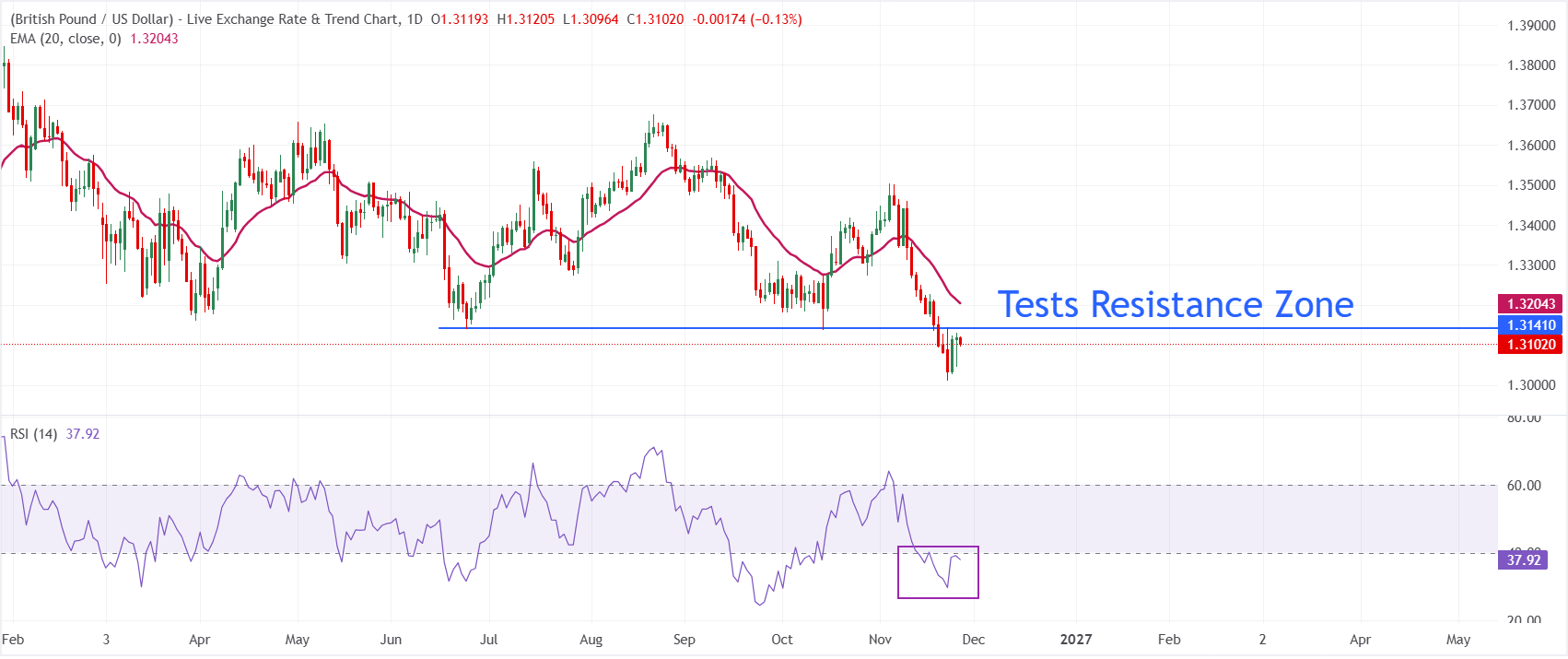
In the daily chart, GBP/USD trades at 1.3102, extending its retreat below the short-term Moving Average Exponential (20-day EMA) at 1.3204, which now caps the topside and reinforces a bearish near-term bias. The Relative Strength Index (14) at about 38 remains in negative territory but above oversold levels, hinting at persistent downside pressure rather than a capitulation sell-off.
On the topside, immediate resistance emerges at November 23 high of 1.3144, followed by the 20-day EMA around 1.3204, and a daily close back above this barrier would be needed to ease the current bearish tone. Looking down, the November 23 low at 1.3011 would act as key support level, a deicisive close below that level would expose the pair to 1.2900.
(The technical analysis of this story was written with the help of an AI tool. Know more.)
Fed FAQs
Monetary policy in the US is shaped by the Federal Reserve (Fed). The Fed has two mandates: to achieve price stability and foster full employment. Its primary tool to achieve these goals is by adjusting interest rates. When prices are rising too quickly and inflation is above the Fed’s 2% target, it raises interest rates, increasing borrowing costs throughout the economy. This results in a stronger US Dollar (USD) as it makes the US a more attractive place for international investors to park their money. When inflation falls below 2% or the Unemployment Rate is too high, the Fed may lower interest rates to encourage borrowing, which weighs on the Greenback.
The Federal Reserve (Fed) holds eight policy meetings a year, where the Federal Open Market Committee (FOMC) assesses economic conditions and makes monetary policy decisions. The FOMC is attended by twelve Fed officials – the seven members of the Board of Governors, the president of the Federal Reserve Bank of New York, and four of the remaining eleven regional Reserve Bank presidents, who serve one-year terms on a rotating basis.
In extreme situations, the Federal Reserve may resort to a policy named Quantitative Easing (QE). QE is the process by which the Fed substantially increases the flow of credit in a stuck financial system. It is a non-standard policy measure used during crises or when inflation is extremely low. It was the Fed’s weapon of choice during the Great Financial Crisis in 2008. It involves the Fed printing more Dollars and using them to buy high grade bonds from financial institutions. QE usually weakens the US Dollar.
Quantitative tightening (QT) is the reverse process of QE, whereby the Federal Reserve stops buying bonds from financial institutions and does not reinvest the principal from the bonds it holds maturing, to purchase new bonds. It is usually positive for the value of the US Dollar.
Author
Sagar Dua
FXStreet
Sagar Dua is associated with the financial markets from his college days. Along with pursuing post-graduation in Commerce in 2014, he started his markets training with chart analysis.

















