ECB Press Conference: Lagarde speaks on policy outlook after leaving key rates unchanged

Christine Lagarde, President of the European Central Bank (ECB), explains the ECB's decision to leave key rates unchanged at the July policy meeting and responds to questions from the press.
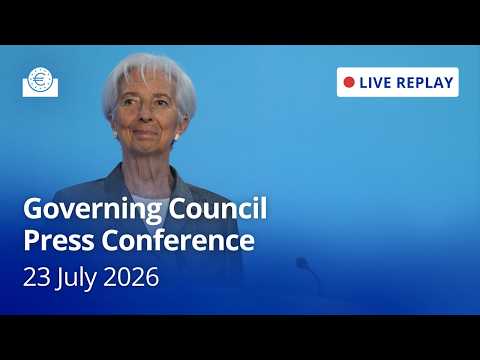
ECB press conference highlights
"Recent data points to some improvement in economic activity."
"Firms, households expect labour market to remain weaker than before conflict."
"Indicators suggest economic activity will remain modest."
"Energy shock feeding into higher prices."
"Firms expect to raise selling prices."
"Underlying inflation contained, full effect yet to play out."
"Surveys indicate moderate wage growth."
"Rising labour productivity helps contain unit labour cost growth."
"Most measures of longer-term inflation expectations stand at around 2%."
"Energy inflation likely to keep inflation well above target into first half of 2027."
"Inflation will then decline."
"Conflict a major source of uncertainty."
"Risks to growth tilted to downside."
"Higher energy prices will weigh on real incomes."
"Risks to inflation tilted to upside."
"Energy shock could intensify further."
"Longer energy prices stay high, the likely to have second round impacts."
"Extreme weather events, climate crisis could drive up food prices."
"Have had some relatively benign developments since June decision."
"Post-MOU drop in Brent crude was quicker than anticipated."
"Studied density, durability, propagation of supply shock."
"Decision was unanimous."
"There were some who asked whether we should consider a hike."
"Positioned adequately to wait."
"Will receive long list of fresh data before September meeting."
"Particularly attentive to any risk of second round effects."
"Decision was unanimous."
"There were some who asked whether we should consider a hike."
"Positioned adequately to wait."
"Will receive long list of fresh data before September meeting."
"Particularly attentive to any risk of second round effects."
"Not seeing second round effects yet."
"Gradual decline in wages still happening."
"Not giving any forward guidance."
This section below was published at 12:15 GMT to cover the European Central Bank's (ECB) policy announcements and the initial market reaction.
The European Central Bank (ECB) announced on Thursday that it left key rates unchanged following the July policy meeting, as expected. With this decision, the interest rate on the main refinancing operations, the interest rates on the marginal lending facility and the deposit facility stood at 2.4%, 2.65% and 2.25%, respectively.

ECB policy statement key takeaways
"Outlook for energy prices, while highly volatile, currently stands close to baseline of June Eurosystem staff projections and well above levels recorded prior to conflict in Middle East."
"Uncertainty remains high and full inflationary impact of energy shock has yet to play out."
"With today’s decision, ECB remains well positioned to navigate uncertainty caused by conflict."
"Will follow a data-dependent and meeting-by-meeting approach to determining appropriate monetary policy stance."
"In particular, ECB’s interest rate decisions will be based on its assessment of inflation outlook and risks surrounding it, in light of incoming economic and financial data, as well as dynamics of underlying inflation and strength of monetary policy transmission."
"ECB is not pre-committing to a particular rate path."
"APP and Pandemic Emergency Purchase Programme (PEPP) APP and PEPP portfolios are declining at a measured and predictable pace, as eurosystem no longer reinvests principal payments from maturing securities."
"ECB stands ready to adjust all of its instruments within its mandate to ensure that inflation stabilises at its 2% target in medium term and to preserve smooth functioning of monetary policy transmission."
Market reaction to ECB policy decisions
EUR/USD remains under modest bearish pressure and was last seen losing 0.23% on the day at 1.1385.
Euro Price Today
The table below shows the percentage change of Euro (EUR) against listed major currencies today. Euro was the weakest against the Canadian Dollar.
| USD | EUR | GBP | JPY | CAD | AUD | NZD | CHF | |
|---|---|---|---|---|---|---|---|---|
| USD | 0.23% | 0.20% | 0.21% | -0.08% | 0.12% | 0.54% | 0.24% | |
| EUR | -0.23% | -0.01% | 0.00% | -0.32% | -0.11% | 0.34% | 0.00% | |
| GBP | -0.20% | 0.01% | 0.02% | -0.32% | -0.10% | 0.35% | 0.02% | |
| JPY | -0.21% | 0.00% | -0.02% | -0.30% | -0.11% | 0.32% | 0.01% | |
| CAD | 0.08% | 0.32% | 0.32% | 0.30% | 0.18% | 0.63% | 0.31% | |
| AUD | -0.12% | 0.11% | 0.10% | 0.11% | -0.18% | 0.46% | 0.14% | |
| NZD | -0.54% | -0.34% | -0.35% | -0.32% | -0.63% | -0.46% | -0.33% | |
| CHF | -0.24% | -0.01% | -0.02% | -0.01% | -0.31% | -0.14% | 0.33% |
The heat map shows percentage changes of major currencies against each other. The base currency is picked from the left column, while the quote currency is picked from the top row. For example, if you pick the Euro from the left column and move along the horizontal line to the US Dollar, the percentage change displayed in the box will represent EUR (base)/USD (quote).
This section below was published as a preview of the European Central Bank's (ECB) monetary policy decisions at 08:00 GMT.
- The European Central Bank is expected to hold key interest rates steady on Thursday, following a June hike.
- All eyes will be on ECB President Lagarde’s words amid cooling inflation, weaker growth and a pullback in Oil prices.
- The Euro faces two-way risks heading into the ECB policy announcements.
The European Central Bank (ECB) is expected to hold the interest rate on the main refinancing operations and the deposit facility steady at 2.4% and 2.25%, respectively. The decision will be announced on Thursday at 12:15 GMT.
Unlike in June, the interest rate decision will not be accompanied by the staff’s updated economic projections this time, but will be followed by ECB President Christine Lagarde’s press conference at 12:45 GMT.
The Euro is set to rock on the ECB’s policy announcements, as traders will look for fresh cues on the central bank’s rate hike prospects.
What to expect from the ECB interest rate decision?
At last month's monetary policy meeting, the ECB changed course and hiked rates by 25 basis points (bps) in response to the energy shock triggered by the Middle East war.
Meanwhile, the ECB said in its June meeting Accounts, which were released earlier this month, that "communication should remain neutral, neither suggesting that the current decision was the first of a sequence of hikes to come nor that it was a one-off move.” This suggested that policymakers agreed to keep their options open to respond to different scenarios in the US-Iran conflict.
Since the June meeting, inflation has cooled more than expected, helped by lower energy prices and easing underlying price pressures. The Eurozone’s core Harmonised Index of Consumer Prices (HICP) rose by 0.2% month on month in June, softening from 0.3% in the prior reading.
A brief de-escalation of Middle East tensions pulled Oil prices back to pre-war levels. Easing inflationary concerns could give the ECB some room to pause its rate path and wait for September’s updated staff projections before deciding on a potential hike.
However, natural gas and refined fuel prices remain elevated, while inflation expectations are still projected to stay above the ECB's 2% target through 2027. Additionally, the renewed outbreak of hostilities in the Middle East seen so far this month has revived the Oil price uptrend and inflation fears.
At the same time, the Eurozone economy is losing momentum. Growth is slowing and business activity remains weak amid worsening labor market conditions. The bloc’s economy contracted by 0.2% in the first quarter of 2026, compared with the estimated 0.1% growth expected.
These concerning factors could throw the ECB into a dilemma between supporting growth and containing elevated inflation.
President Lagarde, therefore, could stick to the ECB's meeting-by-meeting and data-dependent approach on Thursday, keeping the door open to another rate hike in September but with a non-committal stance.
How could the ECB meeting impact EUR/USD?
The Euro holds near 1.1400 against the US Dollar (USD) after correcting from the monthly high of 1.1482 hit on July 15 as traders brace for the ECB showdown, with the tone of the meeting likely to matter far more than the rate decision itself.
If Lagarde continues to emphasize upside inflation risks, keeps September rate hike expectations firmly on the table and signals that policy may need to remain restrictive for longer, markets could read this as a hawkish hold decision, providing near-term support to the Euro. That scenario could allow EUR/USD to retest the 1.1600 threshold, particularly if markets rebuild expectations for one final ECB rate hike in September.
Conversely, if the central bank’s president acknowledges slowing growth, softer inflation and a weakening labour market while sounding less confident about further tightening, traders could quickly scale back bets for a September rate hike. That would likely weigh on the Euro, dragging the pair back toward the 1.1350 region.
Dhwani Mehta, Asian Session Lead Analyst at FXStreet, highlights key technical levels for trading EUR/USD following the monetary policy announcement.
“EUR/USD maintains a bearish near-term bias as the pair holds beneath a dense stack of moving averages. The 50-day simple moving average (SMA) at 1.1510 is the first cap, with the 100-day SMA at 1.1578 and the 200-day SMA at 1.1638 reinforcing a broader topside ceiling. The Relative Strength Index (14) sits below the neutral 50 line, hinting at lingering downside pressure rather than an immediate recovery.”
“On the downside, a break of the 1.1350 demand area would leave EUR/USD probing for new support below the 1.1300 round level,” Dhwani adds.
Euro Price Last 7 Days
The table below shows the percentage change of Euro (EUR) against listed major currencies last 7 days. Euro was the weakest against the Australian Dollar.
| USD | EUR | GBP | JPY | CAD | AUD | NZD | CHF | |
|---|---|---|---|---|---|---|---|---|
| USD | 0.26% | 1.10% | 0.44% | 0.19% | -0.27% | 0.47% | 0.97% | |
| EUR | -0.26% | 0.82% | 0.30% | -0.13% | -0.48% | 0.26% | 0.71% | |
| GBP | -1.10% | -0.82% | -0.55% | -0.96% | -1.32% | -0.89% | -0.12% | |
| JPY | -0.44% | -0.30% | 0.55% | -0.36% | -0.70% | -0.20% | 0.49% | |
| CAD | -0.19% | 0.13% | 0.96% | 0.36% | -0.40% | 0.27% | 0.80% | |
| AUD | 0.27% | 0.48% | 1.32% | 0.70% | 0.40% | 0.71% | 1.16% | |
| NZD | -0.47% | -0.26% | 0.89% | 0.20% | -0.27% | -0.71% | 0.52% | |
| CHF | -0.97% | -0.71% | 0.12% | -0.49% | -0.80% | -1.16% | -0.52% |
The heat map shows percentage changes of major currencies against each other. The base currency is picked from the left column, while the quote currency is picked from the top row. For example, if you pick the Euro from the left column and move along the horizontal line to the US Dollar, the percentage change displayed in the box will represent EUR (base)/USD (quote).
Euro FAQs
The Euro is the currency for the 20 European Union countries that belong to the Eurozone. It is the second most heavily traded currency in the world behind the US Dollar. In 2022, it accounted for 31% of all foreign exchange transactions, with an average daily turnover of over $2.2 trillion a day. EUR/USD is the most heavily traded currency pair in the world, accounting for an estimated 30% off all transactions, followed by EUR/JPY (4%), EUR/GBP (3%) and EUR/AUD (2%).
The European Central Bank (ECB) in Frankfurt, Germany, is the reserve bank for the Eurozone. The ECB sets interest rates and manages monetary policy. The ECB’s primary mandate is to maintain price stability, which means either controlling inflation or stimulating growth. Its primary tool is the raising or lowering of interest rates. Relatively high interest rates – or the expectation of higher rates – will usually benefit the Euro and vice versa. The ECB Governing Council makes monetary policy decisions at meetings held eight times a year. Decisions are made by heads of the Eurozone national banks and six permanent members, including the President of the ECB, Christine Lagarde.
Eurozone inflation data, measured by the Harmonized Index of Consumer Prices (HICP), is an important econometric for the Euro. If inflation rises more than expected, especially if above the ECB’s 2% target, it obliges the ECB to raise interest rates to bring it back under control. Relatively high interest rates compared to its counterparts will usually benefit the Euro, as it makes the region more attractive as a place for global investors to park their money.
Data releases gauge the health of the economy and can impact on the Euro. Indicators such as GDP, Manufacturing and Services PMIs, employment, and consumer sentiment surveys can all influence the direction of the single currency. A strong economy is good for the Euro. Not only does it attract more foreign investment but it may encourage the ECB to put up interest rates, which will directly strengthen the Euro. Otherwise, if economic data is weak, the Euro is likely to fall. Economic data for the four largest economies in the euro area (Germany, France, Italy and Spain) are especially significant, as they account for 75% of the Eurozone’s economy.
Another significant data release for the Euro is the Trade Balance. This indicator measures the difference between what a country earns from its exports and what it spends on imports over a given period. If a country produces highly sought after exports then its currency will gain in value purely from the extra demand created from foreign buyers seeking to purchase these goods. Therefore, a positive net Trade Balance strengthens a currency and vice versa for a negative balance.
Author

FXStreet Team
FXStreet
Composed of a group of economic journalists and FX experts, the FXStreet content team produces and oversees all content published on FXStreet. It provides a purely journalistic approach to the Forex market.
















