Euro stalls as high energy prices increase Fed hawkish bets
- Red Sea tanker attacks lift Oil and Fed tightening bets.
- Markets price higher July hike risk before Fed decision.
- ECB hold and Lagarde remarks guide Euro’s next move.

The EUR/USD consolidates near 1.1400 late on Wednesday, up a modest 0.08%, as it consolidates, with the shared currency failing to capitalise on overall US Dollar weakness across the board.
EUR/USD steadies as Middle East escalation limits Dollar downside
The escalation of the US-Iran war might boost the Greenback in the near-term. US President Donald Trump warned Iran that any ship attacked would trigger retaliation, which includes bombing a bridge or power plants near Iran’s capital.
The US continued its attacks for the twelfth consecutive day. Meanwhile, the UK Maritime Trade Operations (UKMTO) reported an attack to a tanker within the Red Sea. Recently, Yemen’s Houthis announced that they attacked two Saudi oil tankers.
This pushed Oil prices higher, as West Texas Intermediate (WTI) rose nearly 8% to $88 per barrel, increasing the chances that the Federal Reserve could tighten monetary policy sooner rather than later.
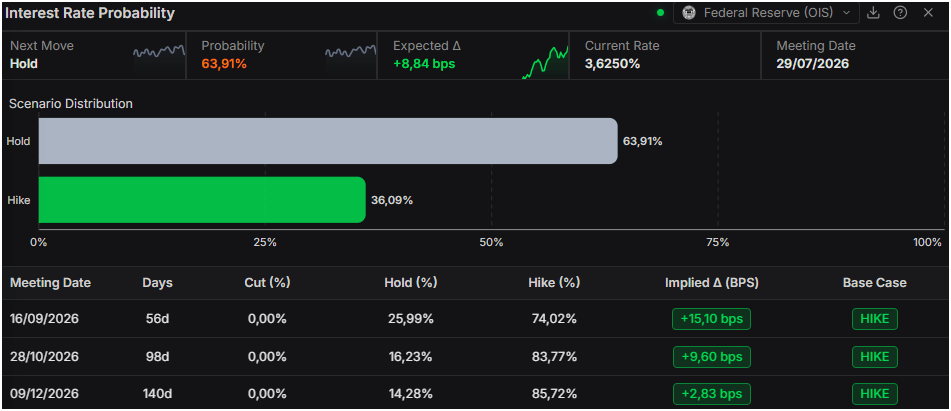
Money markets had priced in a 63% that the US central bank will keep rates unchanged at the July 29 meeting. This leaves a 37% chance of a rate hike, up from 23% a day ago, according to Prime Terminal data.
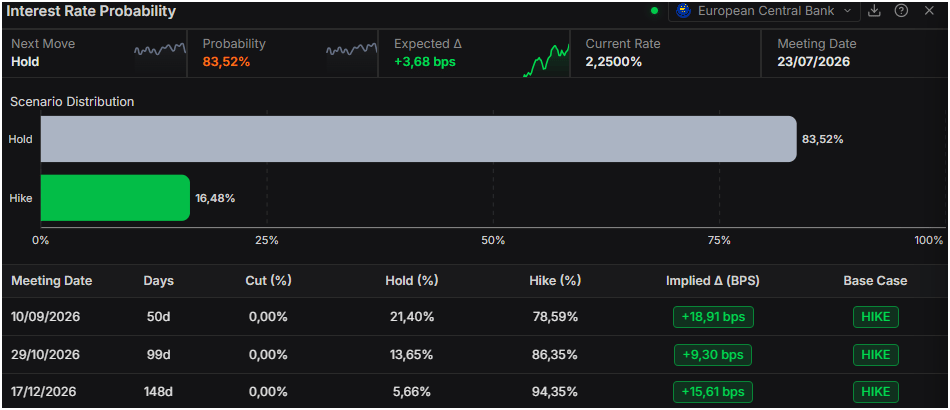
On Thursday, the European Central Bank (ECB) will release its latest monetary policy decision, in which the central bank is expected to hold the ECB FRate On Deposit Facility unchanged at 2.25%. After the decision, eyes would be on the press conference led by ECB President Christine Lagarde.
Across the pond, the US economic schedule will be light, with the release of Initial Jobless Claims for the week ending July 18, which are expected to rise from 208K to 212K.
EUR/USD Price Forecast: Technical outlook
In the daily chart, EUR/USD trades at 1.1408, keeping a bearish near-term bias as spot holds beneath the latest triple simple moving average at 1.1510 and within a downward parallel channel. The pair is trading just over the channel floor at 1.1396, while the prior downtrend resistance line’s break level at 1.1574 and the channel top at 1.1570 remain well overhead, suggesting rallies are likely to be capped. The Relative Strength Index (14) at 43.38 stays below the neutral 50 mark, hinting at weak but not oversold downside momentum in line with the prevailing structure.
On the topside, initial resistance is seen at the clustered area formed by the triple simple moving average around 1.1510, followed by the channel’s upper boundary near 1.1570 and the former trend-line break point at 1.1574, ahead of a stronger horizontal barrier at 1.1849. On the downside, immediate support sits at the bottom of the descending channel near 1.1396; a sustained break below this level would open the way for an extension of the current bearish phase toward lower psychological levels.
(The technical analysis of this story was written with the help of an AI tool. Know more.)
Euro FAQs
The Euro is the currency for the 20 European Union countries that belong to the Eurozone. It is the second most heavily traded currency in the world behind the US Dollar. In 2022, it accounted for 31% of all foreign exchange transactions, with an average daily turnover of over $2.2 trillion a day. EUR/USD is the most heavily traded currency pair in the world, accounting for an estimated 30% off all transactions, followed by EUR/JPY (4%), EUR/GBP (3%) and EUR/AUD (2%).
The European Central Bank (ECB) in Frankfurt, Germany, is the reserve bank for the Eurozone. The ECB sets interest rates and manages monetary policy. The ECB’s primary mandate is to maintain price stability, which means either controlling inflation or stimulating growth. Its primary tool is the raising or lowering of interest rates. Relatively high interest rates – or the expectation of higher rates – will usually benefit the Euro and vice versa. The ECB Governing Council makes monetary policy decisions at meetings held eight times a year. Decisions are made by heads of the Eurozone national banks and six permanent members, including the President of the ECB, Christine Lagarde.
Eurozone inflation data, measured by the Harmonized Index of Consumer Prices (HICP), is an important econometric for the Euro. If inflation rises more than expected, especially if above the ECB’s 2% target, it obliges the ECB to raise interest rates to bring it back under control. Relatively high interest rates compared to its counterparts will usually benefit the Euro, as it makes the region more attractive as a place for global investors to park their money.
Data releases gauge the health of the economy and can impact on the Euro. Indicators such as GDP, Manufacturing and Services PMIs, employment, and consumer sentiment surveys can all influence the direction of the single currency. A strong economy is good for the Euro. Not only does it attract more foreign investment but it may encourage the ECB to put up interest rates, which will directly strengthen the Euro. Otherwise, if economic data is weak, the Euro is likely to fall. Economic data for the four largest economies in the euro area (Germany, France, Italy and Spain) are especially significant, as they account for 75% of the Eurozone’s economy.
Another significant data release for the Euro is the Trade Balance. This indicator measures the difference between what a country earns from its exports and what it spends on imports over a given period. If a country produces highly sought after exports then its currency will gain in value purely from the extra demand created from foreign buyers seeking to purchase these goods. Therefore, a positive net Trade Balance strengthens a currency and vice versa for a negative balance.
Author

Christian Borjon Valencia
FXStreet
Markets analyst, news editor, and trading instructor with over 14 years of experience across FX, commodities, US equity indices, and global macro markets.
















