EUR/USD Price Forecast: Reflects strength ahead of ECB’s policy decision
- EUR/USD trades higher to near 1.1430 ahead of the ECB’s monetary policy announcement.
- The ECB is expected to keep policy rates steady.
- Investors seek fresh cues regarding Eurozone second-round inflation risks.

The Euro (EUR) is up 0.15% at around 1.1430 against the US Dollar (USD) during the early European trading session on Thursday. The EUR/USD pair rises as the major currency outperforms its peers ahead of the European Central Bank’s (ECB) monetary policy announcement at 12:15 GMT.
Euro Price Today
The table below shows the percentage change of Euro (EUR) against listed major currencies today. Euro was the strongest against the US Dollar.
| USD | EUR | GBP | JPY | CAD | AUD | NZD | CHF | |
|---|---|---|---|---|---|---|---|---|
| USD | -0.15% | -0.09% | -0.05% | -0.15% | -0.23% | -0.04% | -0.13% | |
| EUR | 0.15% | 0.08% | 0.11% | 0.00% | -0.08% | 0.13% | 0.03% | |
| GBP | 0.09% | -0.08% | 0.04% | -0.09% | -0.16% | 0.05% | -0.05% | |
| JPY | 0.05% | -0.11% | -0.04% | -0.11% | -0.19% | -0.01% | -0.09% | |
| CAD | 0.15% | 0.00% | 0.09% | 0.11% | -0.09% | 0.11% | 0.01% | |
| AUD | 0.23% | 0.08% | 0.16% | 0.19% | 0.09% | 0.21% | 0.12% | |
| NZD | 0.04% | -0.13% | -0.05% | 0.00% | -0.11% | -0.21% | -0.10% | |
| CHF | 0.13% | -0.03% | 0.05% | 0.09% | -0.01% | -0.12% | 0.10% |
The heat map shows percentage changes of major currencies against each other. The base currency is picked from the left column, while the quote currency is picked from the top row. For example, if you pick the Euro from the left column and move along the horizontal line to the US Dollar, the percentage change displayed in the box will represent EUR (base)/USD (quote).
The ECB is expected to leave policy rates steady after a 25-basis point (bp) hike in the June policy meeting. Therefore, investors will pay close attention to the monetary policy statement and remarks from ECB President Christine Lagarde in the press conference regarding the monetary policy and the inflation outlook.
According to a Reuters report, traders price in two more interest rate hikes from the ECB this year. Market participants would like to know whether fears of second-round effects of inflation in the Eurozone economy are real.
ECB policymaker and Governor of Bank of Italy, Fabio Panetta, said in the mid of the month that the central bank’s goal is to keep inflation expectations firmly anchored and limit indirect and second-round effects of shocks.
Meanwhile, the US Dollar (USD) faces marginal selling pressure despite surging oil prices amid Middle East energy supply risks.
EUR/USD technical analysis
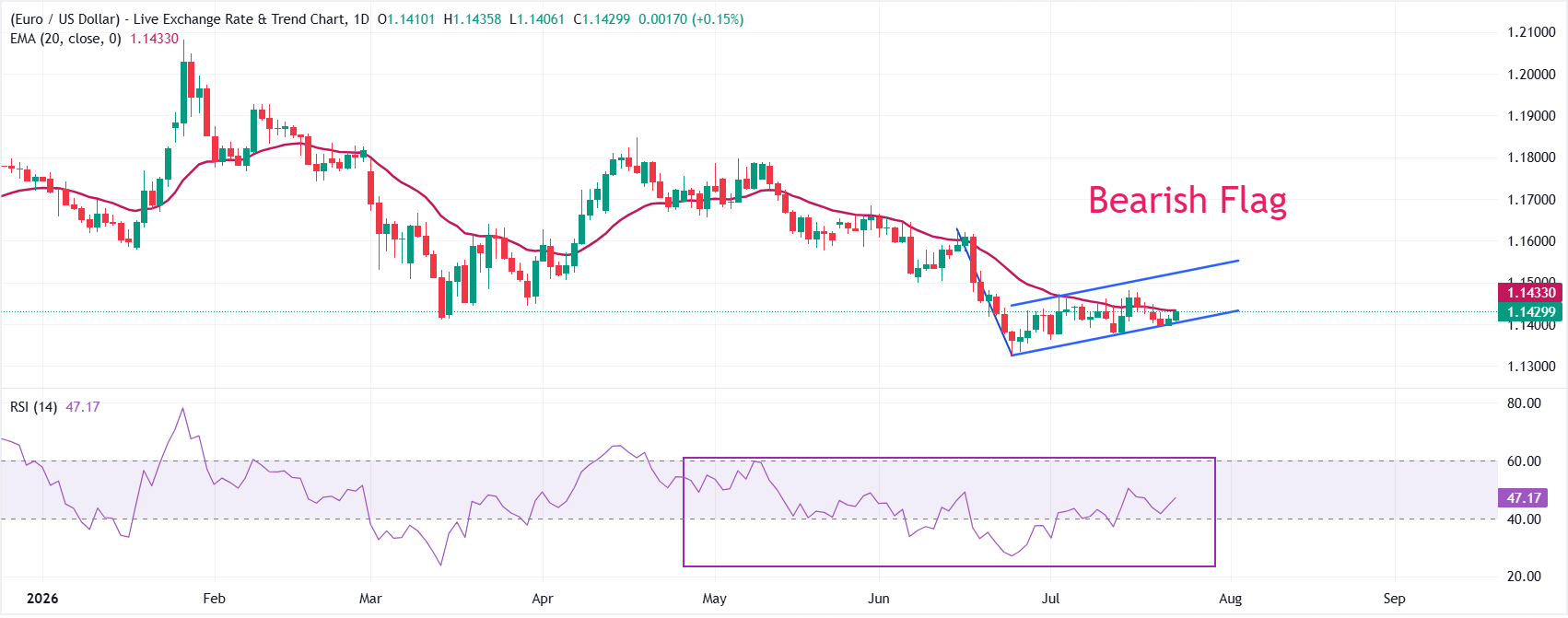
EUR/USD trades higher at around 1.1430 at press time. The major currency pair has rebounded to near the 20-period exponential moving average (EMA), which is at 1.1433, signaling a neutral near-term bias. The pair trades in a Bearish Flag chart pattern, which is a trend-following pattern that continues a downside trend after a brief pause.
The Relative Strength Index (14) stays inside the 40.00-60.00zone, hinting at subdued bullish momentum and reinforcing the idea that rallies are vulnerable while price holds beneath the nearby moving average and trend-line resistance.
On the topside, the psychological level of 1.500 is the immediate resistance, with a more notable barrier at the upper line of the rising channel near 1.1521. On the downside, initial support is seen at the channel’s lower boundary around 1.1402; a clear break beneath this floor would open the way for a deeper slide towards the June 24 low at 1.1384.
(The technical analysis of this story was written with the help of an AI tool. Know more.)
Economic Indicator
ECB Rate On Deposit Facility
One of the European Central Bank's three key interest rates, the rate on the deposit facility, is the rate at which banks earn interest when they deposit funds with the ECB. It is announced by the European Central Bank at each of its eight scheduled annual meetings.
Read more.Next release: Thu Jul 23, 2026 12:15
Frequency: Irregular
Consensus: 2.25%
Previous: 2.25%
Source: European Central Bank
Author

Sagar Dua
FXStreet
Sagar Dua is associated with the financial markets from his college days. Along with pursuing post-graduation in Commerce in 2014, he started his markets training with chart analysis.
















