Canadian Dollar flattens against US Dollar while entering into weekend
- Canadian Dollar trades calm near 1.4240 against the US Dollar, outlook remains uncertain.
- The Fed is certain to hike policy rates in the December meeting.
- BoC Governor Macklem warns of rate hikes if inflation remains high for too long.

The Canadian Dollar (CAD) trades almost flat at around 1.4240 against the US Dollar (USD) during the Asian trading session on Friday. The Loonie pair consolidates while the US Dollar trades subduedly after holiday in United States (US) markets on Thursday due to Thanksgiving Day.
As of writing, the US Dollar Index (DXY), which gauges the Greenback’s value against six major currencies, trades marginally lower to near 103.70. The DXY has corrected from its almost 20-month high of 104.57 posted earlier this week.
However, the outlook of the US Dollar remains firm as upwardly revised Q3 US Gross Domestic Product (GDP) growth and hot Personal Consumption Expenditure (PCE) Price Index report for October have reinforced hawkish Federal Reserve (Fed) expectations.
US data underline still-elevated inflation alongside stronger growth
Analysts at Danske Bank note that October US PCE inflation “was broadly in line with expectations but remain elevated,” with “headline and core PCE both rose 0.3% m/m SA (cons: 0.3%, prior: 0.3%), taking core inflation to 3.3% y/y (cons: 3.2%, prior: 3.1%).” They highlight that while “energy price growth slowed as expected, core goods inflation picked up notably and core services inflation remains on the high side of what is consistent with 2% inflation,” underscoring persistent underlying price pressures.
On activity, Danske Bank points out that “Q3 GDP growth was revised up notably to 4.3% q/q SAAR from 3.4% (cons: 3.5%), driven by stronger private consumption and investment, with final sales to domestic purchasers rising to 5.8% y/y from 4.9%.” The combination of firmer growth and still-elevated core inflation reinforces the picture of a resilient US economy and a labour market that remains consistent with a solid demand backdrop.
According to the CME FedWatch tool, traders are certain that the Fed will hike interest rates in the December policy meeting.
On the Loonie front, the warning from Bank of Canada (BoC) Governor Tiff Macklem, in his speech on Tuesday, that “more rate hikes would be needed if inflation remains high for too long”, has revived fears of monetary tightening.
BoC hawkish tilt keeps December hike in play and questions usd/cad strength
Strategists at Brown Brothers Harriman (BBH) note that BoC Governor Tiff Macklem “struck a hawkish tone” in his latest remarks, even as he acknowledged CPI-trim and CPIX as the BoC’s preferred core gauges. They highlight that Macklem “downplayed the policy significance of underlying inflation near 2%,” stressing instead that “our 2% target applies to total CPI inflation. Core measures are an input into our outlook for total CPI, not a target.” With headline CPI inflation “around 3% since last April” and the bank projecting it “to rise to 3.4% by year-end,” BBH argues that this backdrop “keeps a second straight 25bps rate hike to 2.75% firmly in play on December 9,” leaving the recent USD/CAD “overshoot on shaky ground.”
USD/CAD Technical Analysis
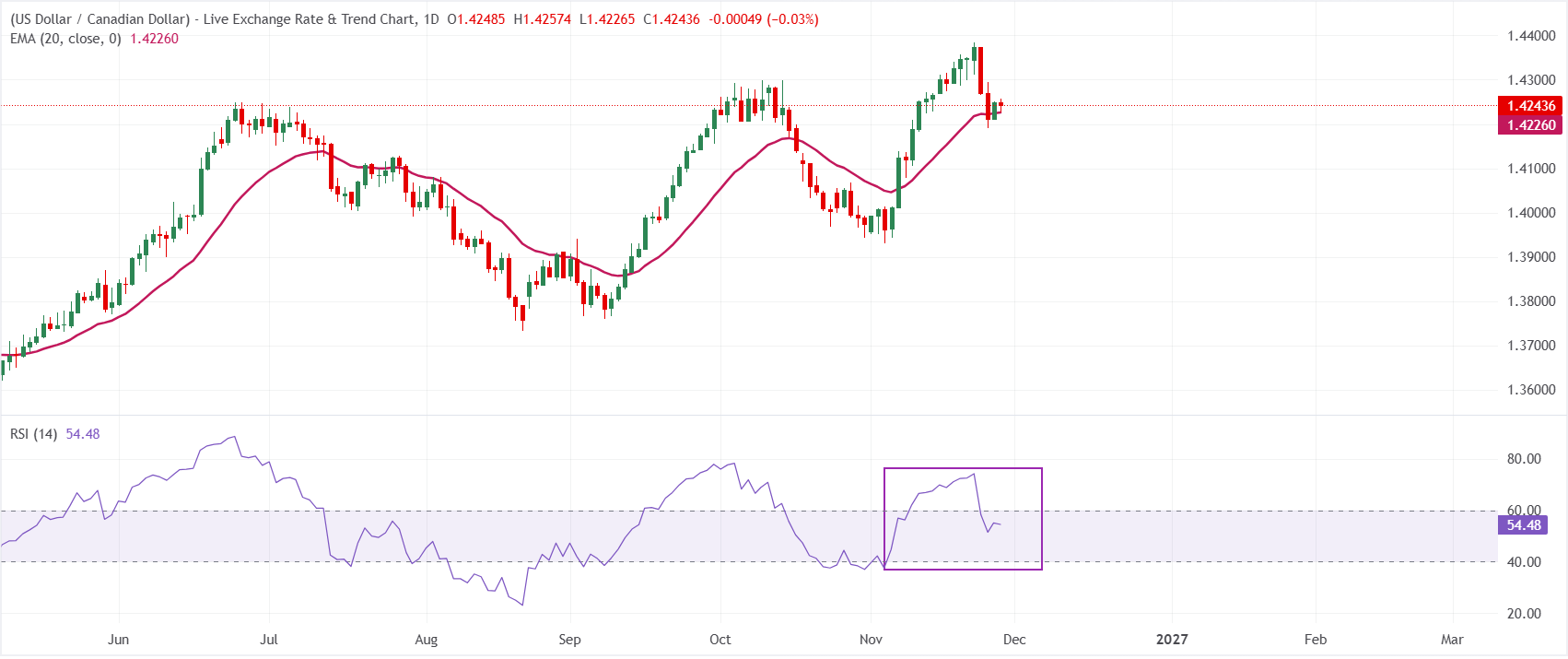
In the daily chart, USD/CAD trades at 1.4244. The pair holds a modest bullish near-term bias as it remains above the 20-day exponential moving average (EMA) at 1.4226, suggesting underlying demand after the recent advance from the 1.40 region. The Relative Strength Index (RSI) at 54.5 has eased out of overbought territory but stays in neutral-to-positive ground, hinting that upside momentum is consolidating rather than reversing.
On the downside, immediate support is provided by the 20-day EMA at 1.4226, which acts as the first line of defense on any pullback. A sustained break below this level would open the door for a deeper correction toward prior lows, while holding above it keeps the broader constructive tone intact for USD/CAD.
(The technical analysis of this story was written with the help of an AI tool. Know more.)
Central banks FAQs
Central Banks have a key mandate which is making sure that there is price stability in a country or region. Economies are constantly facing inflation or deflation when prices for certain goods and services are fluctuating. Constant rising prices for the same goods means inflation, constant lowered prices for the same goods means deflation. It is the task of the central bank to keep the demand in line by tweaking its policy rate. For the biggest central banks like the US Federal Reserve (Fed), the European Central Bank (ECB) or the Bank of England (BoE), the mandate is to keep inflation close to 2%.
A central bank has one important tool at its disposal to get inflation higher or lower, and that is by tweaking its benchmark policy rate, commonly known as interest rate. On pre-communicated moments, the central bank will issue a statement with its policy rate and provide additional reasoning on why it is either remaining or changing (cutting or hiking) it. Local banks will adjust their savings and lending rates accordingly, which in turn will make it either harder or easier for people to earn on their savings or for companies to take out loans and make investments in their businesses. When the central bank hikes interest rates substantially, this is called monetary tightening. When it is cutting its benchmark rate, it is called monetary easing.
A central bank is often politically independent. Members of the central bank policy board are passing through a series of panels and hearings before being appointed to a policy board seat. Each member in that board often has a certain conviction on how the central bank should control inflation and the subsequent monetary policy. Members that want a very loose monetary policy, with low rates and cheap lending, to boost the economy substantially while being content to see inflation slightly above 2%, are called ‘doves’. Members that rather want to see higher rates to reward savings and want to keep a lit on inflation at all time are called ‘hawks’ and will not rest until inflation is at or just below 2%.
Normally, there is a chairman or president who leads each meeting, needs to create a consensus between the hawks or doves and has his or her final say when it would come down to a vote split to avoid a 50-50 tie on whether the current policy should be adjusted. The chairman will deliver speeches which often can be followed live, where the current monetary stance and outlook is being communicated. A central bank will try to push forward its monetary policy without triggering violent swings in rates, equities, or its currency. All members of the central bank will channel their stance toward the markets in advance of a policy meeting event. A few days before a policy meeting takes place until the new policy has been communicated, members are forbidden to talk publicly. This is called the blackout period.
Author
Sagar Dua
FXStreet
Sagar Dua is associated with the financial markets from his college days. Along with pursuing post-graduation in Commerce in 2014, he started his markets training with chart analysis.
















