British Pound Sterling greets a new Prime Minister with a three-day slide
- GBP/USD trades back below 1.3450, on track for a third straight daily loss as the latest advance stalls under the 1.3550 wall.
- Andy Burnham formally takes office as the United Kingdom's seventh Prime Minister in a decade, promising sweeping change from day one.
- Jobs, inflation, and retail figures land across four consecutive sessions in the Pound's heaviest domestic docket of the summer.

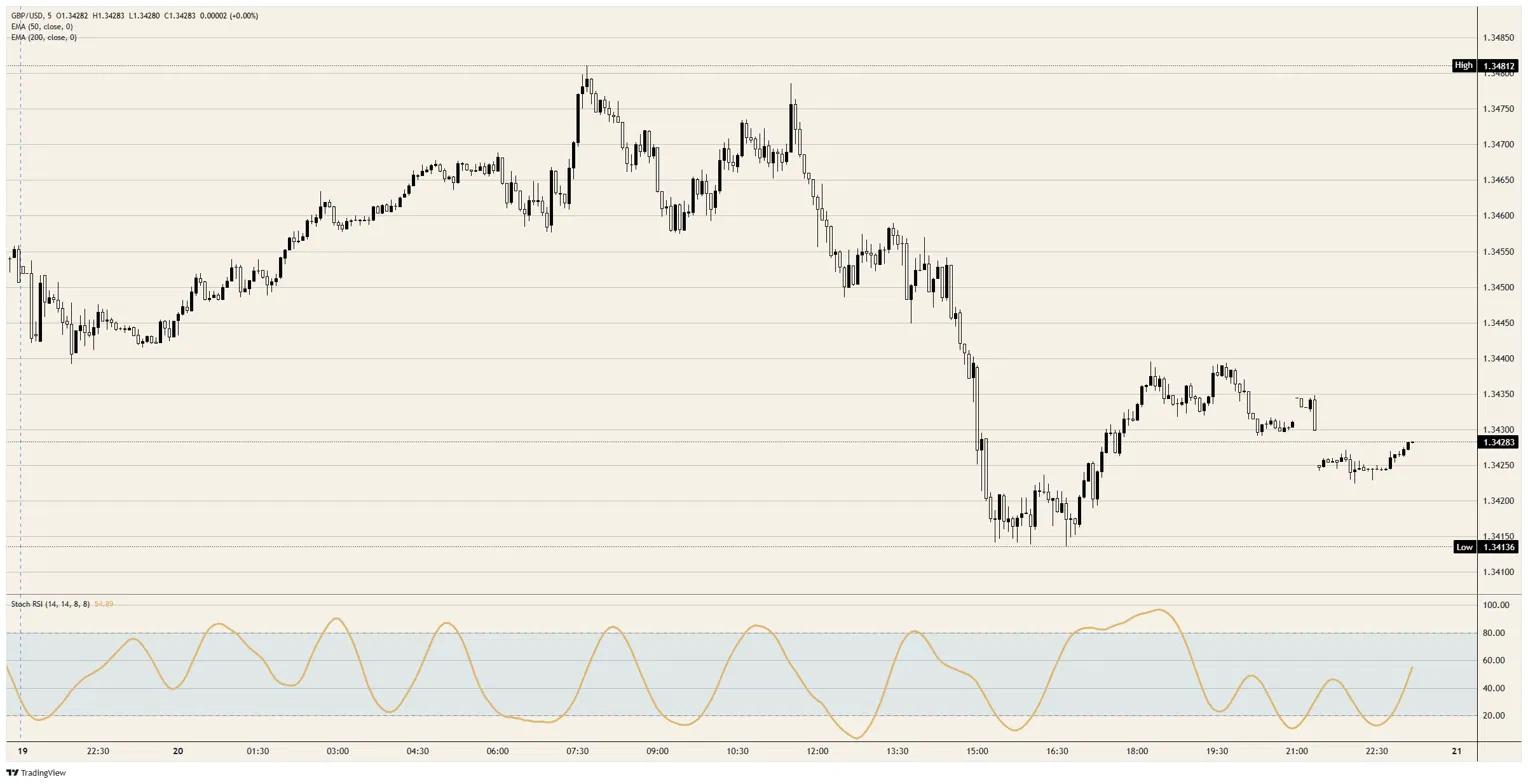
GBP/USD trades down around 0.17% on Monday and is on track for a third consecutive daily decline, fading from short of 1.3500 in the London morning to a New York probe just above the 1.3400 handle before steadying between the two. The slide unwinds the last of the mid-July rebound's momentum and confirms that Cable's recovery off the summer base has run out of road well before the levels that matter.
The rejection zone tells the larger story, because 1.3550 has graduated from a line in the sand into a hard wall: it capped the pair in mid-June, repelled last week's push, and now marks the floor of a full-depth resistance zone running up to the next ceiling at 1.3650. With the daily Stochastic Relative Strength Index pushing 90, the market picked the top of an overbought bounce to hand Downing Street to a new tenant.
A new tenant and an old problem
Andy Burnham formally became Prime Minister on Monday, accepting the King's invitation to form a government and pitching his premiership as a hard reset for a country on its seventh leader in a decade. He promised a ten-year national plan later this year alongside immediate cost-of-living support, and reports that Shabana Mahmood takes the Treasury eased the gilt market's worst fears of a leftward fiscal lurch.
The bond market's verdict has been notably politer than the currency's, with the 10-year gilt yield holding just below 5% while Sterling bleeds for a third session. That gap is the tell: gilts trade the fiscal-rules pledge and the Treasury reports, while the Pound trades the growth picture underneath, which is about to be audited four days running. Even Trump managed to price both sides at once, praising the new government's plans for North Sea energy expansion while dismissing Britain itself as an impoverished mess.
The hawkish case goes on trial
The Bank of England (BoE) held Bank Rate at 3.75% last month, and the money market still carries one 2026 hike, fully priced by November, as its base case. That pricing has survived on resilience, with May output eking out growth, the three-month trend beating forecasts, and the war-era oil bid keeping the inflation risk premium alive.
This week runs the audit across four consecutive sessions, and consensus is stacked toward the soft side. Tuesday's labour report is expected to show unemployment ticking up to 5% with claimant counts rising 28.3K, Wednesday's Consumer Price Index (CPI) is seen cooling to 2.7% YoY with core at 2.5%, and Friday pairs a negative retail sales consensus with flash Purchasing Managers Index (PMI) surveys whose services gauge starts from 48.8, already in contraction. A sweep of soft prints leaves the November hike resting on the oil price alone, and the Pound's three-day slide reads like the market front-running exactly that.
A Dollar with one input
The Dollar offers no counterweight of its own, because the Federal Reserve (Fed) sits in its pre-meeting blackout ahead of the 29 July decision and the American docket stays effectively empty until Friday's PMI round. That leaves the Gulf as the Greenback's only live driver. Central Command announced a fresh round of strikes on Iranian targets beginning 20:00 GMT Monday, the tenth consecutive night of the campaign, while Trump vowed on Truth Social that Tehran repays every American death many times over.
Markets continue to lean on the other half of the message, since Washington keeps professing openness to talks even as it strikes nightly, and that single thread keeps ceasefire expectations pinned and risk appetite propped. For the Pound the arrangement is double-edged: the war keeps the oil bid underwriting the BoE's hawkish pricing, and the same war feeds the import-cost squeeze that this week's data is expected to show catching up with the consumer.
The week ahead
The docket opens at 06:00 GMT on Tuesday with the June claimant count, seen rising 28.3K, alongside a 5% unemployment print and ex-bonus wage growth holding at 3.4%. CPI follows at 06:00 GMT on Wednesday, with the headline seen at 2.7% YoY from 2.8% and core easing to 2.5%, before GfK consumer confidence lands late Thursday.
Friday is the heavy session: June retail sales at 06:00 GMT carry a -0.2% MoM consensus after the prior month's 1.2% jump, and the flash PMI round at 08:30 GMT starts from a services reading of 48.8. The United States answers at 13:45 GMT with its own flash surveys, the only red-band American release standing between here and the Fed's decision the following Wednesday.
Technical levels to watch
Resistance: The 1.3550 wall is the trigger for everything topside, a full-depth supply zone that has repelled every advance since mid-June and now stands guard below the 1.3650 ceiling. Beyond those, the January peak just above 1.3850 marks the year's high-water mark.
Support: The converged 50-day and 200-day Exponential Moving Averages sit just below 1.3400 as the first meaningful floor, with the 1.3300 shelf behind them and the July base just below 1.3150 as the full-retracement objective.
Bias: Bearish below 1.3550. The pair is fading from a triple-tested wall with daily momentum stretched near overbought extremes and a domestic slate stacked toward soft prints, so a daily close below the moving-average cluster near 1.3400 opens 1.3300 next. Only a decisive reclaim of 1.3550 revives the topside toward 1.3650.
GBP/USD 5-minute chart
Pound Sterling FAQs
The Pound Sterling (GBP) is the oldest currency in the world (886 AD) and the official currency of the United Kingdom. It is the fourth most traded unit for foreign exchange (FX) in the world, accounting for 12% of all transactions, averaging $630 billion a day, according to 2022 data. Its key trading pairs are GBP/USD, also known as ‘Cable’, which accounts for 11% of FX, GBP/JPY, or the ‘Dragon’ as it is known by traders (3%), and EUR/GBP (2%). The Pound Sterling is issued by the Bank of England (BoE).
The single most important factor influencing the value of the Pound Sterling is monetary policy decided by the Bank of England. The BoE bases its decisions on whether it has achieved its primary goal of “price stability” – a steady inflation rate of around 2%. Its primary tool for achieving this is the adjustment of interest rates. When inflation is too high, the BoE will try to rein it in by raising interest rates, making it more expensive for people and businesses to access credit. This is generally positive for GBP, as higher interest rates make the UK a more attractive place for global investors to park their money. When inflation falls too low it is a sign economic growth is slowing. In this scenario, the BoE will consider lowering interest rates to cheapen credit so businesses will borrow more to invest in growth-generating projects.
Data releases gauge the health of the economy and can impact the value of the Pound Sterling. Indicators such as GDP, Manufacturing and Services PMIs, and employment can all influence the direction of the GBP. A strong economy is good for Sterling. Not only does it attract more foreign investment but it may encourage the BoE to put up interest rates, which will directly strengthen GBP. Otherwise, if economic data is weak, the Pound Sterling is likely to fall.
Another significant data release for the Pound Sterling is the Trade Balance. This indicator measures the difference between what a country earns from its exports and what it spends on imports over a given period. If a country produces highly sought-after exports, its currency will benefit purely from the extra demand created from foreign buyers seeking to purchase these goods. Therefore, a positive net Trade Balance strengthens a currency and vice versa for a negative balance.
Author

Joshua Gibson
FXStreet
Joshua joins the FXStreet team as an Economics and Finance double major from Vancouver Island University with twelve years' experience as an independent trader focusing on technical analysis.