British Pound extends losing streak against US Dollar, US PPI in focus
- British Pound falls further against the US Dollar to near 1.3227 on Friday.
- NBC says that the US Dollar remains supported by persistent US inflation and hawkish Fed prospects.
- Investors await the US PPI, and the UK employment and CPI data.
The British Pound (GBP) extends its losing streak against the US Dollar (USD) for the fourth trading day on Friday. The GBP/USD pair drops to near 1.3227 as the US Dollar continues to outperform on prospects that the Federal Reserve (Fed) will speed up its monetary tightening cycle.
At press time, the US Dollar Index (DXY), which gauges the Greenback’s value against six major currencies, clings to its 19-month high of 103.24 posted on Thursday.
Dollar support persists as inflation and Fed outlook underpin safe-haven appeal
Strategists at National Bank of Canada (NBC) observe that the Dollar “remains supported by persistent inflation and the prospect of further Fed tightening.” They note that “following October’s pause, another firm Consumer Price Index (CPI) report reinforces our expectation for tighter policy before year-end,” adding that a “deterioration in global risk appetite could provide further support through safe-haven demand.”
The US CPI report of October showed on Tuesday that headline and the core inflation growth was faster-than-expected at 0.4% and 0.3%, respectively, on a monthly basis.
Fed Governor Christopher Waller said before the US CPI data release that “half-point Fed rate hike may be needed in December, if October core CPI inflation comes in around 0.3% or higher.”
Waller’s hawkish tilt boosts Fed rate hike expectations
Fed’s Waller delivered a notably more hawkish tone, with a 9/10 FXS Speechtracker score standing well above the 7.3/10 historical average, underscoring a stronger-than-usual push for tighter policy. The explicit openness to a half-point FED rate hike in December if core CPI prints 0.3% or higher, and support for a quarter-point hike even on better inflation data, signals a clear bias toward additional tightening as inflation is judged “too high” and recent data “bad.” Concerns about the breadth of price increases, persistent producer and energy price pressures, and the need for higher real rates reinforce the message that current policy is seen as insufficiently restrictive, with limited weight given to sharp stock price moves.
The FXS Fed Sentiment Index rose by 3.17 points to 145.50, firmly in hawkish territory and consistent with the elevated FXS Speechtracker score. This move signals a meaningful tightening of perceived Fed stance, likely supporting the Dollar and keeping rate-sensitive assets on the defensive as markets price in a higher probability of December hikes.
Later in the day, investors will focus on the US Producer Price Index (PPI) data for October, which will be published at 13:30 GMT.
On the British currency front, investors shift their focus to the United Kingdom (UK) labor market data for three months ending September and the Consumer Price Index (CPI) data for October, which will be released next week.
GBP/USD Technical Analysis
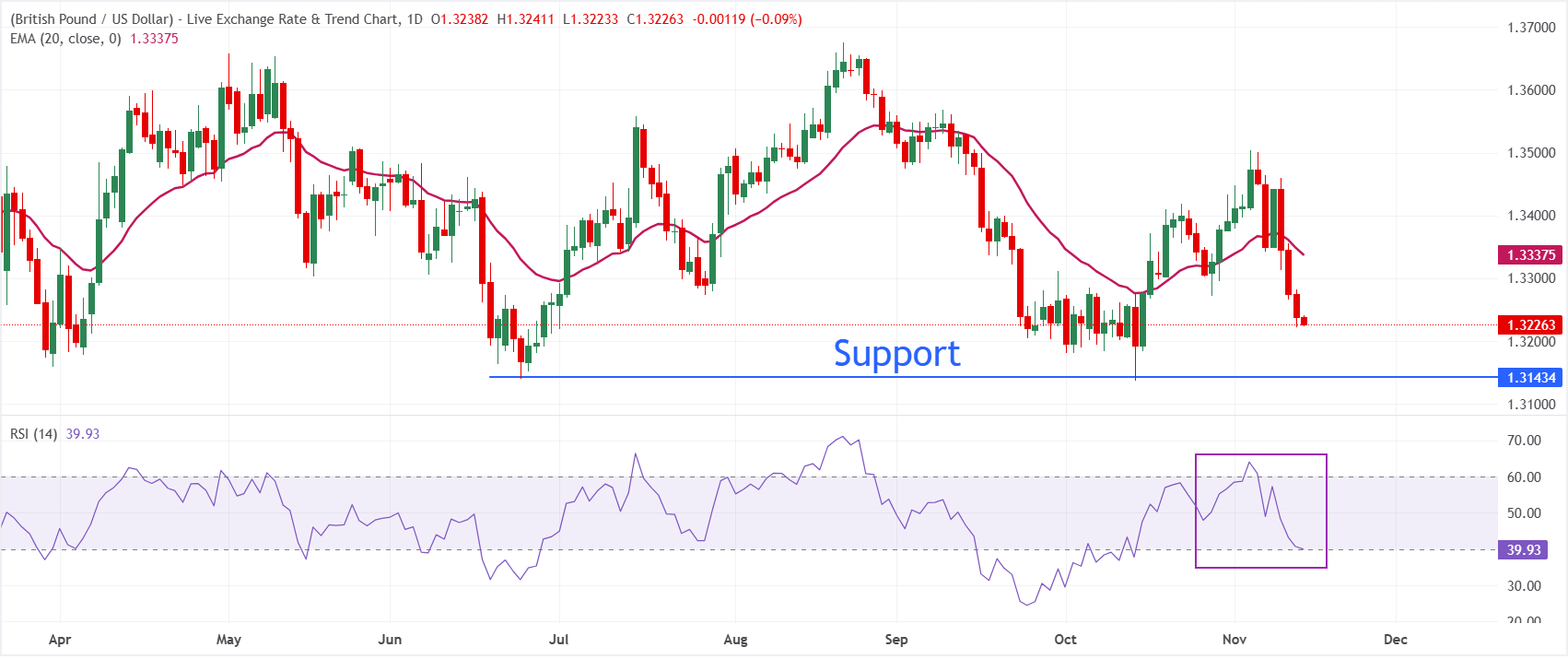
In the daily chart, GBP/USD trades at 1.3226, retaining a bearish near-term bias as spot remains below the 20-period exponential moving average (EMA) at 1.3337, which acts as immediate overhead resistance. The Relative Strength Index (RSI) at 39.9 stays below the neutral 50 line, hinting that downside pressure still dominates despite the absence of oversold extremes.
On the topside, the 20-day EMA at 1.3337 is the first resistance level, and a daily close above this barrier would be needed to ease the current bearish tone and allow a more sustained recovery. Until then, the pair risks extending its decline, with traders likely to sell into rebounds while momentum holds below the midline.
(The technical analysis of this story was written with the help of an AI tool. Know more.)
Economic Indicator
Producer Price Index (MoM)
The Producer Price Index released by the Bureau of Labor statistics, Department of Labor measures the average changes in prices in primary markets of the US by producers of commodities in all states of processing. Changes in the PPI are widely followed as an indicator of commodity inflation. Generally speaking, a high reading is seen as positive (or bullish) for the USD, whereas a low reading is seen as negative (or bearish).
Read more.Next release: Fri Nov 13, 2026 13:30
Frequency: Monthly
Consensus: 0.4%
Previous: 1.3%
Source: US Bureau of Labor Statistics
Author

Sagar Dua
FXStreet
Sagar Dua is associated with the financial markets from his college days. Along with pursuing post-graduation in Commerce in 2014, he started his markets training with chart analysis.