Australian Dollar remains calm following Trade Balance data
- Australia’s Trade Surplus reached A$1,929M in June, far exceeding expectations driven by a 9.6% export surge.
- An Iran-Oman shipping deal in the Strait of Hormuz weakened safe-haven demand for the US Dollar.
- US private payrolls grew by only 44K in July, missing forecasts and weighing on the Greenback.

AUD/USD steadies after two days of gains, trading around 0.7060 during the Asian hours on Thursday. The pair moves little as the Australian Dollar (AUD) remains silent following the release of domestic Trade Balance data.
The Australian Bureau of Statistics (ABS) reported a notable turnaround in the country's Trade Balance for June, which shifted to a surplus of A$1,929 million month-over-month (MoM). This follows a revised deficit of A$2,367 million in the previous reading (initially reported as A$3,018 million) and significantly outperformed market expectations, which had anticipated a deficit of A$1,100 million. The positive shift was driven by a sharp 9.6% MoM increase in exports, rebounding from a revised 7.6% drop in May, while imports edged down by 0.2% MoM, reversing the 0.9% gain recorded the prior month.
The AUD/USD pair could see further appreciation as the US Dollar (USD) faces headwinds from declining safe-haven demand. Sentiment shifted following reports that Iran and Oman have reached an agreement on a shipping route through the Strait of Hormuz, boosting expectations for increased Middle Eastern energy flows. The joint Iran-Oman statement is currently in its final drafting stage. At the same time, the proposed route is expected to operate for two to four months; Tehran emphasized that the deal does not represent a complete reopening of the strategic waterway.
Meanwhile, economic indicators from the US painted a mixed picture. ADP data released on Wednesday revealed that US private-sector employment added just 44K jobs in July, down from 98K in June and missing the market consensus of 70K. On the service side, the ISM Services PMI ticked up slightly to 54.1 in July from 54.0 in June, though it fell just shy of the 54.5 forecast. Investors are now looking ahead to the US Initial Jobless Claims report, scheduled for release later on Thursday.
USD tone softens as tight labour market seen as less inflationary
Strategists at Scotiabank observe that recent US employment data continue to point to a "labour market [that] is tight but not necessarily adding to inflation pressure at the moment"—a combination they describe as "a mild negative for the USD perhaps." In their view, the absence of clear wage-driven inflation signals tempers support for the Dollar, reinforcing the softer bias that has emerged following the latest FOMC-driven selloff.
Strategists also observe that the "USD is steady to slightly softer overall in quiet trade as markets consider a range of impulses for FX," with investors balancing geopolitical concerns, commodity moves and upcoming US data releases in a cautious manner.
Technical Analysis: AUD/USD could target four-year highs as bullish bias prevails
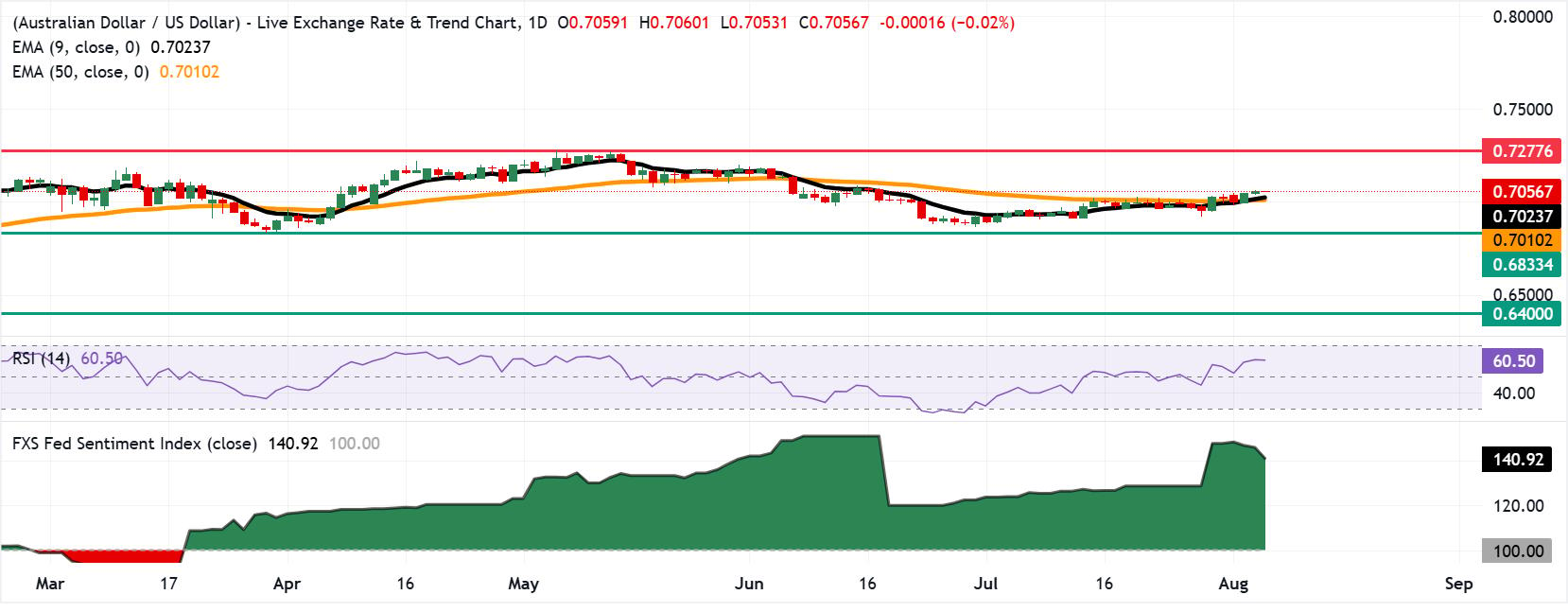
In the daily chart, AUD/USD is keeping a constructive bullish tone as spot holds above both the nine-period and 50-period Exponential Moving Averages (EMAs). The short-term EMA running above the longer one and beneath price hints at a supportive trend structure, while the 14-day Relative Strength Index (RSI) at around 60 suggests firm but not yet overbought momentum, allowing room for further gains toward 0.7277, the highest since June 2022, recorded on May 6, as long as the pair defends its current foothold over the moving averages.
On the downside, immediate support is seen at the nine-period EMA near 0.7023, followed by the 50-period EMA at 0.7010, with deeper demand clustered around the horizontal levels at 0.6833 and 0.6400. On the topside, initial resistance comes at the 0.7278 horizontal barrier, and a daily close above this cap would reinforce the bullish bias and open the way for a more pronounced extension of the current advance.
(The technical analysis of this story was written with the help of an AI tool. Know more.)
Author

Akhtar Faruqui
FXStreet
Akhtar Faruqui is a Forex Analyst based in New Delhi, India. With a keen eye for market trends and a passion for dissecting complex financial dynamics, he is dedicated to delivering accurate and insightful Forex news and analysis.