0.7000: Key support zone for Australian Dollar ahead of Trump-Xi meeting
- Australian Dollar claws back a majority of its early losses against the US Dollar after Aussie job data.
- The Australian economy created 39.5K fresh jobs in August, beating 20K estimates.
- US Treasury yields post a fresh 19-year high near 5.13%.

The Australian Dollar (AUD) recovers a majority of its early losses against the US Dollar (USD) on Thursday. In early European session, the AUD/USD pair is marginally down to near 0.7035.
The antipodean bounces back after the release of the Australian employment data for August, which showed that the economy created 39.5K fresh jobs, higher than 20K estimates. However, the Unemployment rate jumped to 4.6%, while it was expected to remain flat at 4.5%.
Upbeat job data could prompt Reserve Bank of Australia’s (RBA) near-term interest rate hike expectations.
Meanwhile, investors await the meeting between United States (US) President Donald Trump and Chinese leader Xi Jinping later in the day, in which they are expected to discuss trade, Artificial Intelligence (AI), technology, Taiwan and Middle East energy supply.
On the Washington front, surging US Treasury Yields have strengthened the US Dollar’s outlook. 10-year US Treasury Yields have jumped to 5.13%, the highest level seen in 19 years. The US Dollar Index (DXY), which gauges the Greenback’s value against six major currencies, trades close to its eight-week high of 101.23 posted on Thursday.
AUD/USD Technical Analysis
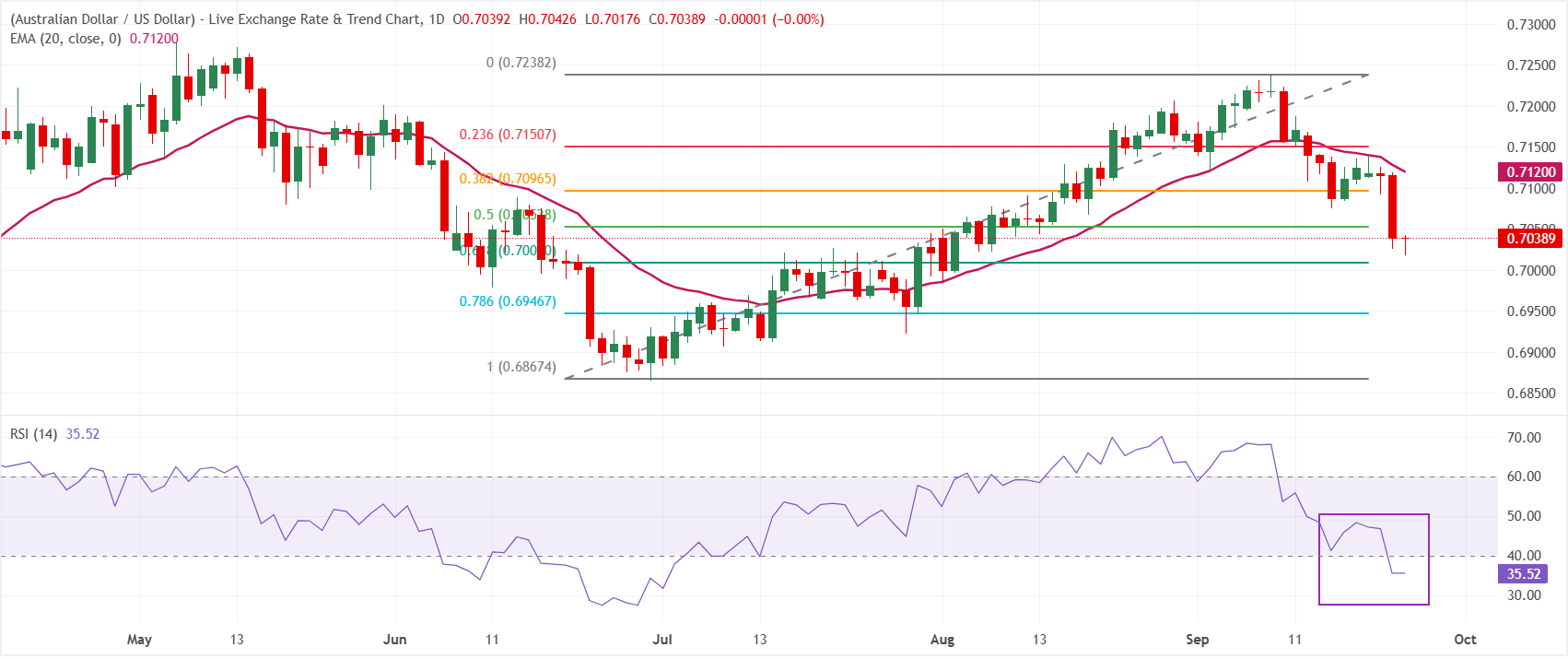
In the daily chart, AUD/USD trades at 0.7038, keeping a bearish near-term bias as it sits beneath the 20-period exponential moving average (EMA) at 0.7120 and the mid-range 50.0% Fibonacci retracement at 0.7053. The pair has slipped back through the 38.2% retracement at 0.7097, while the Relative Strength Index (14) around 35 suggests fading momentum and proximity to oversold territory, reinforcing a corrective tone rather than outright capitulation.
On the downside, initial support is aligned with the 61.8% Fibonacci retracement at 0.7009, ahead of deeper Fibonacci floors at 0.6947 (78.6%) and 0.6867 (100.0%), which mark the lower end of the current swing structure. On the topside, a recovery would first need to reclaim the 50.0% retracement at 0.7053, with further resistance at 0.7097 and the 20-period EMA near 0.7120, before the 23.6% retracement at 0.7151 and the cycle anchor at 0.7238 come into play as stronger caps.
(The technical analysis of this story was written with the help of an AI tool. Know more.)
Economic Indicator
Employment Change s.a.
The Employment Change released by the Australian Bureau of Statistics is a measure of the change in the number of employed people in Australia. The statistic is adjusted to remove the influence of seasonal trends. Generally speaking, a rise in Employment Change has positive implications for consumer spending, stimulates economic growth, and is bullish for the Australian Dollar (AUD). A low reading, on the other hand, is seen as bearish.
Read more.Last release: Thu Sep 24, 2026 01:30
Frequency: Monthly
Actual: 39.5K
Consensus: 20K
Previous: -15.8K
Source: Australian Bureau of Statistics
Author

Sagar Dua
FXStreet
Sagar Dua is associated with the financial markets from his college days. Along with pursuing post-graduation in Commerce in 2014, he started his markets training with chart analysis.