
In less than 100 days, President Donald Trump initiated a radical transformation of global economic relations under the pretext of reducing trade deficits. His method: imposing high tariffs on key trading partners, withdrawing from multilateral agreements, and unilaterally reshaping the rules of global commerce. While this strategy was politically framed as a corrective measure, it represents far more than a shift in trade dynamics—it is a deliberate attempt to construct a new global normality, defined by a U.S.-centered economic and ideological order.
This emerging doctrine is deeply neo-mercantilist in nature—reviving protectionism not only as a policy tool but as an organizing principle of global influence. To fully understand the significance of this approach, we must examine it through the lens of three foundational pillars: knowledge, activities, and beliefs. These form the bedrock of how societies define truth, decide what is worth doing, and shape their collective priorities.
1. Redefining knowledge: The contest for “what is true”
President Trump’s trade policy begins by challenging the epistemological foundations of globalization. Agreements long considered sacrosanct—such as NAFTA or WTO frameworks—are reinterpreted as imbalanced and exploitative. Economic data is selectively framed to portray trade deficits as strategic threats rather than symptoms of structural competitiveness.
In doing so, the administration attempts to construct a new knowledge paradigm: one that elevates bilateral power plays over multilateral cooperation, and national trade surpluses over global efficiency. The goal is to embed a new economic “truth”—that self-interest and zero-sum logic must prevail over shared benefit.
For currency markets, this shift introduces systemic uncertainty. Traditional macroeconomic signals become blurred as narratives diverge. FX pricing becomes increasingly sensitive to political messaging, trade threats, and retaliatory actions—fueling short-term volatility and longer-term revaluation of global risk perceptions.
2. Rewriting activities: Deciding “what is worth doing”
The second pillar is about execution. The Trump administration moved swiftly to convert its ideology into action: from imposing tariffs on Chinese goods and steel imports to promoting reshoring and revising trade deals to favor U.S. manufacturing.
This operational doctrine redefines what is economically valuable. It places a premium on domestic production, reduced dependence on foreign supply chains, and transactional leverage. In this model, economic activities are worth pursuing only if they serve national sovereignty.
The global implications are profound. Capital and investment begin to redirect, supply chains fragment, and multinational coordination erodes. FX markets respond to these shifts not just through trade flows, but also via risk premiums, as countries become more exposed to policy shocks, capital flight, and liquidity disruptions.
3. Reshaping beliefs: Reframing “what is important”
Finally, Trump’s trade philosophy seeks to reshape the collective moral compass of economic engagement. Cooperation is no longer assumed; it must be earned or enforced. Multilateralism is portrayed as weakness. Sovereignty, strength, and the ability to act unilaterally define importance.
This reorientation is strategic—it aims to intimidate, to shift not just policies, but values. It repositions the United States not as a global collaborator, but as a dominant actor that sets the rules and compels others to follow.
As beliefs evolve, currency markets react to perception risk. Confidence in institutional frameworks and geopolitical alliances becomes fragile. Safe haven flows become less predictable. Market sentiment, which is built on shared expectations, becomes fractured—amplifying FX market sensitivity.
Strengthening the strong, weakening the vulnerable
The consequences of such a shift are significant. Developed economies with the institutional and financial capacity to absorb shocks may recalibrate and eventually benefit from renegotiated trade terms or improved domestic industries. However, developing economies, which depend heavily on global trade openness and foreign investment, are likely to face disproportionate challenges. Supply chain disruptions, reduced access to U.S. markets, and heightened uncertainty could derail years of developmental progress.
In essence, Trump’s approach seeks to reengineer the global economic architecture by transforming the philosophical foundations upon which it stands. It is not merely a policy shift but an ideological campaign to redefine how nations perceive truth, determine their economic actions, and prioritize their values.
A New Normality or a Temporary Disruption?
Whether President Trump’s trade strategy will permanently alter the global order remains to be seen. However, what is clear is that his early actions mark a deliberate attempt to establish a new normal—one based on protectionism, sovereignty, and selective cooperation. If successful, this could lead to a multipolar world where regional powers assert their truths and moral compasses, further fragmenting global cohesion.
As history teaches us, reshaping the pillars of knowledge, activity, and belief is a monumental task. The true legacy of Trump's trade doctrine may lie not only in the tariffs imposed or deals renegotiated but in the intellectual and ethical frameworks it inspires—or dismantles—across the global stage.
CFDs are complex instruments and come with a high risk of losing money rapidly due to leverage. You should consider whether you understand how CFDs work and whether you can afford to take the high risk of losing your money. The Article/Information available on this website is for informational purposes only, you should not construe any such information or other material as investment advice or any other research recommendation. Nothing contained on this Article/ Information in this website constitutes a solicitation, recommendation, endorsement, or offer by LegacyFX and A.N. ALLNEW INVESTMENTS LIMITED in Cyprus or any affiliate Company, XE PRIME VENTURES LTD in Cayman Islands, AN All New Investments BY LLC in Belarus and AN All New Investments (VA) Ltd in Vanuatu to buy or sell any securities or other financial instruments in this or in in any other jurisdiction in which such solicitation or offer would be unlawful under the securities laws of such jurisdiction. LegacyFX and A.N. ALLNEW INVESTMENTS LIMITED in Cyprus or any affiliate Company, XE PRIME VENTURES LTD in Cayman Islands, AN All New Investments BY LLC in Belarus and AN All New Investments (VA) Ltd in Vanuatu are not liable for any possible claim for damages arising from any decision you make based on information or other Content made available to you through the website, but investors themselves assume the sole responsibility of evaluating the merits and risks associated with the use of any information or other Article/ Information on the website before making any decisions based on such information or other Article.
Editors’ Picks

EUR/USD onsolidates around mid-1.1800s as traders keenly await FOMC Minutes
The EUR/USD pair struggles to capitalize on the previous day's goodish rebound from the 1.1800 neighborhood, or a one-and-a-half-week low, and consolidates in a narrow band during the Asian session on Wednesday. Spot prices currently trade just below mid-1.1800s, nearly unchanged for the day.

GBP/USD bounces off lows, retargets 1.3550
After bottoming out just below the 1.3500 yardstick, GBP/USD now gathers some fresh bids and advances to the 1.3530-1.3540 band in the latter part of Tuesday’s session. Cable’s recovery comes as the Greenback surrenders part of its advance, although it keeps the bullish bias well in place for the day.

USD/JPY is looking for direction around 153.00 with key US data in focus
USD/JPY reversal from 153.70 has been contained above 152.70 on Tuesday. Major currencies are trading within narrow ranges amid thin trading volumes. Investors await the release of the US GDP and PCE Inflation figures to make decisions.
Editors’ Picks
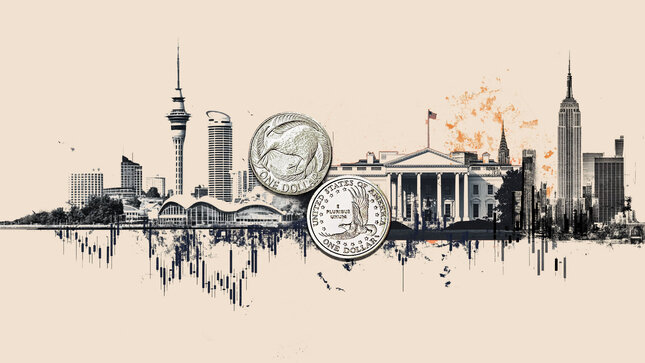
NZD/USD remains heavy near 0.6000 after dovish RBNZ hold
NZD/USD is attacking 0.6000, under heavy selling pressure early Wednesday, responding to the Reserve Bank of New Zealand's (RBNZ) dovish interest rate on hold decision. The RBNZ kept the OCR unchanged at 2.25%. Gowernor Anna Breman reinforced the dovish outlook at her debut press conference.

AUD/USD holds lower ground below 0.7100, awaits FOMC Minutes
AUD/USD holds lower ground below 0.7100 in Wednesday's Asian session. Traders await more cues about the US Fed's rate-cut path before placing fresh directional bets. Hence, the focus will be on the FOMC Minutes, due for release later today, which will drive the US Dollar and the currency pair. In the meantime, the RBA's hawkish stance and a generally positive risk tone might continue to cap the Aussie's downside amid hopes for additional stimulus from China.

Gold bounces back toward $4,900, looks to FOMC Minutes
Gold is attempting a bounce from the $4,850 level, having touched a one-week low on Tuesday. Signs of progress in US–Iran talks dented demand for the traditional safe-haven bullion, weighing on Gold in early trades. However, rising bets for more Fed rate cuts keep the US Dollar bulls on the defensive and act as a tailwind for the non-yielding yellow metal. Traders now seem reluctant ahead of the FOMC Minutes, which would offer cues about the Fed's rate-cut path and provide some meaningful impetus.

DeFi could lift crypto market from current bear phase: Bitwise
Bitwise Chief Investment Officer Matt Hougan hinted that the decentralized finance sector could lead the crypto market out of the current bear phase, citing Aave Labs’ latest community proposal as a potential signal of good things to come.

UK jobs market weakens, bolstering rate cut hopes
In the UK, the latest jobs report made for difficult reading. Nonetheless, this represents yet another reminder for the Bank of England that they need to act swiftly given the collapse in inflation expected over the coming months.
RECOMMENDED LESSONS
Making money in forex is easy if you know how the bankers trade!

I’m often mystified in my educational forex articles why so many traders struggle to make consistent money out of forex trading. The answer has more to do with what they don’t know than what they do know. After working in investment banks for 20 years many of which were as a Chief trader its second knowledge how to extract cash out of the market.
5 Forex News Events You Need To Know

In the fast moving world of currency markets where huge moves can seemingly come from nowhere, it is extremely important for new traders to learn about the various economic indicators and forex news events and releases that shape the markets. Indeed, quickly getting a handle on which data to look out for, what it means, and how to trade it can see new traders quickly become far more profitable and sets up the road to long term success.
Top 10 Chart Patterns Every Trader Should Know

Chart patterns are one of the most effective trading tools for a trader. They are pure price-action, and form on the basis of underlying buying and selling pressure. Chart patterns have a proven track-record, and traders use them to identify continuation or reversal signals, to open positions and identify price targets.
7 Ways to Avoid Forex Scams

The forex industry is recently seeing more and more scams. Here are 7 ways to avoid losing your money in such scams: Forex scams are becoming frequent. Michael Greenberg reports on luxurious expenses, including a submarine bought from the money taken from forex traders. Here’s another report of a forex fraud. So, how can we avoid falling in such forex scams?
What Are the 10 Fatal Mistakes Traders Make
Trading is exciting. Trading is hard. Trading is extremely hard. Some say that it takes more than 10,000 hours to master. Others believe that trading is the way to quick riches. They might be both wrong. What is important to know that no matter how experienced you are, mistakes will be part of the trading process.
The challenge: Timing the market and trader psychology

Successful trading often comes down to timing – entering and exiting trades at the right moments. Yet timing the market is notoriously difficult, largely because human psychology can derail even the best plans. Two powerful emotions in particular – fear and greed – tend to drive trading decisions off course.