XRP extends decline as risk-off sentiment, fading retail demand weigh
- XRP declines for the second consecutive day, weighed down by sustained risk-off sentiment and a weak technical structure.
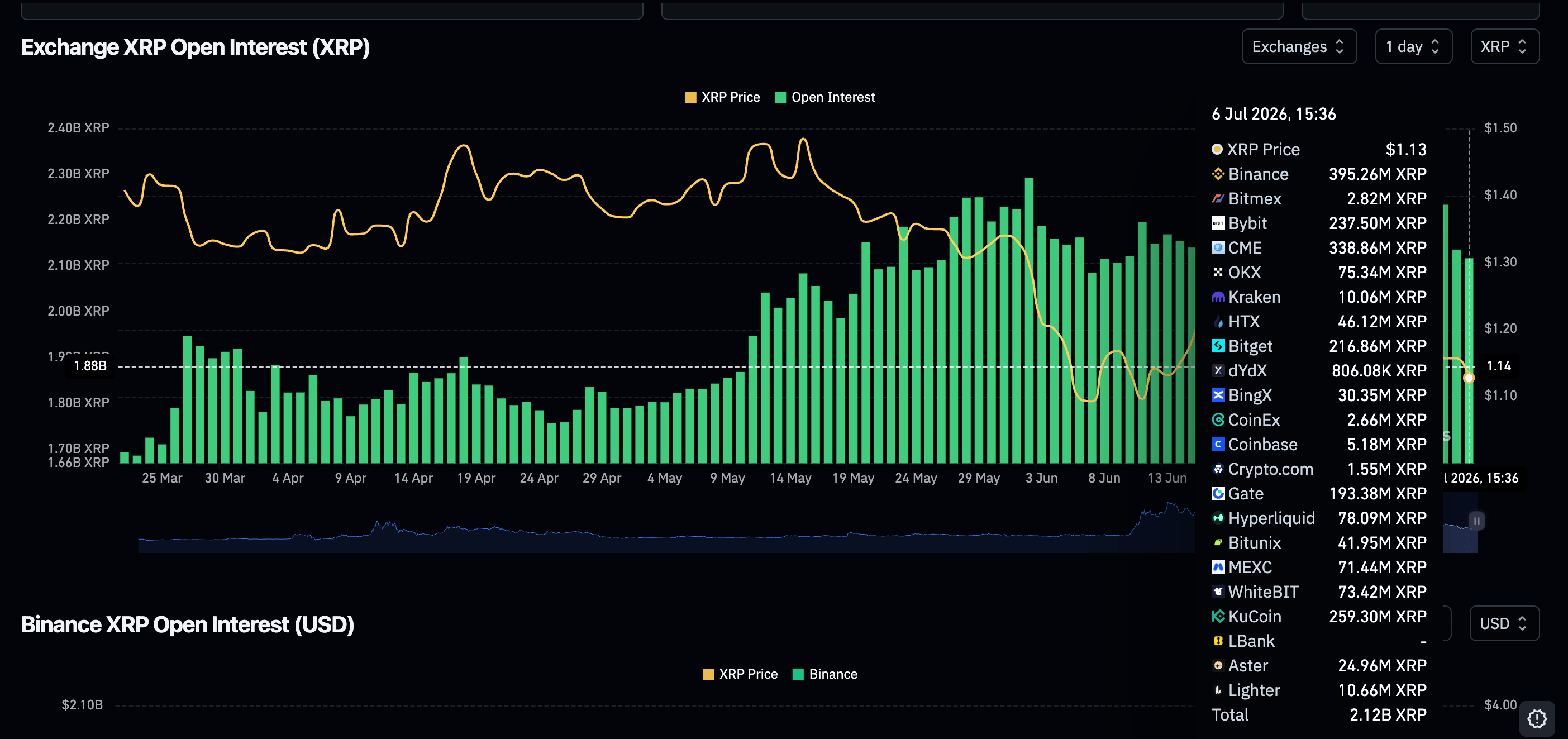
- XRP is at risk of extending its decline amid cooling retail demand, with futures Open Interest falling to 2.12 billion XRP.
- XRP momentum indicators are mixed, with the MACD upholding a buy signal while the RSI slips into bearish territory.

Ripple (XRP) sustains losses on Monday, edging lower toward the short-term $1.10 support. XRP failed to sustain momentum above $1.20 on the previous day, prompting profit-taking amid a broader crypto market drawdown attributed to mild inflows into related digital investment products, declining retail participation and macroeconomic uncertainty.
XRP retail activity slows amid mild capital inflows
Retail participation in the XRP derivatives market remains generally low despite the mild institutional inflows through spot Exchange-Traded Funds (ETFs). CoinGlass data show that perpetual Open Interest (OI) has declined to 2.12 billion XRP on Monday, from 2.14 billion XRP the previous day.
A wider scope highlights a steep drawdown from 2.38 billion XRP recorded on June 23, while further cooling could limit the token’s recovery potential.
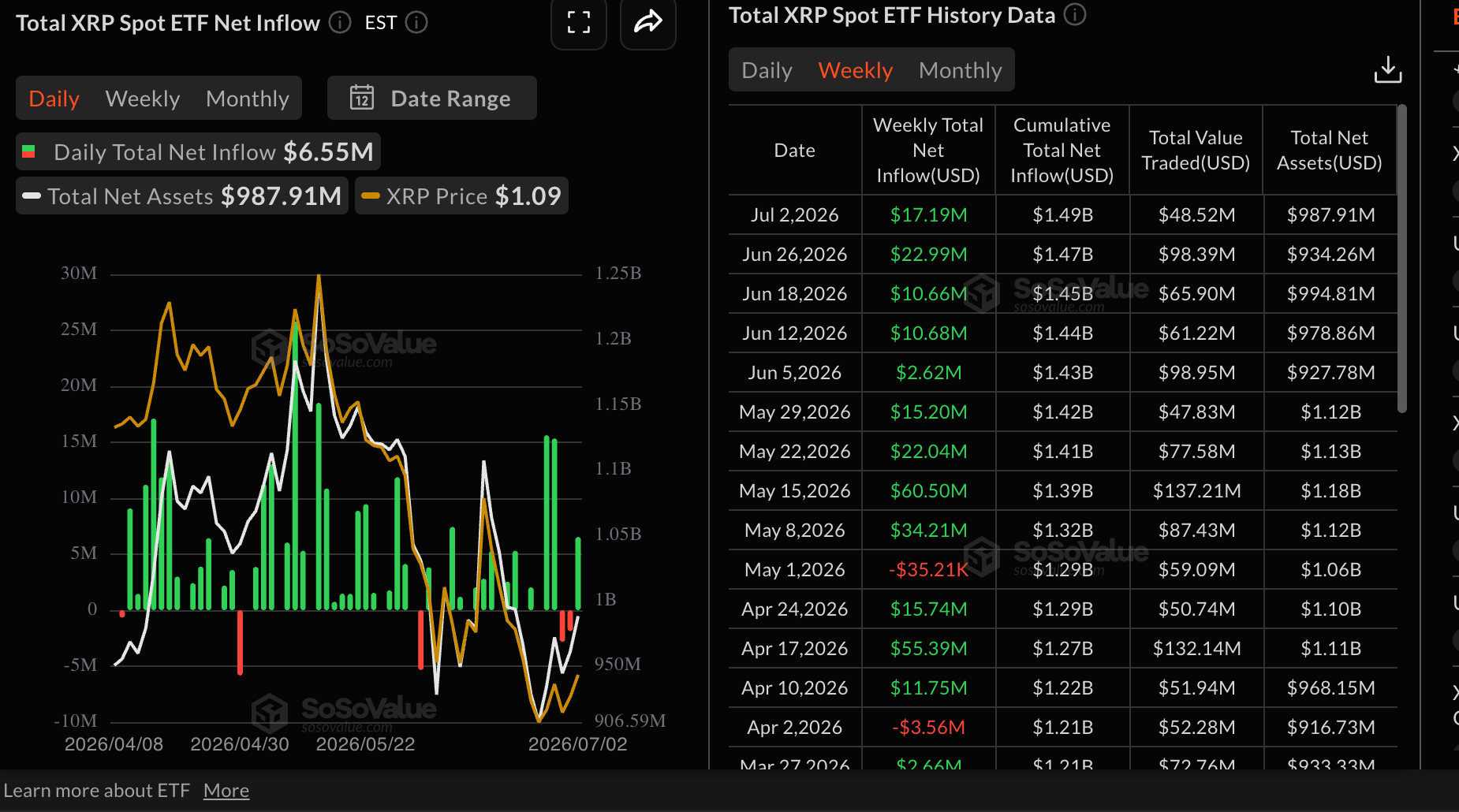
Meanwhile, interest in XRP spot ETFs has held steady, outperforming other major assets such as Bitcoin (BTC) and Ethereum (ETH), with nearly $12 million in inflows last week. With nine straight weeks of inflows, interest in XRP-related digital investment products remains intact despite the headwinds and broader risk-off sentiment.
Cumulative inflows hold steady at $1.49 billion while net assets under management average $988 million, according to SoSoValue data.
Price analysis: XRP slides, aiming for $1.10 support
XRP pair remains confined within a broader downward parallel channel and trades well below the 50-day, 100-day and 200-day Exponential Moving Averages (EMAs) at $1.18, $1.29 and $1.50 respectively, which keeps the near-term bias decisively bearish.
At the same time, the remittance token holds above the Bollinger Bands' middle boundary at $1.10, suggesting some short-term stabilization, but the sequence of descending long-term EMAs hints that rallies are more likely to be sold than sustained.
Still, a mildly positive Moving Average Convergence Divergence (MACD) histogram on the daily chart shows that XRP has the potential to rebound if traders reengage and defend the $1.10 psychological support.
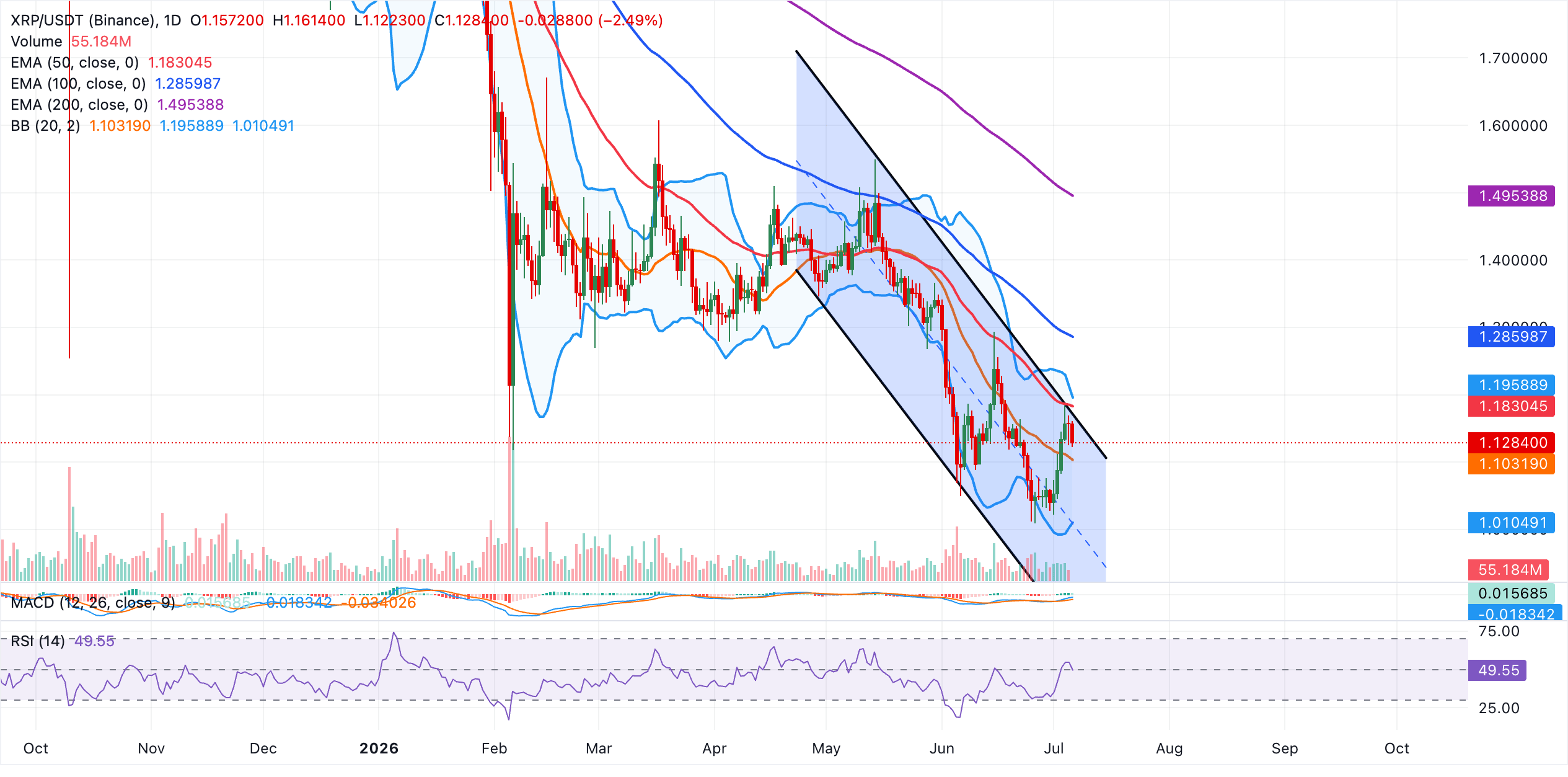
Initial resistance is aligned with the upper boundary of the active downward channel near $1.17, followed by the 50-day EMA at $1.18 and the upper Bollinger Band around $1.20. A daily close above these clustered barriers would be needed to ease the prevailing downside pressure and open the door toward the 100-day EMA near $1.29 and the 200-day EMA around $1.50. Looking down, immediate support is seen at the Bollinger midline around $1.10, ahead of the lower Bollinger Band near $1.01. A deeper deterioration toward the channel floor around $0.84 cannot be ruled out if sellers regain control below the current pivot area.
(This article was created with the help of an Artificial Intelligence tool and reviewed by an editor. Know more.)
Open Interest, funding rate FAQs
Higher Open Interest is associated with higher liquidity and new capital inflow to the market. This is considered the equivalent of increase in efficiency and the ongoing trend continues. When Open Interest decreases, it is considered a sign of liquidation in the market, investors are leaving and the overall demand for an asset is on a decline, fueling a bearish sentiment among investors.
Funding fees bridge the difference between spot prices and prices of futures contracts of an asset by increasing liquidation risks faced by traders. A consistently high and positive funding rate implies there is a bullish sentiment among market participants and there is an expectation of a price hike. A consistently negative funding rate for an asset implies a bearish sentiment, indicating that traders expect the cryptocurrency’s price to fall and a bearish trend reversal is likely to occur.
Author

John Isige
FXStreet
John Isige is a seasoned cryptocurrency journalist and markets analyst committed to delivering high-quality, actionable insights tailored to traders, investors, and crypto enthusiasts. He enjoys deep dives into emerging Web3 tren