Polymarket taps Nasdaq, launching prediction markets linked to private companies
- Polymarket announces the launch of prediction markets tied to private companies.
- The Nasdaq Private Market will serve as the resolution data provider, creating an additional price discovery tool for investors.
- Prediction markets will cover various events, including valuation, IPO timings and secondary market activity.

Polymarket launched on Tuesday prediction markets linked to the performance of private companies, effectively providing investors with access to startups and unicorns with a combined valuation of over $5 trillion.
Polymarket partners with Nasdaq Private Market
Polymarket's new offering targets several private-company-related events, including valuations, Initial Public Offering (IPO) timing, and secondary-market activity. According to a Reuters report, the offering paves the way for a new price-discovery tool for institutional investors. The Nasdaq Private Market is a key pillar of the new prediction markets, providing resolution data.
Meanwhile, the launch comes at a time when companies are staying private longer, even though their valuations exceed or are comparable to those of S&P 500 firms. Polymarket estimates that nearly 1,600 unicorns and startups worldwide boast a combined valuation of more than $5 trillion, attracting growing investor interest in private markets.
Polymarket is the largest on-chain prediction market, covering broad events such as crypto, politics, finance, sports and weather. The platform has captured over 97% of all on-chain prediction markets fees, underscoring the growing demand in the sector.
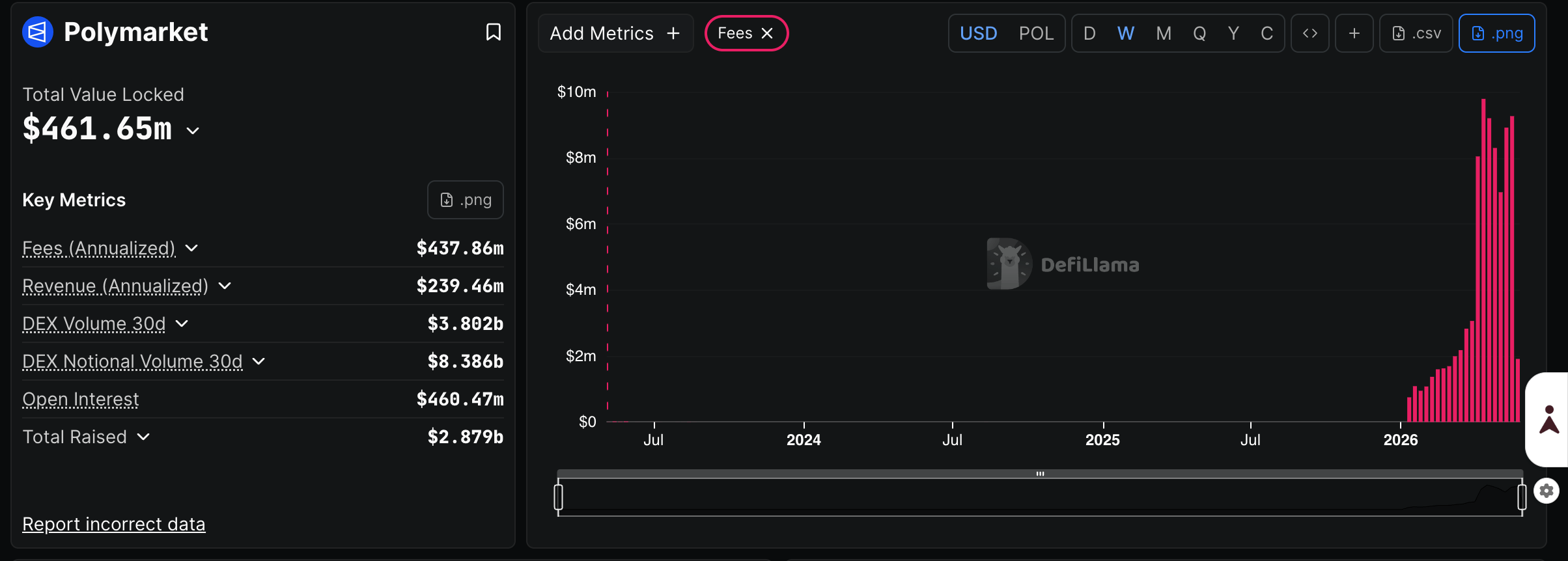
Defi Llama data shows that Polymarket's annualized fees average $438 million, while its revenue stands at $239 million. Polymarket recently completed a comprehensive fee model restructure and a software upgrade that improved wallet safety protocols.
Bitcoin, altcoins, stablecoins FAQs
Bitcoin is the largest cryptocurrency by market capitalization, a virtual currency designed to serve as money. This form of payment cannot be controlled by any one person, group, or entity, which eliminates the need for third-party participation during financial transactions.
Altcoins are any cryptocurrency apart from Bitcoin, but some also regard Ethereum as a non-altcoin because it is from these two cryptocurrencies that forking happens. If this is true, then Litecoin is the first altcoin, forked from the Bitcoin protocol and, therefore, an “improved” version of it.
Stablecoins are cryptocurrencies designed to have a stable price, with their value backed by a reserve of the asset it represents. To achieve this, the value of any one stablecoin is pegged to a commodity or financial instrument, such as the US Dollar (USD), with its supply regulated by an algorithm or demand. The main goal of stablecoins is to provide an on/off-ramp for investors willing to trade and invest in cryptocurrencies. Stablecoins also allow investors to store value since cryptocurrencies, in general, are subject to volatility.
Bitcoin dominance is the ratio of Bitcoin's market capitalization to the total market capitalization of all cryptocurrencies combined. It provides a clear picture of Bitcoin’s interest among investors. A high BTC dominance typically happens before and during a bull run, in which investors resort to investing in relatively stable and high market capitalization cryptocurrency like Bitcoin. A drop in BTC dominance usually means that investors are moving their capital and/or profits to altcoins in a quest for higher returns, which usually triggers an explosion of altcoin rallies.
Author

John Isige
FXStreet
John Isige is a seasoned cryptocurrency journalist and markets analyst committed to delivering high-quality, actionable insights tailored to traders, investors, and crypto enthusiasts. He enjoys deep dives into emerging Web3 tren