The Australian Dollar is losing the one thing that was holding it up
Australian interest rates rose faster than American ones for most of 2026, and that gap kept the Aussie Dollar up while iron ore fell. The Reserve Bank of Australia has signalled a pause in the same fortnight the Federal Reserve began discussing a half-point rise.
The Reserve Bank of Australia (RBA) raised its cash rate to 4.85% on November 3, the highest since 2008, and the Australian Dollar (AUD) has since fallen about 2.5% to its lowest since March. A rate rise is supposed to do the opposite. This one passed 6-3 and came without the earlier line about raising again if needed, so traders took it as the last of the series.
That matters more for the Aussie than it would for most currencies. For most of this year, the extra interest paid on Australian debt was the main reason to hold it, and that extra interest is now close to nothing.
Five rate rises, and the premium is back near zero
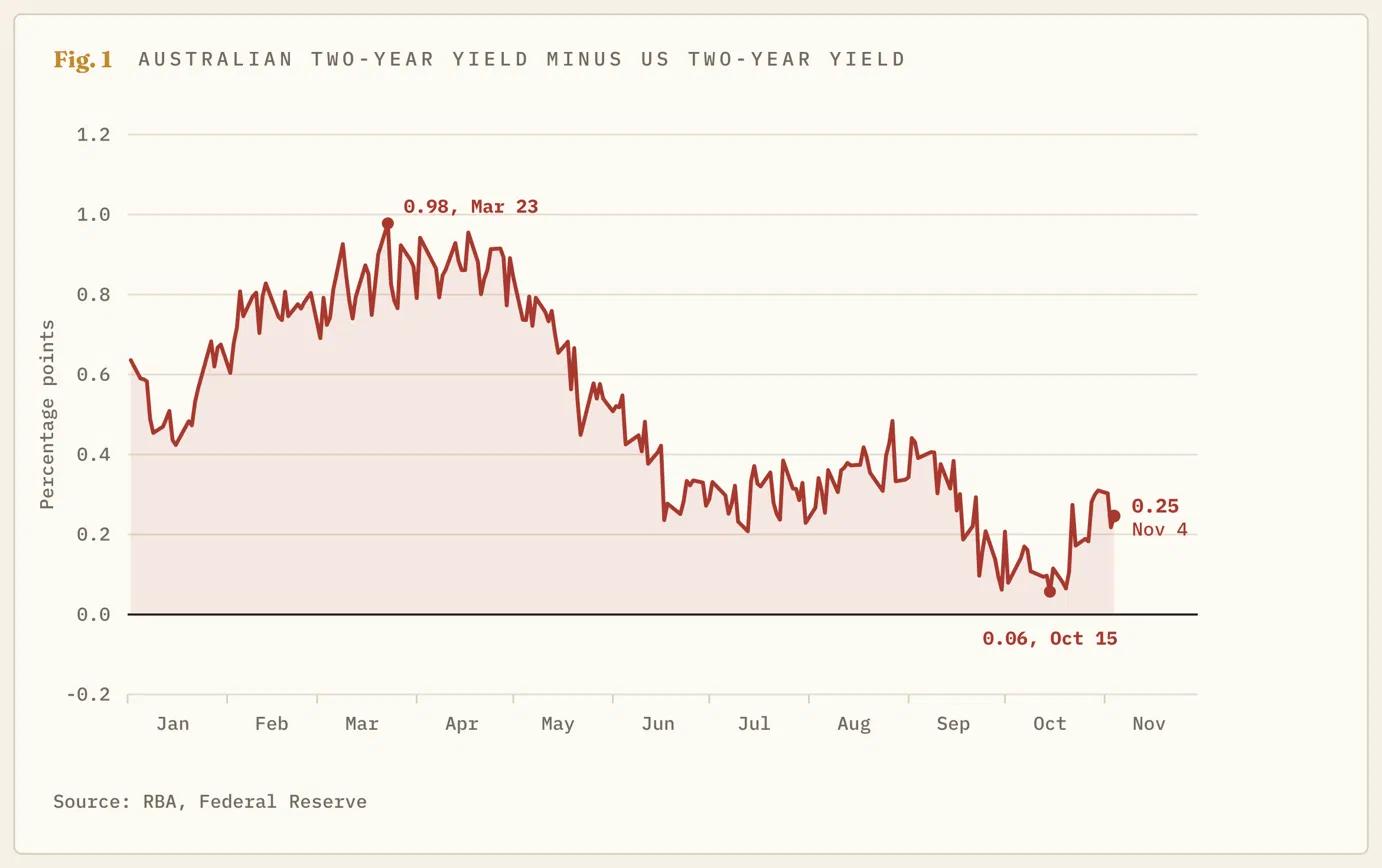
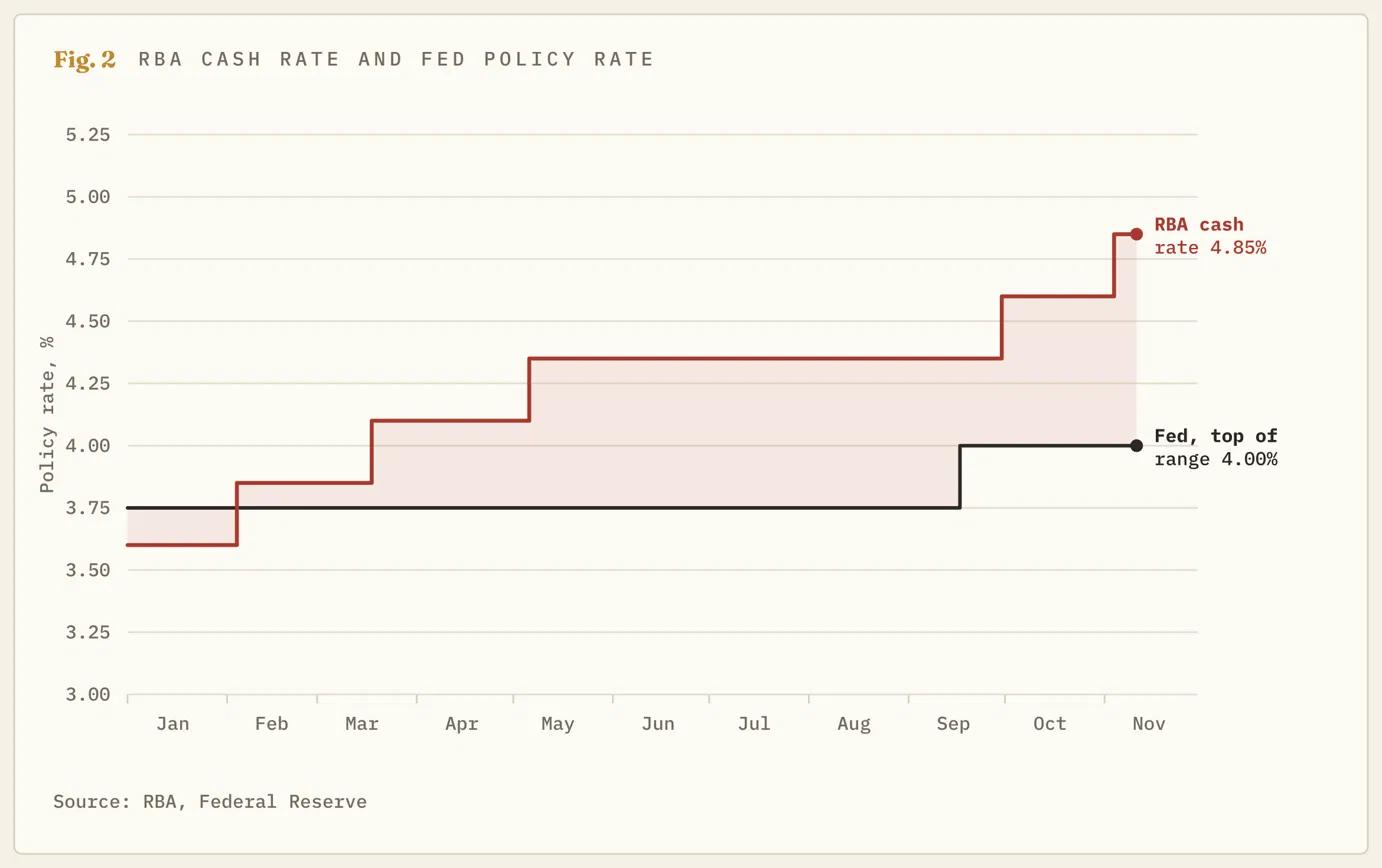
At the start of 2026, the RBA's rate was 3.60%, slightly under the Federal Reserve's 3.50%-3.75%. The RBA then raised rates in February, March and May, while the Fed did nothing until September. Traders moved ahead of the decisions. The yield on a two-year Australian government bond went from 0.64 of a point above the two-year US Treasury in early January to almost a full point above it on March 23.
That gap is how a rate rise reaches a currency. An investor who can earn nearly a point more a year in Australian bonds has to buy Aussie Dollars to do it, and the Aussie climbed to its high for the year in mid-May, about seven weeks after the gap peaked.
The gap has been shrinking since. US yields rose through the summer as the Fed moved toward its September rise, and by the end of that month the two-year premium was 0.06 of a point. It was 0.25 on November 4, the day after the RBA decision. Australia's two-year yield was 4.74% on November 6, and the US two-year yield jumped to about 4.74% on Tuesday. The RBA has raised rates five times this year, and on those two readings the reward for holding Australian two-year debt over American is nil.
The other supports are already gone
A commodity currency usually has a second leg to stand on, and the Aussie's is iron ore, Australia's largest export. Singapore iron ore futures fell under $90 a tonne in late October, the lowest in more than two years, and are trading near $92. The World Steel Association expects China's steel use to fall 2% this year. Less steel made in China means fewer Dollars earned by Australian miners and fewer of them converted into Aussie.
The economy isn't helping either. The RBA's own November statement says growth is slowing, housing prices have fallen significantly, and unemployment will rise more than it forecast in August. The same statement has inflation above 3% for the coming year and not back at the top of the 2%-3% target until late 2027. Three of the nine board members read that forecast and voted against a rate hike.
That left the rate gap carrying the currency alone. A split board with a slowing economy is unlikely to add to it soon, and futures agree: they put no chance on a rise at the December 8 meeting and less than one in five on February.
The US side is moving the other way
The Fed has raised once this year and is about to do more. October's jobs report showed 165K new jobs against a forecast of 65K. Tuesday's Consumer Price Index (CPI) showed prices outside food and energy up 0.3% for a third month running, which Fed Governor Waller had said would justify considering a half-point rise. Futures treat a December 9 rise as certain and show about a three-quarter-point rise by June.
The arithmetic for the Aussie is short. The RBA's 4.85% is 0.85 points above the top of the Fed's 3.75%-4.00%. Three Fed rate hikes, with the RBA on hold, would cut that to 0.10 by the middle of next year, and the RBA wouldn't have to do anything for it to happen.
A crowded bet with four dates on it
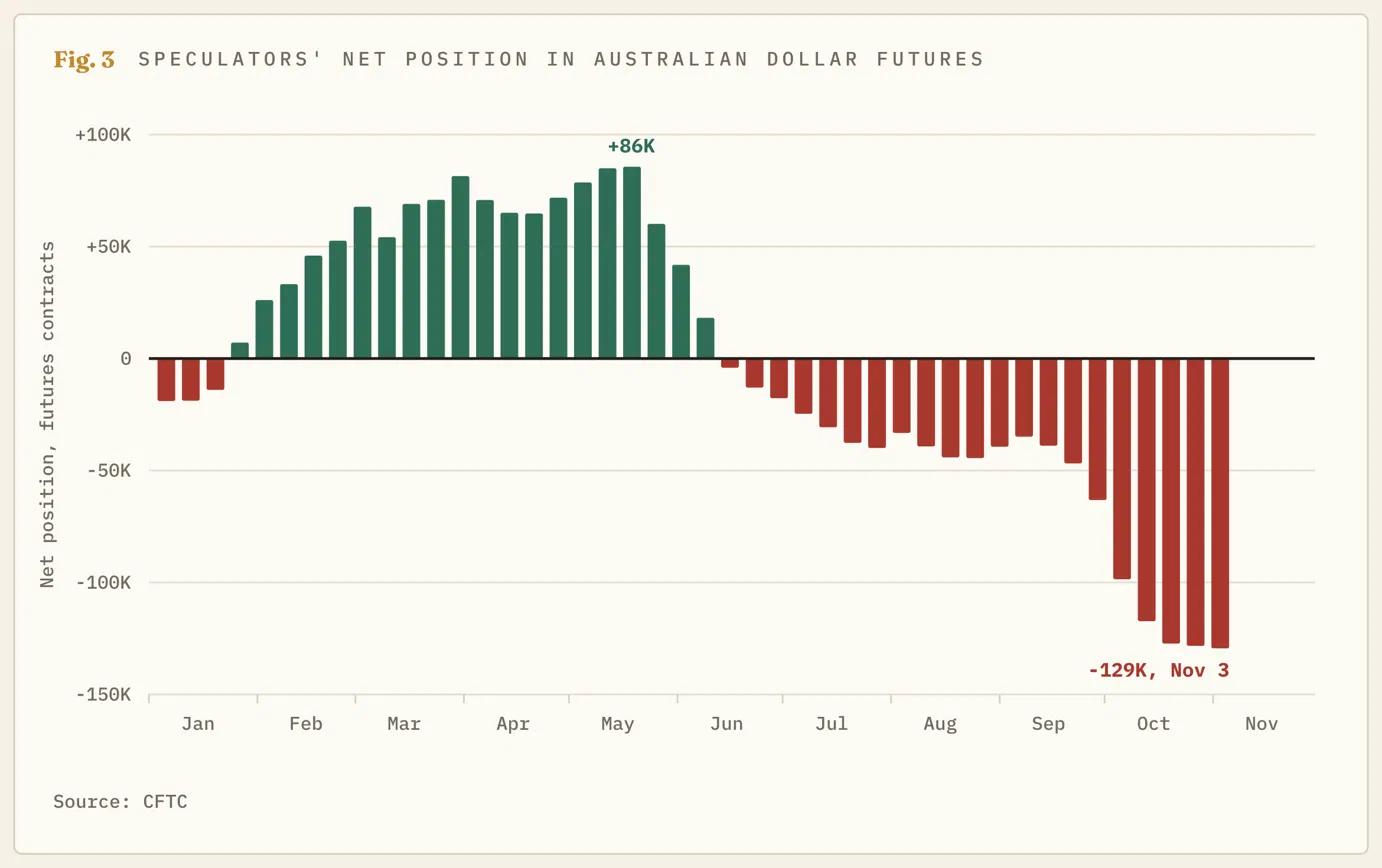
Plenty of traders are already there. Commodity Futures Trading Commission (CFTC) data for November 3 showed speculators holding a net bet against the Aussie of about 129K futures contracts, the largest in the series, and that count was taken before the US inflation number. A trade that's crowded doesn't need good news to reverse, only news that is less bad than expected, because everyone who wanted to sell has sold.
The dates are close together. Australian jobs figures are due November 19 and monthly inflation on November 25. The RBA decides on December 8 and the Fed a day later. If Australian inflation runs hot enough to put a February rise back above even odds, the gap stops shrinking, and a record number of sellers have to buy back, which is how a currency at its lowest since March gets a fast rally. A Fed that raises a quarter-point and talks down anything faster would do the same from the other side. Either one means the view here is wrong.
Without one of them, the lean is lower. The Aussie is trading on its March low. It rallied from there in the spring with the two-year gap near a full point and the RBA partway through three rises in thirteen weeks. This time the gap is near zero, and the RBA has signalled it would rather wait.
Author

Joshua Gibson
FXStreet
Joshua joins the FXStreet team as an Economics and Finance double major from Vancouver Island University with twelve years' experience as an independent trader focusing on technical analysis.

















