Gold's rebound is running out of room below $3,900

Gold (XAU/USD) attempts to stabilize on Tuesday after falling to a 13-month low of $3,832 on Monday. The precious metal briefly climbed to $3,887 earlier in the day, but its inability to sustain the recovery highlights persistent selling pressure.
The rebound comes after a difficult week for Gold, which recorded its steepest weekly decline since June, losing approximately 4.6%. Despite the modest recovery, the fundamental environment remains unfavorable as investors increasingly anticipate three consecutive interest rate hikes from the Federal Reserve (Fed).
The US Dollar (USD) continues to benefit from this shift in monetary policy expectations, while elevated US Treasury yields continue to undermine demand for non-yielding assets such as Gold.
Why Gold's recovery is struggling to gain momentum
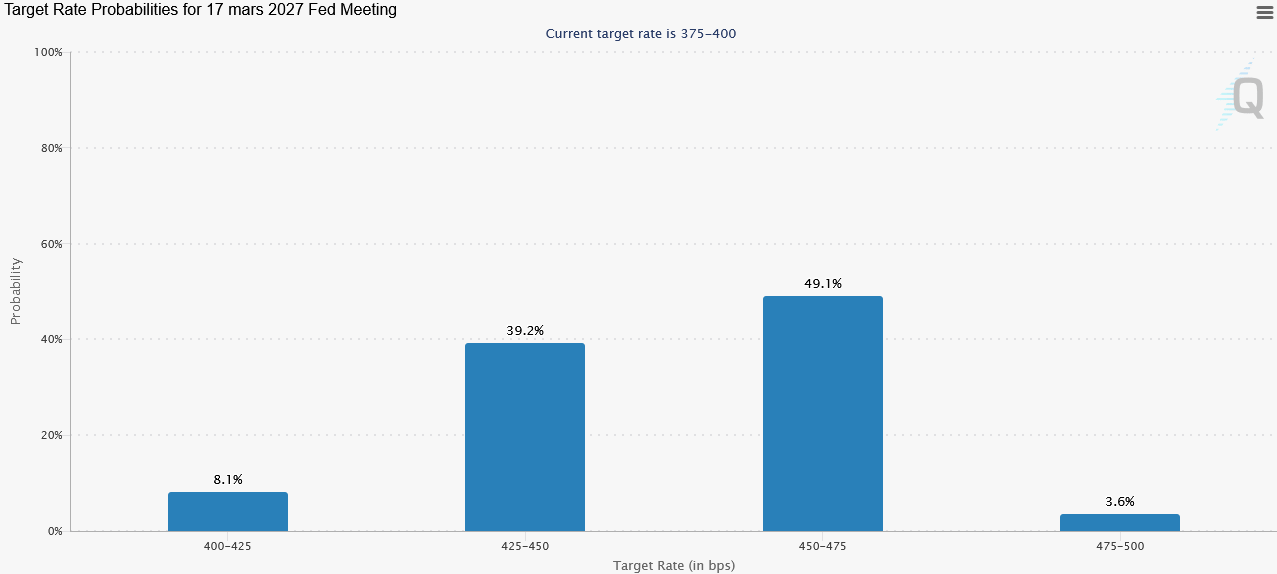
The main obstacle to a sustained Gold recovery remains the sharp repricing of US monetary policy expectations following stronger-than-expected inflation data. According to the CME FedWatch tool, investors have fully priced in a 25-basis-point interest rate increase in December and assign nearly a 70% chance to another hike in January, before a third consecutive rate hike in March that is priced in with a 49% chance.
This increasingly hawkish outlook follows persistent inflationary pressures and a series of comments from Fed officials suggesting that additional monetary tightening will be necessary. On Tuesday, St. Louis Fed President Alberto Musalem warned that inflation would likely remain elevated without further rate increases, suggesting that several hikes could be required before spring. Similarly, Cleveland Fed President Beth Hammack indicated on Monday that she favors gradual increases but remains open to larger adjustments if inflation continues to move in the wrong direction.
These developments are keeping the benchmark 10-year US Treasury yield above 5%, increasing the opportunity cost of holding Gold. ING emphasizes the importance of monetary policy expectations for the precious metal's near-term trajectory: "We expect gold to remain volatile in the near term, with the direction of US yields and the dollar likely to remain the key drivers," notes the bank notes. ING also highlights that recent weakness in technology stocks has contributed to selling pressure, as some investors reduce exposure to other assets to cover losses.
This suggests that Gold's recent decline reflects not only changing interest rate expectations but also broader portfolio adjustments amid deteriorating market sentiment.
The US Dollar remains Gold's biggest obstacle
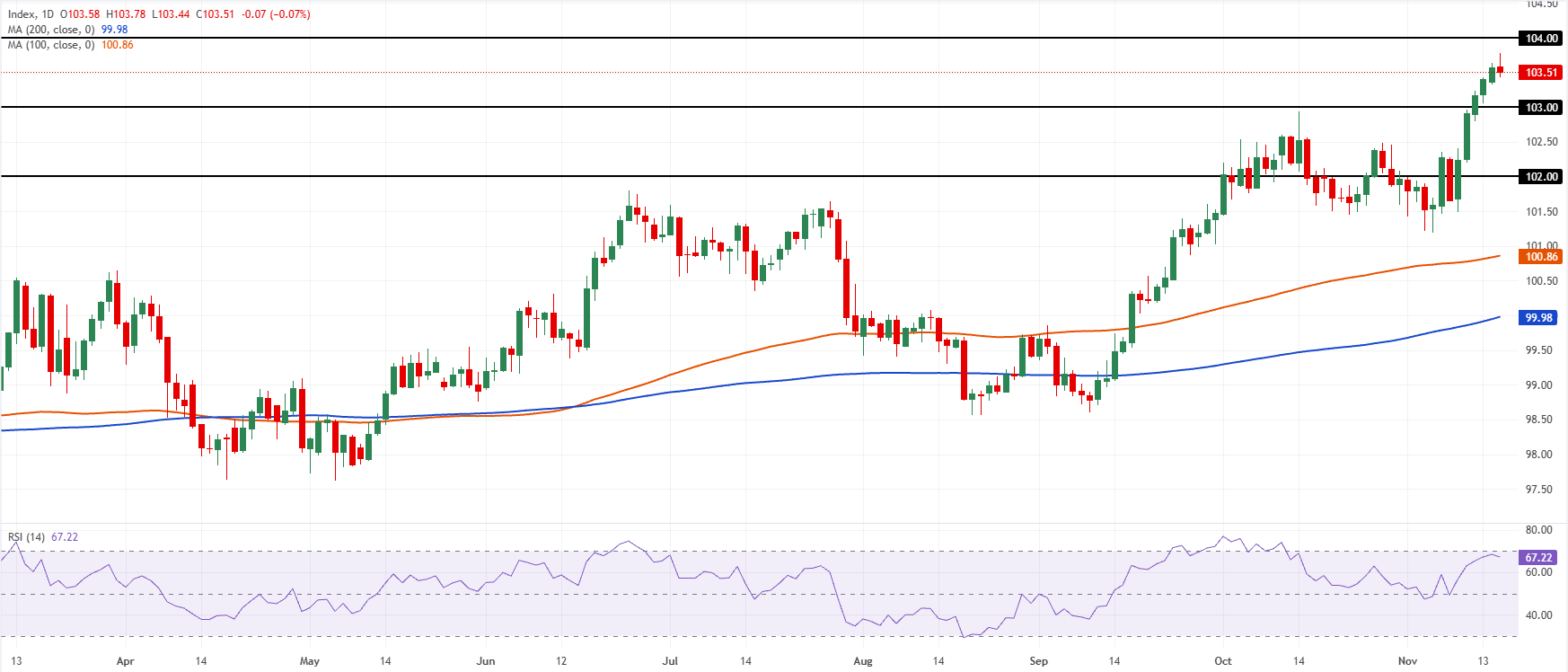
Beyond interest rates, the strength of the US Dollar represents another significant challenge for Gold buyers. The Greenback remains close to its highest level since April 2025, supported by expectations of further Fed tightening and persistent geopolitical uncertainty surrounding the conflict between the United States (US) and Iran. Recent attacks involving Oil tankers in the Strait of Hormuz have reinforced concerns about regional instability and potential disruptions to energy supplies.
However, these developments have primarily supported demand for the US Dollar as a safe-haven asset rather than generating a sustained recovery in Gold. Moreover, the possibility of renewed energy-driven inflation could complicate the Fed's efforts to bring consumer prices back toward its 2% target, reinforcing expectations of restrictive monetary policy.
Strategists at Brown Brothers Harriman (BBH) believe the underlying economic environment continues to favor the US currency, arguing that "robust US growth, favorable labor market conditions and sticky underlying inflation keep USD bias tilted higher."
As long as this combination of strong US Dollar demand and elevated Treasury yields persists, Gold could struggle to attract sufficient buying interest to establish a sustainable recovery.
Is Gold's longer-term bullish outlook still intact?
Despite the challenging short-term environment, some major financial institutions remain constructive on Gold's medium-term prospects. Oversea-Chinese Banking Corporation (OCBC) acknowledges that restrictive US monetary conditions could continue to weigh on precious metals in the coming months. However, they maintain that structural demand remains supportive. "For gold, we remain cautiously optimistic over the medium term, underpinned by central-bank diversification, investment demand, geopolitical uncertainty and longer-term fiscal concerns," notes OCBC. The bank nevertheless warns that "elevated real yields and USD resilience may continue to constrain the sustainability of near-term rebounds."
This distinction between short-term monetary pressures and longer-term structural demand is particularly important. While higher interest rates and US Dollar strength are currently dominating price action, central-bank purchases and portfolio diversification could eventually provide a foundation for recovery.
For now, however, Gold investors face an unfavorable balance between immediate monetary headwinds and longer-term supportive factors.
Gold’s rebound remains fragile below $3,900
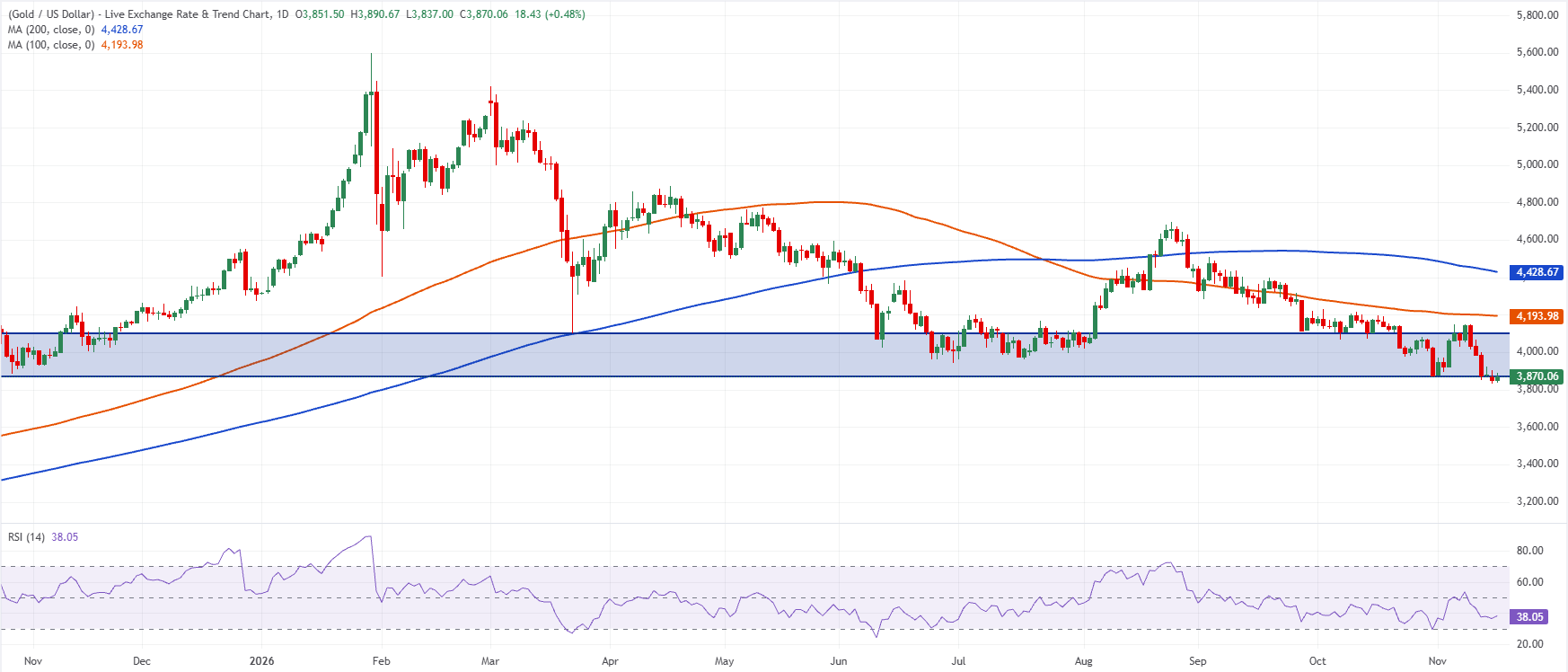
Gold's daily chart shows that selling pressure remains dominant despite Tuesday's modest rebound attempt. The precious metal has slipped below the $3,870 support level, which represents the lower boundary of a broad consolidation zone extending toward $4,100. Although prices are attempting to stabilize around this threshold, buyers have yet to demonstrate sufficient strength to reclaim it decisively.
The Relative Strength Index (RSI) stands near 37, indicating persistent bearish momentum without reaching oversold territory. Meanwhile, Gold remains below its 100-day and 200-day Simple Moving Averages (SMAs), currently around $4,194 and $4,429, respectively.
The immediate challenge for buyers is to regain the $3,870 level before attempting another recovery toward the $3,900 level. A sustained move above $3,900 could encourage a stronger rebound toward $4,000, although the broader technical picture would remain fragile as long as Gold trades below the $4,100 resistance area.
Conversely, failure to recover above $3,870 would leave the precious metal exposed to another test of Monday's low at $3,832, followed by the psychological $3,800 level. A decisive breakdown below this area would confirm a more significant deterioration in the technical outlook and could open the door to further losses.
Author
Ghiles Guezout
FXStreet
Ghiles Guezout is a Market Analyst with a strong background in stock market investments, trading, and cryptocurrencies. He combines fundamental and technical analysis skills to identify market opportunities.

















