Gold Weekly Forecast: Inflation fears attract bears ahead of critical Fed meeting
- Gold fell below $4,000 for the first time in three months despite falling US T-bond yields.
- The technical outlook suggests that the bearish bias remains intact in the near term.
- The Fed’s policy meeting and third-quarter growth data from the US could drive Gold’s valuation.
Gold (XAU/USD) failed to benefit from falling US Treasury bond yields and closed the week deep in negative territory as rising energy prices fed into inflation fears. The Federal Open Market Committee (FOMC) meeting and third-quarter Gross Domestic Product (GDP) growth data from the United States (US) could ramp up the precious metal’s volatility.
Gold sellers ignore falling US yields
Gold edged slightly higher at the start of the week as the US Dollar (USD) struggled to find demand, with investors refraining from pricing in an interest rate hike in October following Federal Reserve (Fed) Chair Kevin Warsh’s cautious comments about tightening policy ahead of the weekend. However, signs of further escalation in the Middle East capped the precious metal’s upside. Mohsen Rezaei, a secretary of Iran’s Supreme National Security Council, warned that Tehran has prepared a new retaliation plan for any renewed US-Israeli attack. Meanwhile, Iran’s Islamic Revolutionary Guard Corps (IRGC) said that an Oil tanker caught fire and exploded after striking a naval mine in the southern part of the Strait of Hormuz.
In the absence of high-impact data releases, Gold registered marginal losses on Tuesday, before staging a technical rebound on Wednesday.
The risk-averse market atmosphere triggered a leg lower in US Treasury bond yields on Thursday, with the benchmark 10-year reference falling below 5% for the first time in a month. Still, Gold, which usually has an inverse correlation with US T-bond yields, failed to attract buyers and lost nearly 3% on a daily basis as rising Oil prices fed into inflation fears. As Oil continued to push higher early Friday, Gold touched its weakest level since mid-July below $4,000.
In a report published on Friday, analysts at ING explained that Gold prices "failed to benefit from yesterday's equity sell-off and the significant fall in US Treasury yields, with the 10-year yield falling back below 5%." Instead of drawing safe-haven support, they note that "Gold prices came under pressure." According to ING, the market appears "more focused on higher Oil prices and what it could mean for inflation — and ultimately central bank policy," suggesting that shifting expectations around the policy response to energy-driven price pressures are currently exerting a stronger influence on bullion than moves in equities or US yields.
The data from the US showed on Friday that the S&P Global Composite Purchasing Managers' Index (PMI) came in at 57.6 in October's flash estimate, showing that the business activity in the private sector continued to expand at a robust pace. With this print, the USD held its ground heading into the weekend and didn't allow XAU/USD to stage a rebound.
Gold investors await Fed rate decision, US GDP data
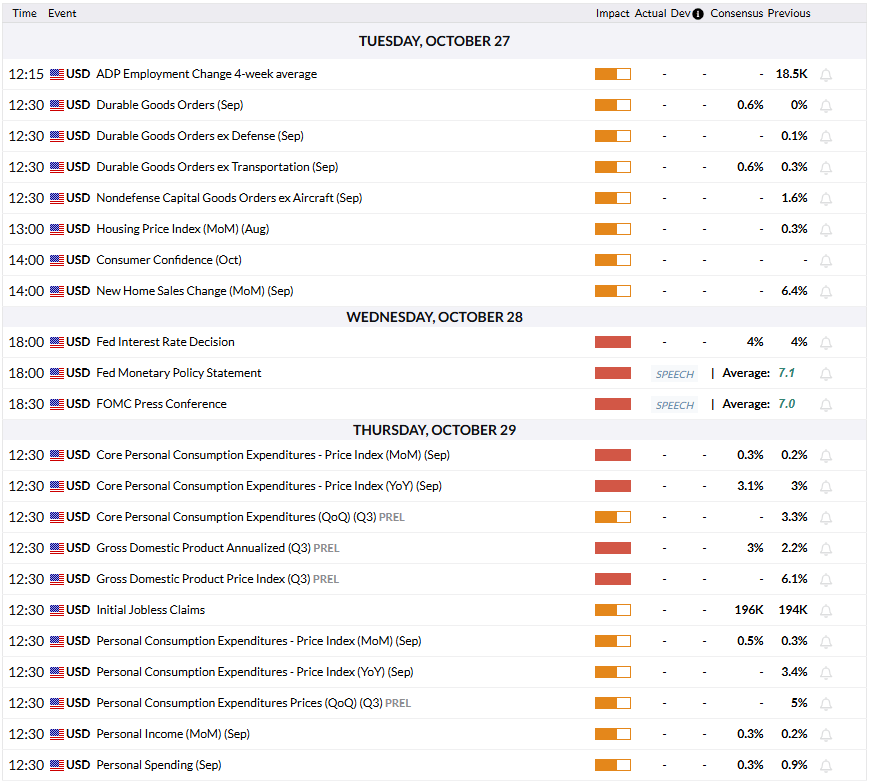
The US economic calendar will not feature any high-impact data releases in the first half of the week. Hence, Gold’s action is likely to remain subdued until the Fed announces its interest rate decision and publishes the policy statement late Wednesday.
The CME FedWatch Tool shows that markets are currently pricing in less than a 10% chance of a 25 basis points (bps) rate hike. Thus, a decision to hold the policy rate on its own shouldn’t be surprising or trigger a significant market reaction. However, if the policy statement shows that multiple policymakers voted for a rate hike, Gold could come under bearish pressure in the immediate aftermath. With a unanimous vote to keep the policy rate unchanged, a small increase could be seen in Gold price until Fed Chair Warsh’s press conference.
In his last public appearance, Warsh said that he won’t pre-judge meeting outcomes. If Warsh goes against this stance and reaffirms that a rate hike in December will be warranted, citing hotter-than-forecast September inflation and core inflation prints, XAU/USD could turn south in the short term. According to the CME FedWatch Tool, market participants see about a 75% probability of a December rate hike, suggesting room for a USD-positive market reaction. Conversely, the USD could have a hard time finding demand and allow Gold to edge higher if Warsh downplays inflation concerns and reiterates that he won’t make a decision until the last meeting of the year.
According to TD Securities, the FOMC is “likely to remain on hold in October,” a decision that in their view “raises the likelihood of a December hike while increasing the risk that officials fall behind the curve.” The bank argues that “barring an unexpected shock, the December rate hike is all but locked in,” meaning that “pausing next week will set the bar high for avoiding an additional rate increase this year.”
TD Securities also cautions that “the opposite is also true: the bar is low for the market to feel that the Fed is falling behind the curve.” They note that “it only takes one notably bad inflation report and/or a collection of strong labor market data for the market to start pricing larger odds of a 50bp rate increase in upcoming meetings.” While Warsh is “unlikely to offer forward guidance,” TD Securities believes “a hawkish inflation message could ease credibility concerns and encourage markets to price further tightening.”
On Thursday, the US Bureau of Economic Analysis (BEA) will publish its preliminary estimate of the third-quarter Gross Domestic Product (GDP) growth. Markets expect the US economy to expand at an annual rate of 3%, following the 2.2% growth recorded in the second quarter. The reaction to this data is likely to be straightforward and remain short-lived unless there is a significant divergence from the market expectation. A positive print could weigh on XAU/USD, while a negative one could help it hold its ground. Still on Thursday, the BEA will also release the Core Personal Consumption Expenditures (PCE) Price Index for September, the Fed’s preferred inflation gauge.
In the meantime, investors will continue to pay close attention to developments in the Middle East and their impact on Oil prices. In the near term, the inverse correlation between Oil and Gold could continue to influence the precious metal’s performance.
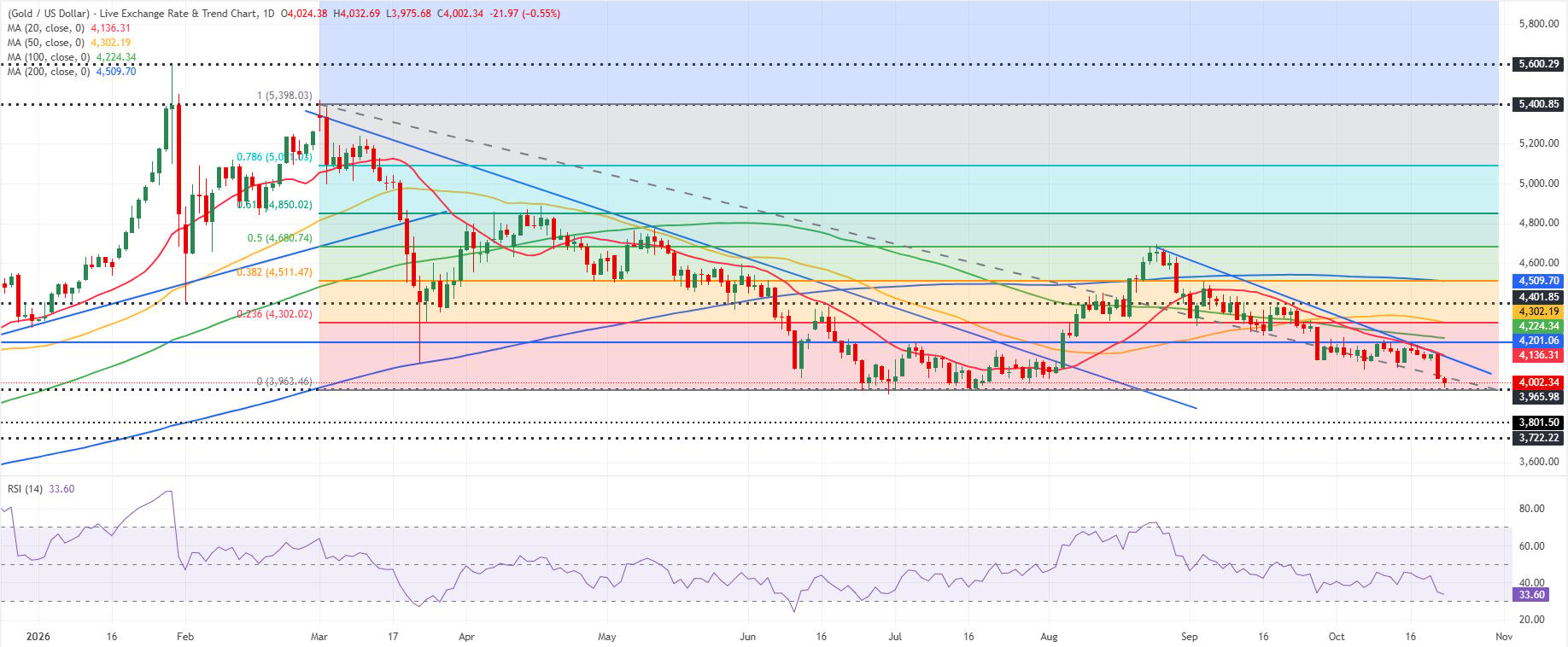
Gold technical analysis: Sellers retain control as XAU/USD closes in on key support area
The Relative Strength Index (RSI) indicator on the daily chart dropped below 40, pointing to a buildup in bearish pressure. Additionally, Gold remains below the descending trend line drawn from August 25. On the downside, $4,000-$3,970 (static level, round level, end-point of March-August downtrend) aligns as a key support region. If Gold drops below this area and fails to reclaim it, technical sellers could show interest and open the door for an extended slide toward $3,800 (static level, round level) and $3,720 (static level).
Looking north, the first resistance could be spotted at $4,150, where the descending trend line is reinforced by the 20-day Simple Moving Average (SMA). In case XAU/USD manages to clear this hurdle, the 100-day SMA could form the next resistance level at $4,220, ahead of $4,300 (Fibonacci 23.6% retracement of the March-August downtrend, the 50-day SMA).
Gold FAQs
Gold has played a key role in human’s history as it has been widely used as a store of value and medium of exchange. Currently, apart from its shine and usage for jewelry, the precious metal is widely seen as a safe-haven asset, meaning that it is considered a good investment during turbulent times. Gold is also widely seen as a hedge against inflation and against depreciating currencies as it doesn’t rely on any specific issuer or government.
Central banks are the biggest Gold holders. In their aim to support their currencies in turbulent times, central banks tend to diversify their reserves and buy Gold to improve the perceived strength of the economy and the currency. High Gold reserves can be a source of trust for a country’s solvency. Central banks added 1,136 tonnes of Gold worth around $70 billion to their reserves in 2022, according to data from the World Gold Council. This is the highest yearly purchase since records began. Central banks from emerging economies such as China, India and Turkey are quickly increasing their Gold reserves.
Gold has an inverse correlation with the US Dollar and US Treasuries, which are both major reserve and safe-haven assets. When the Dollar depreciates, Gold tends to rise, enabling investors and central banks to diversify their assets in turbulent times. Gold is also inversely correlated with risk assets. A rally in the stock market tends to weaken Gold price, while sell-offs in riskier markets tend to favor the precious metal.
The price can move due to a wide range of factors. Geopolitical instability or fears of a deep recession can quickly make Gold price escalate due to its safe-haven status. As a yield-less asset, Gold tends to rise with lower interest rates, while higher cost of money usually weighs down on the yellow metal. Still, most moves depend on how the US Dollar (USD) behaves as the asset is priced in dollars (XAU/USD). A strong Dollar tends to keep the price of Gold controlled, whereas a weaker Dollar is likely to push Gold prices up.
Author

Eren Sengezer
FXStreet
As an economist at heart, Eren Sengezer specializes in the assessment of the short-term and long-term impacts of macroeconomic data, central bank policies and political developments on financial assets.