Gold snaps a five-day losing streak as Bessent warns the Fed against overtightening


Gold (XAU/USD) stages a strong recovery on Monday to trade above the $3,600 level. The precious metal snaps a five-day losing streak after suffering a nearly 9% decline last week, its steepest weekly setback in the recent sell-off, as investors reconsider the prospects for further monetary tightening in the United States (US).
The rebound follows comments from US Treasury Secretary Scott Bessent, who warned that the Federal Reserve (Fed) could jeopardize economic growth by raising interest rates too aggressively. His remarks have encouraged traders to reduce expectations for additional rate hikes in early 2027, weighing on the US Dollar (USD) and providing relief to the non-yielding precious metal.
However, Gold's recovery remains fragile. Persistent inflationary pressures and expectations of further Fed tightening continue to challenge the sustainability of the rebound, while investors await crucial US inflation figures later this week.
Bessent's warning challenges the Fed's increasingly hawkish outlook
The Gold market is finding some relief after Bessent questioned whether the Fed risks making a policy mistake by maintaining an excessively restrictive monetary stance. The Treasury Secretary stated over the weekend that "many people believe that they [the Fed] may be making a policy mistake if they overtighten."
These comments arrive at a particularly sensitive moment for financial markets. Last week's sharp decline in US equities, driven partly by renewed concerns over elevated Artificial Intelligence (AI) sector valuations, triggered a broader liquidation across asset classes. Gold was not spared despite its traditional safe-haven status.
Investors reportedly sold precious metals to raise liquidity and offset losses elsewhere, contributing to the metal's decline toward $3,503 on Friday, its lowest level since September 2025. The subsequent stabilization of equity markets and Bessent's remarks have helped ease fears of an excessively aggressive Fed, encouraging investors to return to Gold.
The recent decline in Oil prices also provides some relief by reducing immediate inflation concerns. However, geopolitical tensions in the Middle East remain a potential source of renewed energy price pressures.
Fed rate hike expectations retreat, offering Gold a lifeline
The shift in monetary policy expectations is emerging as a key driver of Gold's recovery. According to the CME FedWatch Tool, markets currently assign a 96% chance to a 25-basis-point (bps) interest rate increase at the Fed's December meeting, followed by a 62% chance of another hike in January. However, expectations for a third consecutive increase in March have weakened significantly, with the probability falling to 35% from more than 50% in the previous week.
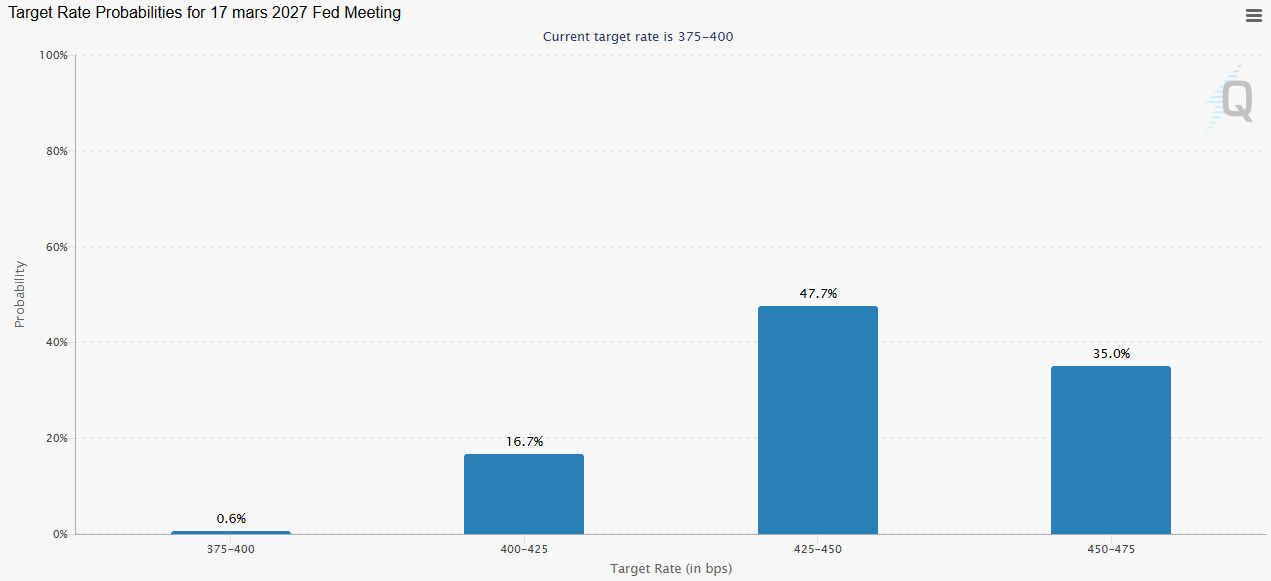
This repricing suggests that investors are increasingly questioning how far the Fed can extend its tightening cycle without undermining economic growth or triggering additional financial market instability. For Gold, the implications are important. Higher interest rates typically increase the opportunity cost of holding non-yielding assets, while supporting the US Dollar. Conversely, diminishing expectations for future tightening tend to improve the appeal of precious metals.
The US Dollar Index (DXY), which measures the Greenback against six major currencies, retreated after approaching a 19-month high last week. Meanwhile, the benchmark 10-year US Treasury yield remains below 5%, providing additional support to Gold.
Nevertheless, the market is not anticipating an imminent monetary policy reversal. Rather, investors are beginning to question the extent of additional tightening beyond the Fed's next two meetings.
US inflation data could determine whether Gold's rebound continues
Attention now turns to Wednesday's release of the October US Personal Consumption Expenditures (PCE) Price Index, the Fed's preferred inflation gauge. The report could prove decisive in determining whether the recent reduction in rate hike expectations is justified.
ING remains cautious about anticipating a sustained decline in the US Dollar, warning that persistent inflation could support the Fed's tightening cycle well into 2027. "Wednesday's release of the core PCE data for October looks set to come in hot again and maintain solid support for a tightening cycle into 2027," notes the bank.
A stronger-than-expected inflation reading could revive expectations for a third rate hike in March, supporting the US Dollar and potentially limiting Gold's recovery. Conversely, softer inflation figures could reinforce concerns about excessive monetary tightening, encouraging further reductions in rate hike expectations and strengthening demand for Gold.
Before Wednesday's inflation report, investors will assess preliminary November US Purchasing Managers Index (PMI) figures from S&P Global for additional clues about economic resilience.
Gold technical outlook: Recovery faces significant obstacles
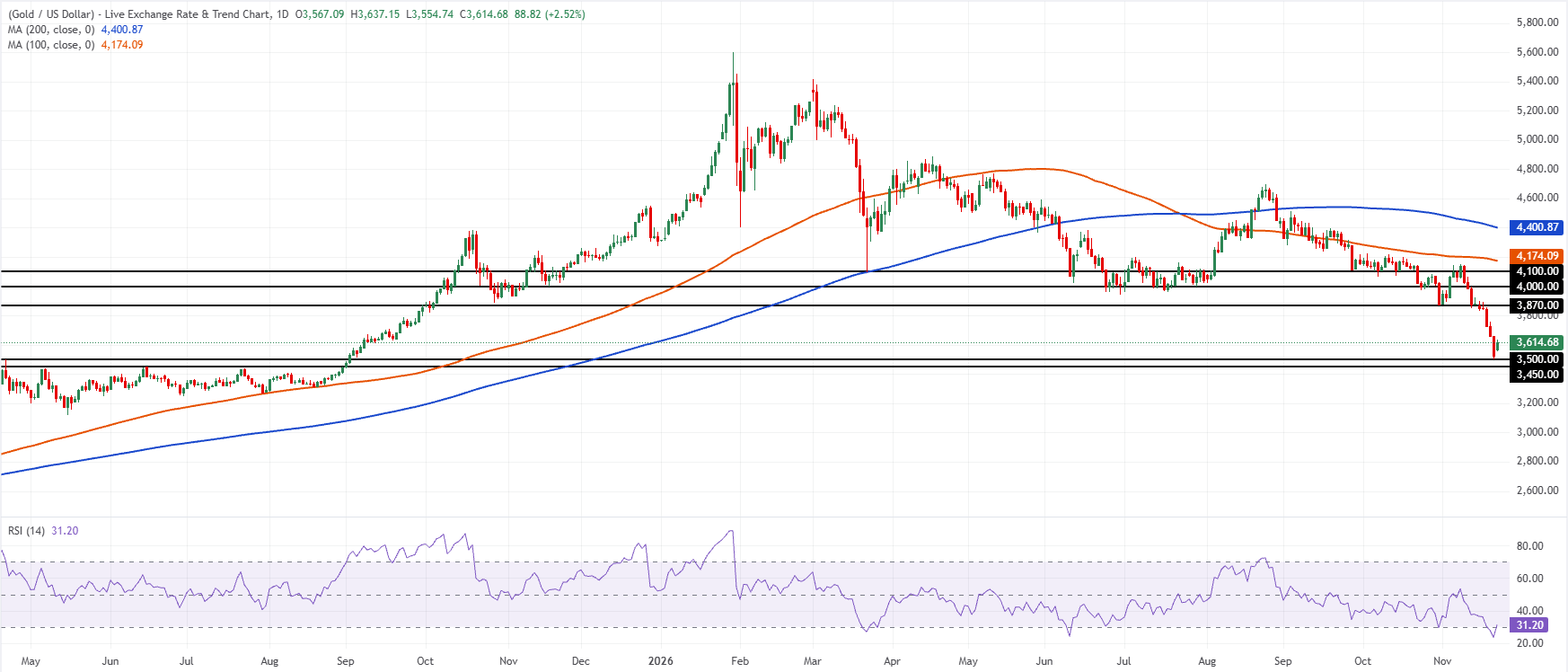
Gold's daily chart shows that the broader bearish trend remains intact despite Monday's rebound from the $3,500 area. The precious metal trades well below its 100-day Simple Moving Average (SMA) at $4,174 and its 200-day SMA at $4,401, indicating persistent selling pressure.
On the upside, $3,870 represents the first major resistance, followed by the psychological $4,000 level. A sustained recovery above these barriers would be necessary to challenge the prevailing bearish structure. Conversely, the $3,500 support area remains crucial. A break below this threshold could expose the next support around $3,450.
The daily Relative Strength Index (RSI) stands near 31, approaching oversold territory. This suggests that selling pressure may be overstretched, potentially allowing a short-term recovery, although it does not yet confirm a sustainable bullish reversal.
Author
Ghiles Guezout
FXStreet
Ghiles Guezout is a Market Analyst with a strong background in stock market investments, trading, and cryptocurrencies. He combines fundamental and technical analysis skills to identify market opportunities.
















