Gold isn't being sold for thew reason most people think


Gold (XAU/USD) remains under heavy selling pressure on Monday, hitting its lowest level in 13 months. The precious metal is struggling to recover despite escalating geopolitical tensions in the Middle East, a backdrop that would normally encourage investors to seek protection in safe-haven assets.
However, the main driver behind Gold's decline is not the geopolitical uncertainty itself. Instead, a dramatic repricing of Federal Reserve (Fed) interest rate expectations is strengthening the US Dollar (USD) and US Treasury yields, creating an increasingly unfavorable environment for the non-yielding metal.
The Fed is changing the rules for Gold
The latest US inflation figures have fundamentally changed investors' expectations for monetary policy. Rather than anticipating lower borrowing costs, markets are now preparing for a renewed tightening cycle as inflation proves more persistent than previously expected. October's Consumer Price Index (CPI) surprised to the upside for the third consecutive month on a core basis, while the Producer Price Index (PPI) reinforced concerns about underlying inflationary pressures.
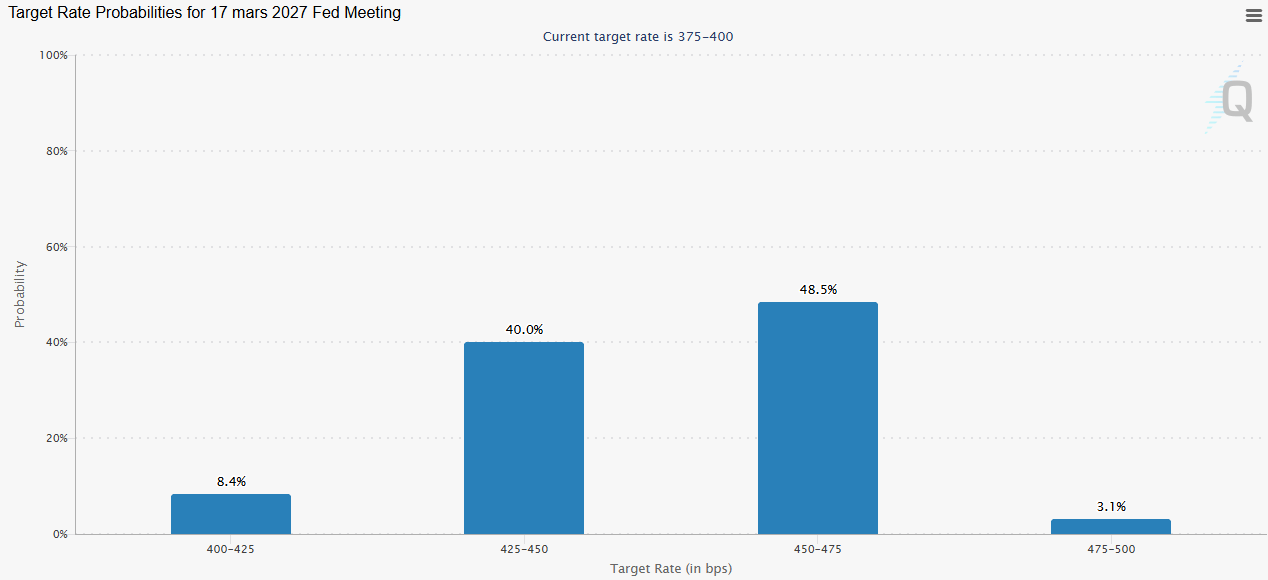
Analysts at MUFG highlight the scale of the shift, noting that “market participants have moved to price in a more aggressive Fed tightening cycle following the third consecutive upside surprise in US core CPI in October and a hawkish shift in Fed rhetoric.” According to the bank, “the US rates market is now assigning a higher probability to three consecutive hikes in December, January and March, which would lift the effective Fed funds rate towards 4.6%.”
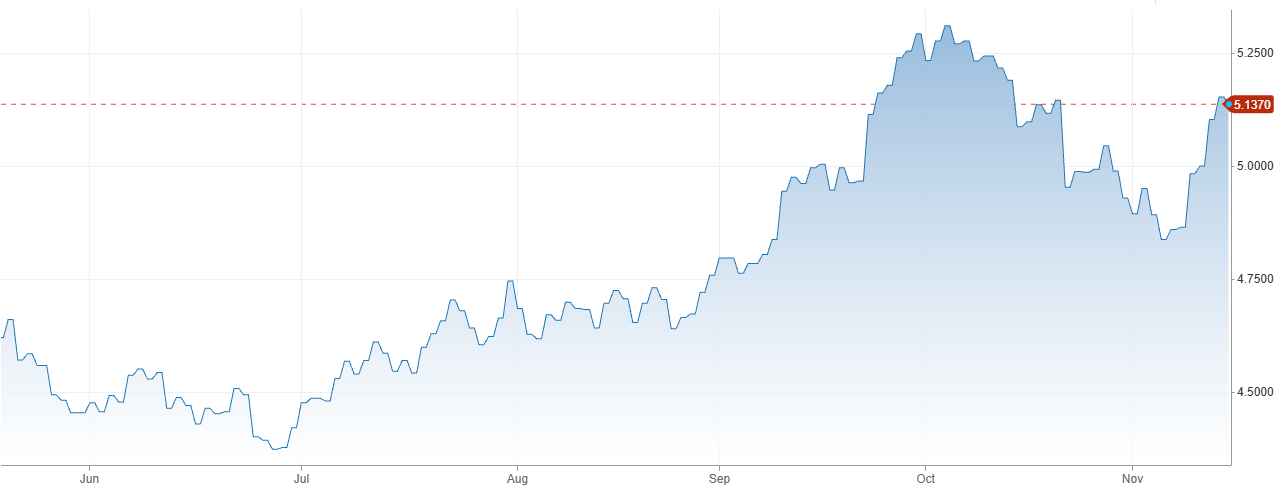
This repricing represents a significant obstacle for Gold. Higher interest rates increase the opportunity cost of holding an asset that generates no income, while rising Treasury yields make interest-bearing investments relatively more attractive. The benchmark 10-year US Treasury yield has climbed above 5%, following a 30-basis-point weekly increase, its strongest weekly performance since April 2025.
Why Middle East tensions are helping the US Dollar instead
The geopolitical backdrop adds another layer of complexity to Gold's decline. Renewed tensions between the United States (US) and Iran have intensified after reports of Iranian drone attacks targeting US military facilities in Bahrain. Meanwhile, incidents involving Oil tankers in the Strait of Hormuz have raised concerns about potential disruptions to global energy supplies.
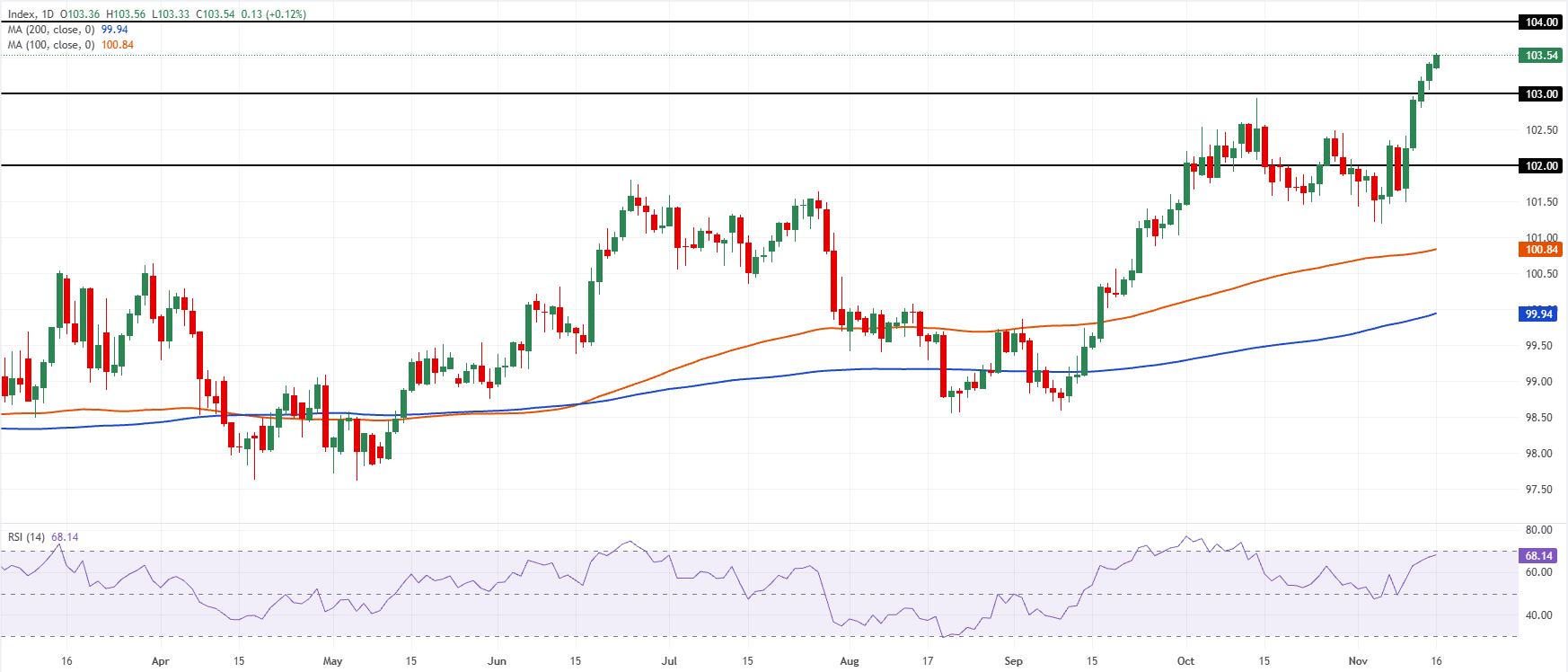
Under normal circumstances, such developments would support Gold through increased safe-haven demand. This time, however, the transmission mechanism is different. Investors are increasingly turning toward the US Dollar as their preferred defensive asset. At the same time, the prospect of higher Oil prices threatens to reinforce inflationary pressures, potentially forcing the Fed to maintain restrictive monetary conditions for longer.
This creates an unusual situation in which geopolitical uncertainty can indirectly strengthen the very forces weighing on Gold. The distinction is important: geopolitical tensions are not necessarily reducing demand for the precious metal. Rather, the strength of the US Dollar and the repricing of interest rates appear to be overwhelming any defensive buying. As a result, Gold is failing to benefit from a geopolitical environment that would traditionally support its valuation.
Fed officials reinforce the hawkish shift
Recent comments from Fed policymakers have further strengthened expectations of additional monetary tightening. Kansas City Fed President Jeff Schmid warned that inflation remains “uncomfortably above” the central bank's 2% target, emphasizing the need to contain persistent price pressures. Boston Fed President Susan Collins also suggested that policymakers “may have to hike more than recently expected,” while advocating a gradual approach to additional tightening.
According to the CME FedWatch tool, markets assign approximately a 92% chance to a 25-basis-point rate increase in December, alongside an 8% chance of a larger 50-basis-point move. More importantly, traders are also pricing in additional interest rate hikes in January and March. These expectations help explain why Gold remains under pressure even as geopolitical risks intensify.
Gold price analysis: The $3,870 support faces a critical test
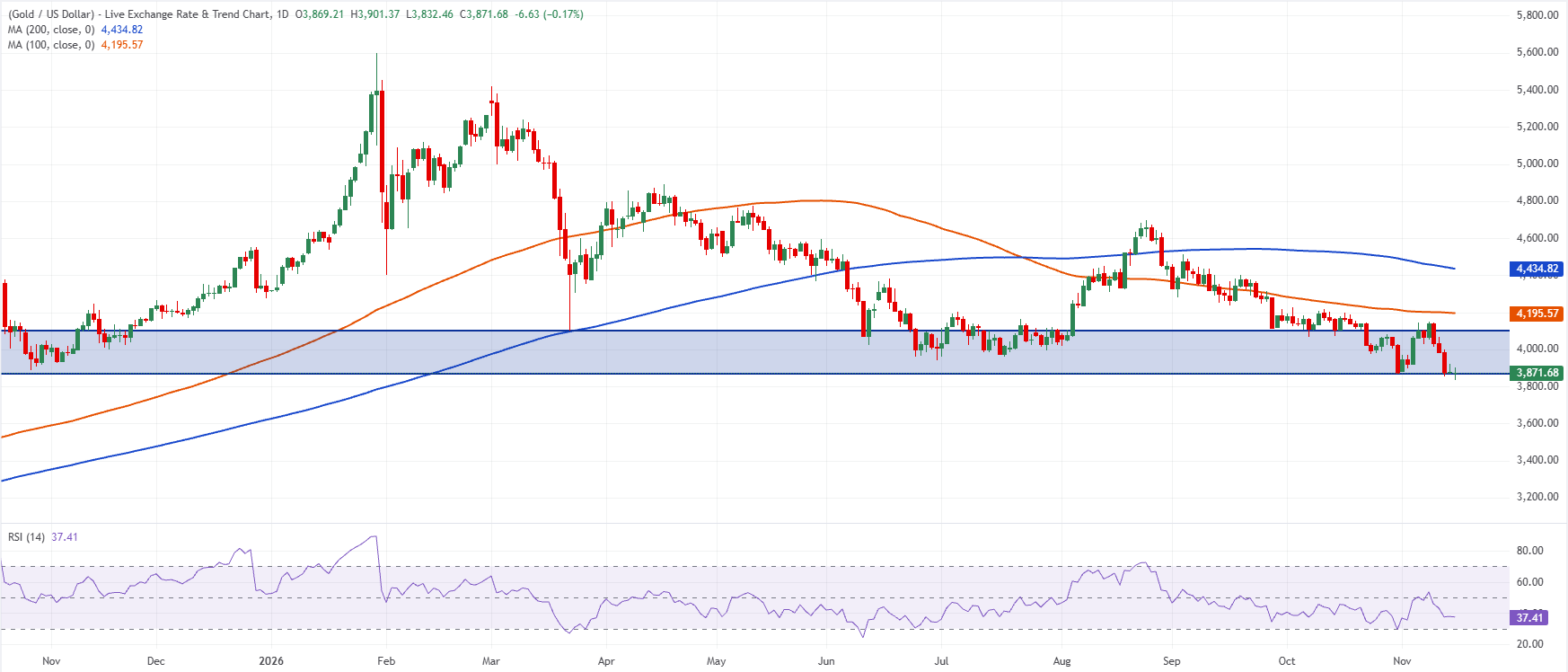
Gold's daily chart highlights the deterioration in market sentiment, with XAU/USD testing the $3,870 level, the lower boundary of a broad support zone extending toward $4,100. Although selling pressure has intensified, a decisive breakdown below this major support has yet to be confirmed.
The Relative Strength Index (RSI) stands near 37, reflecting weakening momentum without indicating extreme oversold conditions. Meanwhile, Gold trades below its 100-day and 200-day Simple Moving Averages (SMAs), currently near $4,196 and $4,435, respectively.
A sustained break below $3,870 would expose the recent low around $3,832, followed by the psychological $3,800 level. Such a development would reinforce the broader bearish outlook.
Conversely, holding above $3,870 could encourage a temporary recovery, although Gold would need to reclaim the $4,100 area to meaningfully improve its technical picture.
For now, the crucial question is not whether geopolitical tensions will continue, but whether the Fed's increasingly hawkish outlook will leave Gold enough room to recover. As long as the US Dollar remains supported by higher interest rate expectations, even escalating geopolitical uncertainty may struggle to reverse the precious metal's downward trajectory.
Author
Ghiles Guezout
FXStreet
Ghiles Guezout is a Market Analyst with a strong background in stock market investments, trading, and cryptocurrencies. He combines fundamental and technical analysis skills to identify market opportunities.