Gold hit its lowest level of 2026 near $3,850

Gold (XAU/USD) attempts to stabilize around $3,890 on Friday after falling to $3,852 on Thursday, its lowest level since October 2025. The precious metal has lost more than 4% this week, as investors increasingly anticipate further monetary tightening from the Federal Reserve (Fed).
The latest decline reflects a sharp change in market expectations. Stronger-than-expected United States (US) inflation data, combined with increasingly hawkish comments from Fed officials, have pushed Treasury yields and the US Dollar (USD) higher, creating a particularly challenging environment for the non-yielding metal.
Although Gold manages a modest rebound on Friday, selling pressure remains significant.
Persistent US inflation forces markets to rethink the Fed's next moves
The latest US Consumer Price Index (CPI) report has significantly altered expectations for monetary policy. Headline inflation increased 0.4% MoM in October, exceeding the 0.3% forecast, while Core CPI, excluding food and energy, rose 0.3%, above expectations of 0.2%. More importantly, underlying inflation has now increased 0.3% for three consecutive months, suggesting that price pressures remain persistent rather than temporary.
Friday's October Producer Price Index (PPI) report provided a more mixed picture of inflation. Headline PPI increased 0.3% MoM, below expectations of 0.4% and sharply lower than September's revised 1.4% increase. On an annual basis, however, producer inflation accelerated to 6.5%, up from 6.3%, though still below the 6.6% forecast. Meanwhile, Core PPI, excluding food and energy, increased 0.3% MoM, matching expectations and slowing from September's 0.8% rise. Annual core producer inflation remained unchanged at 5%, in line with forecasts.
These figures offer some relief after the stronger-than-expected consumer inflation report, and help stabilize Gold prices, but they do not signal a return to price stability.
Consumer inflation figures have strengthened the case for additional interest rate increases, particularly after Fed Governor Christopher Waller suggested that a 50-basis-point rate hike in December could become necessary if monthly core inflation reached 0.3% or higher.
Other policymakers have reinforced this hawkish message. Dallas Fed President Lorie Logan advocates at least two additional 25-basis-point increases, while Cleveland Fed President Beth Hammack warns that inflation pressures are moving in the wrong direction.
According to the CME FedWatch Tool, markets now fully anticipate a December rate hike, assigning approximately an 88.5% chance to a 25-basis-point increase and 11.5% to a larger 50-basis-point move. More importantly, expectations of further tightening have increased dramatically. Traders now see a 65.5% chance of a second consecutive rate hike in January, while the likelihood of a third increase in March has surged to nearly 50%, compared with just 6% a week ago.
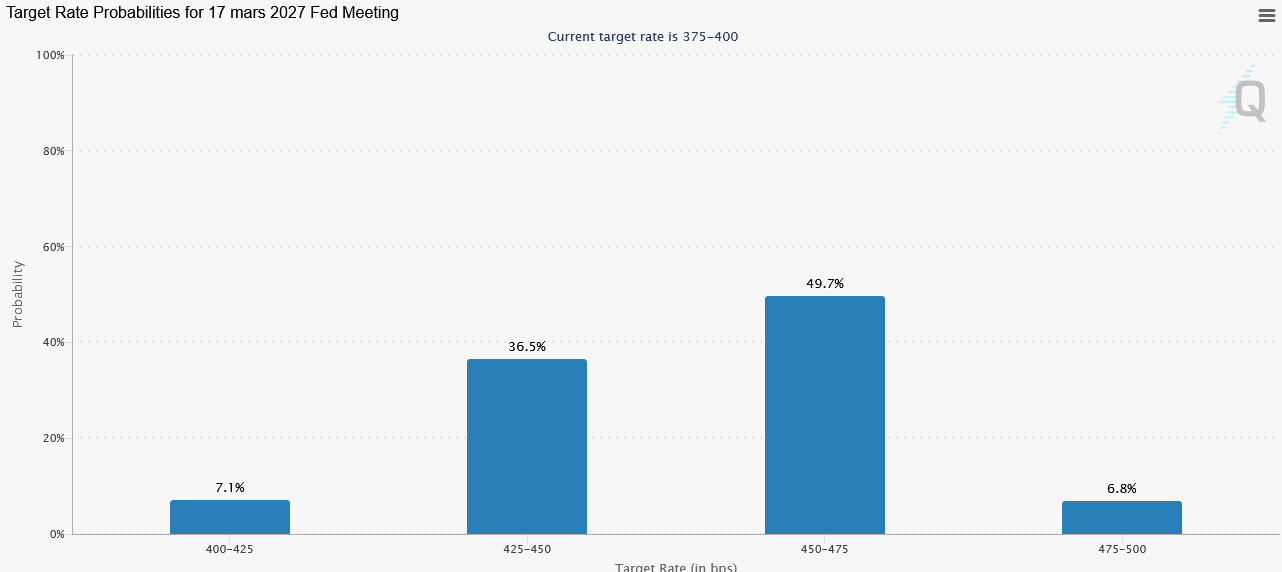
This sharp repricing suggests that investors are no longer anticipating an isolated December adjustment but an extended monetary tightening cycle, reinforcing upward pressure on Treasury yields and the US Dollar while undermining Gold's appeal.
Rising Treasury yields and a stronger US Dollar deepen Gold's losses
The rapid repricing of monetary policy expectations has triggered significant movements in US financial markets. The benchmark 10-year US Treasury yield has climbed above 5%, while shorter-term yields have risen even more sharply, reflecting expectations that interest rates could remain elevated for longer.
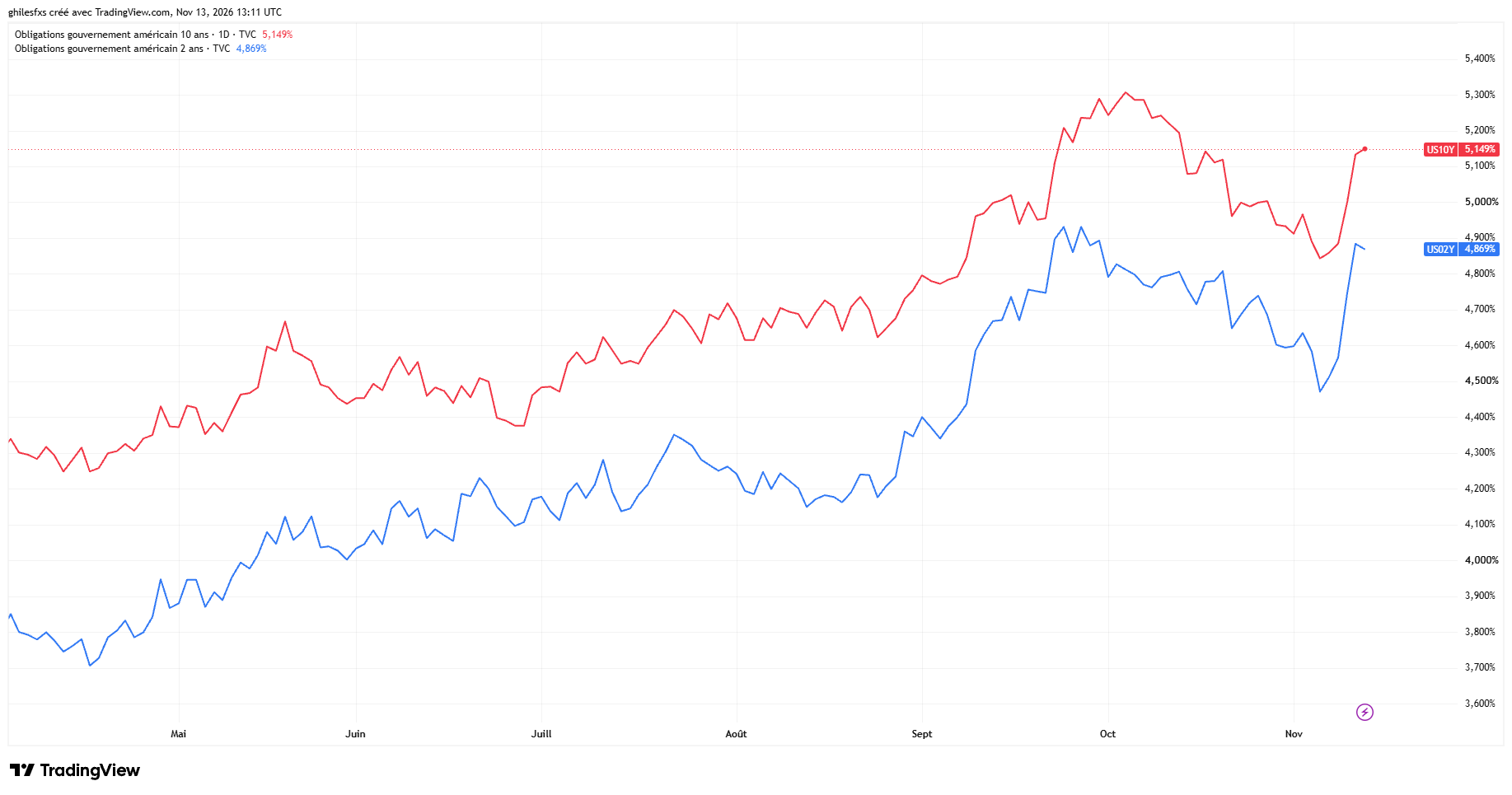
Meanwhile, the US Dollar Index (DXY), which measures the Greenback against six major currencies, trades near 103.20, close to a 19-month high.
This combination creates two major obstacles for Gold. Higher Treasury yields increase the opportunity cost of holding an asset that generates no interest income, while a stronger US Dollar makes the precious metal more expensive for international buyers.
Middle East tensions create an unusual dilemma for Gold
Geopolitical uncertainty would normally support Gold through increased safe-haven demand. However, the ongoing confrontation between the United States and Iran is currently producing a more complicated reaction. US President Donald Trump has indicated that Washington does not need an agreement with Tehran, raising concerns about further military escalation.
Renewed threats against energy infrastructure and shipping routes have pushed Oil prices higher, increasing fears that energy costs could fuel another wave of inflation. For Gold, this creates a paradox: geopolitical tensions may encourage safe-haven buying, but higher energy prices simultaneously strengthen expectations of further Fed tightening.
High Ridge Futures Director of Metals Trading David Meger summarizes this dynamic: "Higher energy prices continue to warrant a hawkish Fed, and a hawkish Fed is an environment of higher interest rates and hence a headwind for the yellow metal," said Meger, according to Reuters.
For now, the monetary policy implications of geopolitical tensions appear to outweigh their traditional supportive effect on Gold.
The $3,870 support is breached, but not decisively
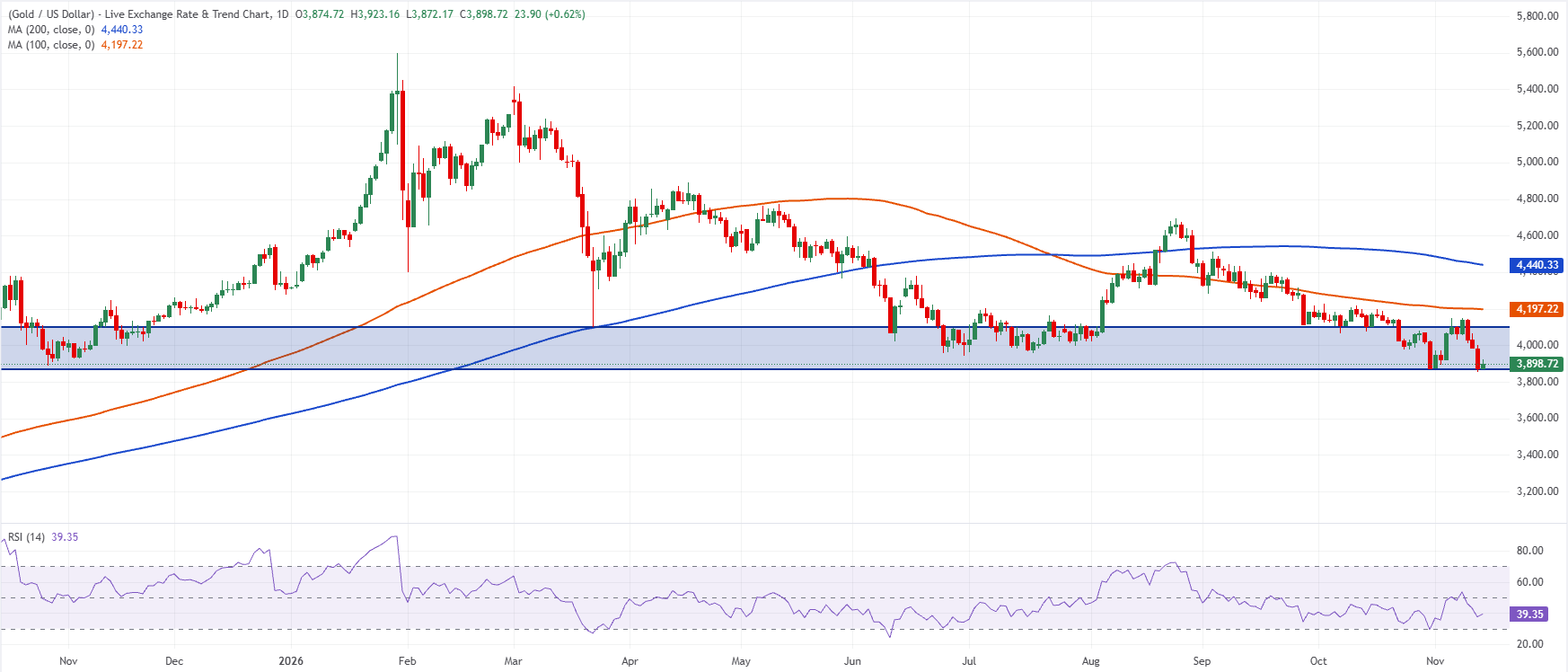
Gold's daily chart shows a clear deterioration in momentum, with the precious metal trading significantly below its 100-day Simple Moving Average (SMA) near $4,197 and its 200-day SMA around $4,440.
The broader support zone between $4,100 and $3,870, which has repeatedly attracted buyers since October 2025, faces its most serious test in several months. Thursday's decline to $3,852 briefly pushed Gold below the lower boundary of this zone. However, Friday's rebound toward $3,890 suggests that buyers are still attempting to defend this area.
Although bearish pressure is clearly intensifying, the move below $3,870 has not yet established a decisive breakdown. A sustained decline beneath $3,850 would provide stronger confirmation and could expose the psychological $3,800 level, followed by $3,700.
Conversely, Gold needs to reclaim $4,000 to ease immediate selling pressure. A recovery above $4,100 would be necessary to improve the short-term outlook, with the 100-day SMA near $4,197 representing another important obstacle.
The daily Relative Strength Index (RSI) stands around 38, confirming weakening bullish momentum without yet indicating oversold conditions.
Ultimately, Gold remains vulnerable as long as Treasury yields and the US Dollar stay elevated. However, Friday's stabilization near $3,890 leaves open the possibility of another rebound before sellers can confirm a more significant bearish breakdown.
Author

Ghiles Guezout
FXStreet
Ghiles Guezout is a Market Analyst with a strong background in stock market investments, trading, and cryptocurrencies. He combines fundamental and technical analysis skills to identify market opportunities.
















