Gold buyers brace for the $4,000 retest

Gold (XAU/USD) comes under renewed selling pressure on Tuesday, after another failed attempt to establish a foothold above $4,100. The precious metal erases Monday's recovery as hawkish Federal Reserve (Fed) comments and stronger-than-expected United States (US) inflation data strengthen the US Dollar (USD) and reinforce expectations of further monetary tightening by the Fed.
The latest rejection marks the second failure above $4,100 in just four trading days, following a similar reversal on Thursday that extended into Friday. This repeated inability to sustain a recovery raises questions about Gold's resilience, particularly as the psychologically important $4,000 threshold comes back into focus.
With inflation proving more persistent than anticipated and investors increasingly considering additional Fed rate hikes beyond December, the precious metal faces a challenging combination of monetary and technical pressures.
Waller's hawkish warning sets the stage before US inflation surprise
Gold's renewed weakness reflects a combination of increasingly hawkish Fed expectations and stronger-than-expected US inflation data, with monetary policy concerns already intensifying before Tuesday's Consumer Price Index (CPI) release.
Earlier in the day, Fed Governor Christopher Waller signaled his willingness to support further monetary tightening, saying he would “still support a 25 basis point increase” in December even if inflation moderated. More importantly, Waller warned that a “half-point Fed rate hike may be needed in December” if monthly core inflation remained “around 0.3% or higher.”
His comments prompted investors to reassess the likelihood of a more aggressive policy response, pushing expectations toward additional rate hikes even before the inflation figures were released.
The subsequent CPI report reinforced these concerns. According to the Bureau of Labor Statistics (BLS), headline inflation increased 0.4% MoM in October, above expectations of 0.3%, although slowing from September's 0.6% rise. Core CPI, which excludes volatile food and energy prices, climbed 0.3%, exceeding the 0.2% forecast and matching September's reading. Crucially, this figure matches the threshold Waller identified as potentially warranting a larger December rate increase.
The combination of Waller's remarks and the inflation surprise strengthens the case for continued monetary tightening, weighing on the non-yielding precious metal.
According to the CME FedWatch Tool, markets now assign approximately an 89% chance to a 25-basis-point increase in December, while the likelihood of a larger 50-bps move stands near 11%. However, the most significant repricing concerns January. The chance of another 25-bps rate increase at that meeting jumps to more than 57%, compared with just 19% the previous day, suggesting that investors increasingly expect the tightening cycle to extend into early 2027.
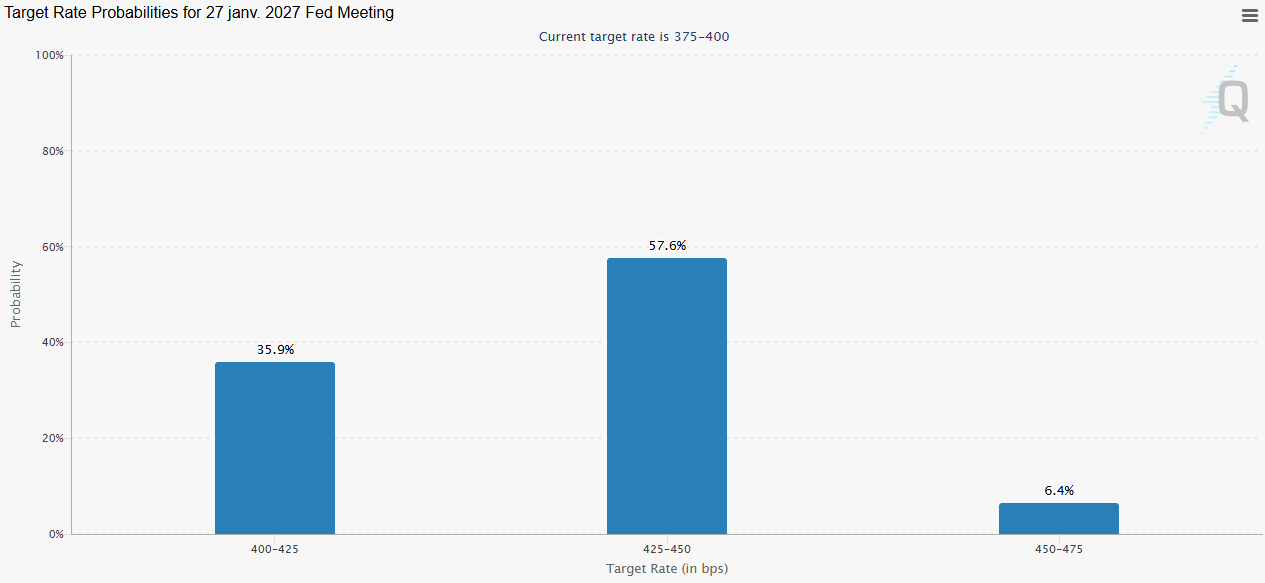
This shift is particularly unfavorable for Gold, as higher interest rates increase the opportunity cost of holding the precious metal, while supporting the US Dollar (USD). The US Dollar Index (DXY), which tracks the Greenback against six major currencies, climbed above 102.00 following the inflation release, adding another source of pressure on Bullion.
Taken together, these developments suggest that Gold is facing more than a temporary reaction to a single inflation report. The market is increasingly pricing in a prolonged period of restrictive monetary policy, potentially limiting the precious metal's ability to sustain a recovery above $4,100.
Could falling Oil prices offer Gold some relief?
Despite the increasingly hawkish monetary outlook, several developments could eventually help limit the downside for Gold. West Texas Intermediate (WTI) Oil prices retreated toward $83 per barrel, their lowest level since late August, after losing more than 15% since the beginning of November.
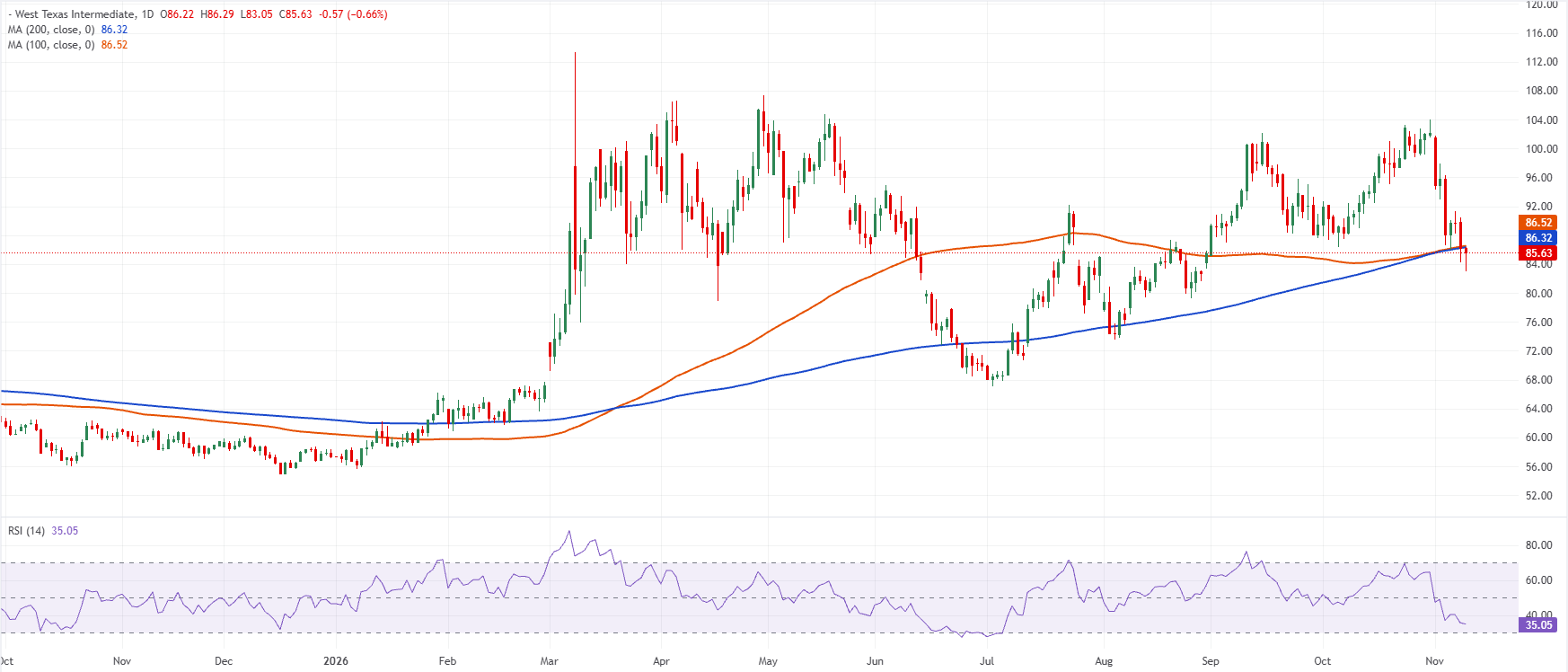
The decline comes amid renewed diplomatic efforts to resolve the conflict involving Iran, with US President Donald Trump pointing to “positive momentum” in negotiations. Lower energy prices could gradually ease inflationary pressures, potentially reducing the need for additional Fed tightening.
However, this relief remains uncertain. October's stronger-than-expected Core CPI suggests that inflation pressures extend beyond energy markets, meaning cheaper Oil alone may not be enough to change the Fed's short-term policy trajectory. Meanwhile, easing geopolitical tensions could also reduce safe-haven demand for Gold, partially offsetting the potential benefits of lower inflation.
The $4,000 defense faces another test
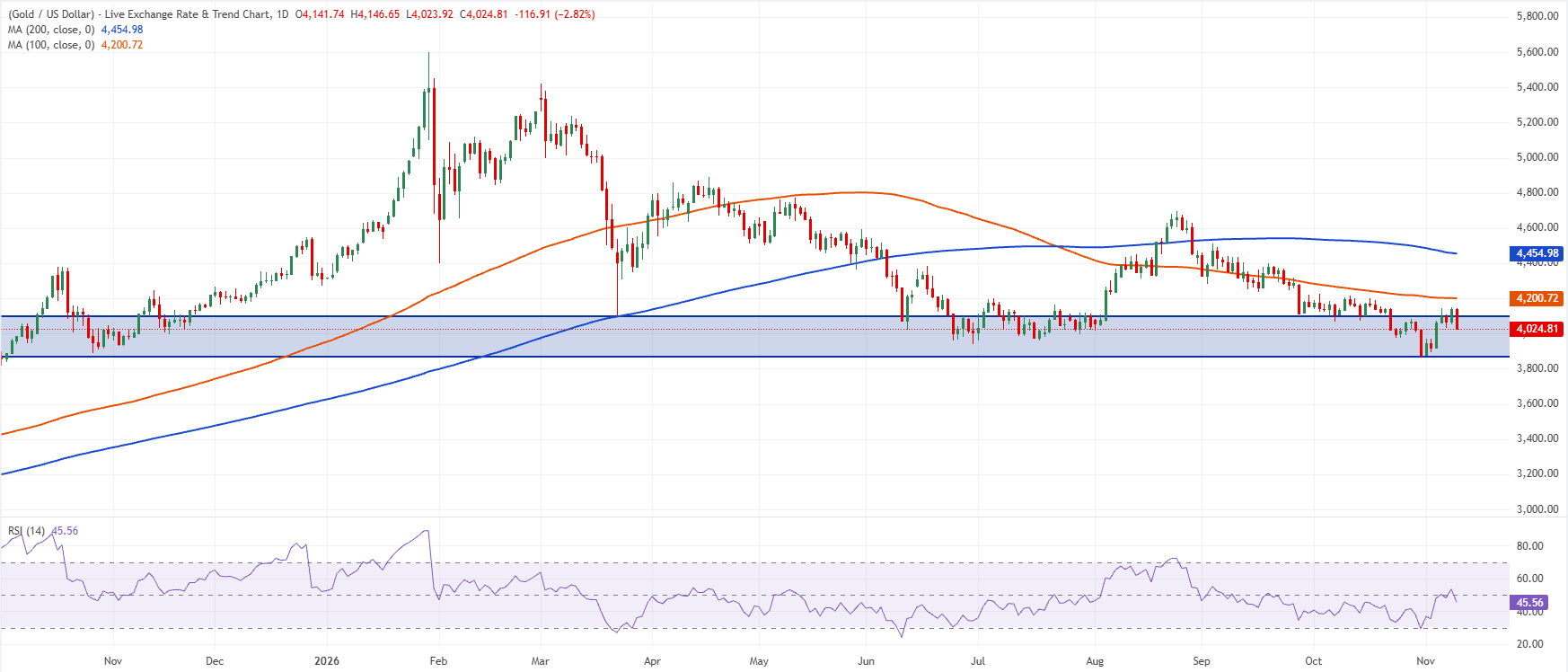
Gold's daily chart reveals a fragile recovery structure, with Tuesday's rejection above $4,100 reinforcing the bearish pressure that has dominated recent months. The precious metal trades below both its 100-day Simple Moving Average (SMA) near $4,201 and its 200-day SMA around $4,455. This configuration suggests that sellers continue to control the broader trend despite intermittent recovery attempts.
The immediate focus turns to the $4,000 psychological level, which represents the first important barrier against further losses. Below this threshold, the October 30 low near $3,870 becomes the next critical support. A decisive break beneath this level would weaken the existing consolidation structure and potentially accelerate the bearish correction.
Conversely, buyers need to reclaim $4,100 to stabilize the short-term outlook. A sustained recovery above this threshold could open the door to the 100-day SMA around $4,201, although the 200-day SMA near $4,455 remains a more distant obstacle.
The daily Relative Strength Index (RSI) stands near 46, reflecting subdued momentum without indicating oversold conditions. This leaves room for additional downside if selling pressure intensifies.
Ultimately, Gold's repeated failures above $4,100, combined with increasingly aggressive Fed expectations, leave the $4,000 threshold exposed. Unless the US Dollar loses momentum or monetary policy expectations soften, a renewed test of the October 30 low near $3,870 remains a credible scenario.
Author

Ghiles Guezout
FXStreet
Ghiles Guezout is a Market Analyst with a strong background in stock market investments, trading, and cryptocurrencies. He combines fundamental and technical analysis skills to identify market opportunities.