French CAC Index plunges: What’s driving the decline?


There has been a significant discrepancy between the US and EU stock markets, especially the French CAC index, which has almost returned to its level at the start of the year.
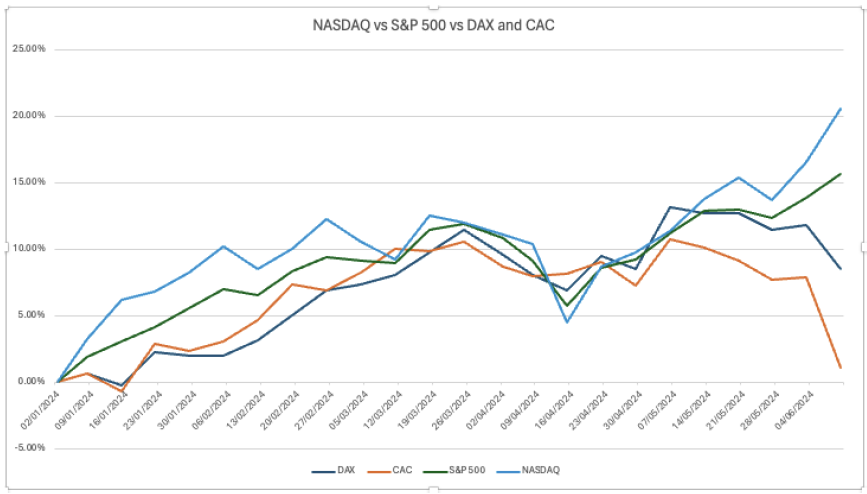
Source: adapted from Reuters
The divergence began in early May and accelerated last week. The key differences lie in France's snap election and monetary policies.
The major cause of the European stock market decline is the French snap election, which Macron announced after losing the European elections.
Recent polls suggest Marine Le Pen’s National Rally (RN) could win 235 to 265 seats, short of the 289 needed for a majority. Macron’s centrist alliance might get 125-155 seats, while left-wing parties could secure 115-145 seats. The left-wing alliance is projected to get 28% of votes, making a coalition government likely.
The RN plans to spend over €100bn despite significant French debt to ease the cost of living crisis, raising concerns about potential economic impacts similar to the Liz Truss crisis in the UK. Investors worry about the ECB's crisis management compared to the Bank of England. The far-left plans to increase taxes to address debt, potentially causing more millionaire emigration. Investors are really worried about the election’s outcome.
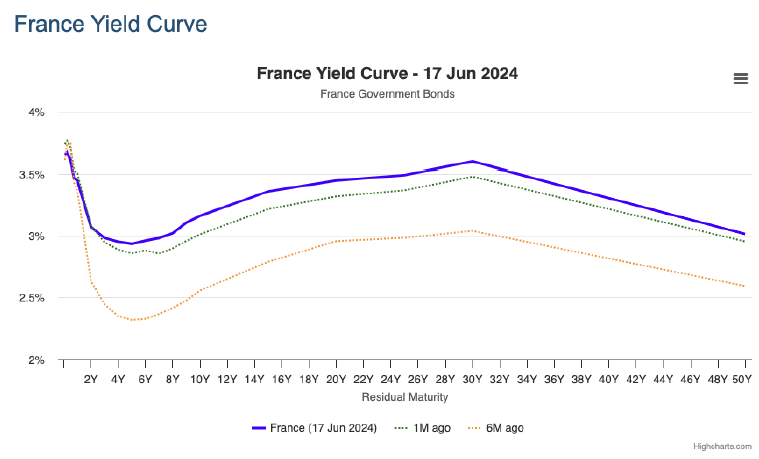
Source: world government bonds
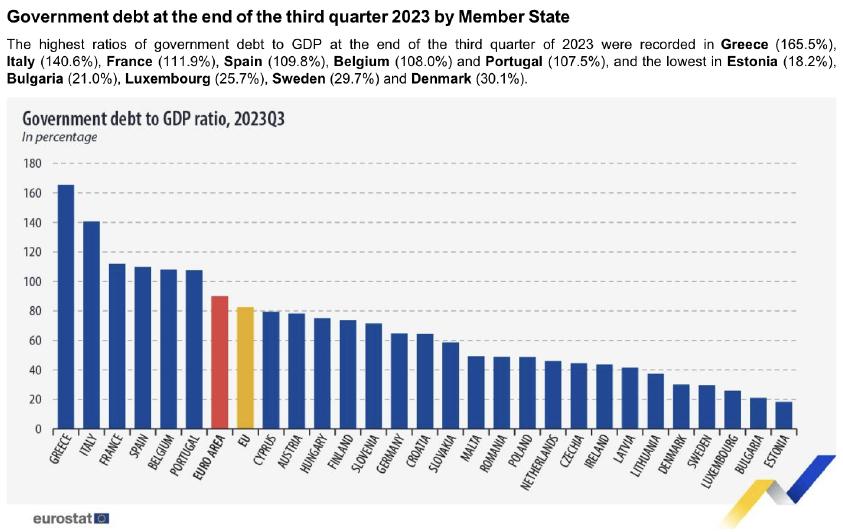
Source: Eurostat
In 2012, during the Euro crisis that began in Greece, Italy, Portugal, and Spain also faced severe economic problems. At that time, Greece's debt-to-GDP ratio surged to 160%, and it remains at that level today, indicating little change.
However, France now has a higher debt-to-GDP ratio than Spain. France's GDP is $2.779 trillion, almost double that of Spain's $1.418 trillion. Reforms are necessary in the EU, but the rise of far-right parties has complicated the situation. This may be a reason why investors are selling French stocks more aggressively. However, bond yields have not surged as they did in 2012. Even Greece, with the worst debt-to-GDP ratio, has not shown the same bond yield pattern.
In addition to the CAC40 drop, French bond yields increased, reflecting uncertainty about government policies after the election and investors’ search for a safe haven.
Another reason for the US stocks and CAC stocks performance discrepancy was that the Federal Reserve kept its benchmark rate steady at 5.25% to 5.5%. Projections suggest possible rate cuts later this year. The ECB cut rates in June, widening the rate gap between the euro and the US dollar. 12 Jun 2024 20 Mar 2024.
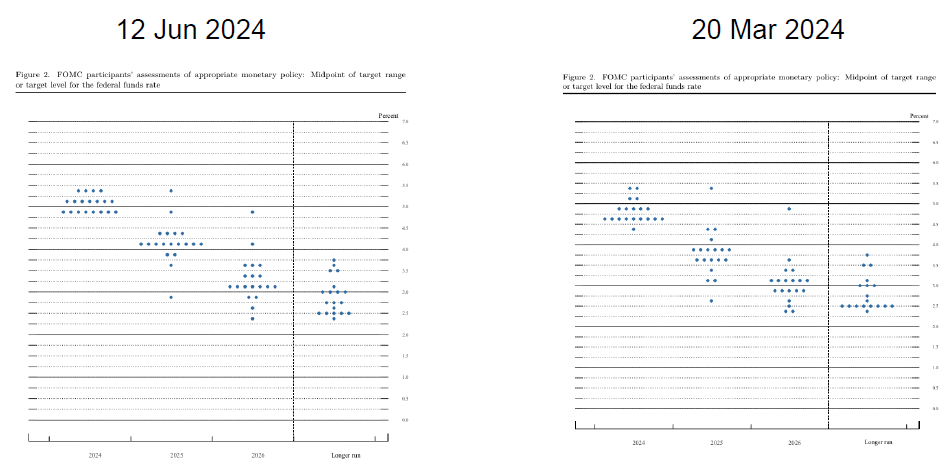
Source: The Federal Reserve
The Fed's dot plot shows a shift in projected rate cuts for this year, from three cuts in March to one cut only, with the possibility of no cuts.
Author
Prakash Bhudia
Deriv
Prakash Bhudia, HOD – Product & Growth at Deriv, provides strategic leadership across crucial trading functions, including operations, risk management, and main marketing channels.